
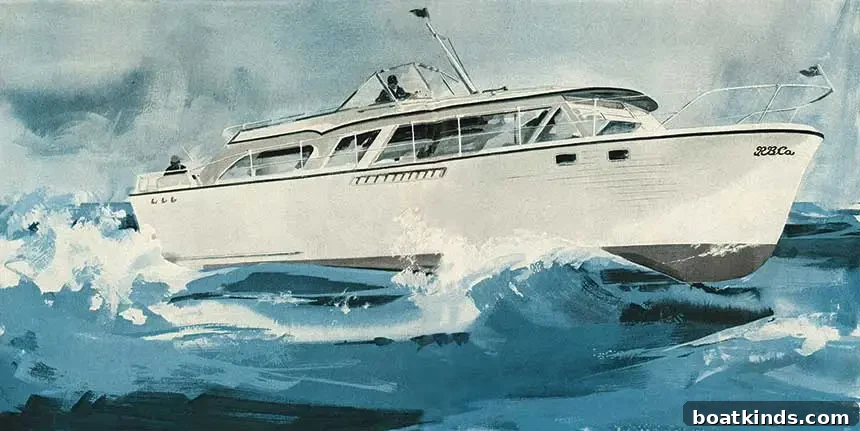
Richardson Boat Co. and the Aluminum-Planked Phantom Motor-Yachts
In the early 1960s, a time when boatbuilding was in transition, Richardson Boat Co. stood out by pursuing an unconventional path. While many yards were adopting new materials like fiberglass and experimenting with cold‑molded plywood, Richardson embraced aluminum. The company partnered with an aircraft manufacturer to adapt aviation construction techniques to pleasure boat design, producing a line of aluminum‑planked motor‑yachts marketed as the Phantom series.
From Wooden Yachts to Aluminum Innovation
George Reid Richardson founded Richardson Boat Co. in 1909 and built a reputation for wooden motoryachts and wartime military craft on the Erie Canal in North Tonawanda, New York. By the late 1950s and into the 1960s, the marine industry was exploring new materials and methods. Fiberglass was capturing attention for its ease of molding and low maintenance, but Richardson argued for the distinct advantages of aluminum hull construction.
Richardson joined forces with Colonial Boat Works of Millville, New Jersey, and together they formed United Marine. The collaboration aimed to blend traditional boatbuilding knowledge with new materials and practices. In advertising and promotional material of the era, the company emphasized aluminum’s strengths: negligible maintenance, resistance to hull leaks, lightness, toughness and long‑term durability.
Aircraft Techniques Applied to Boatbuilding
United Marine worked with Avro Aircraft to borrow ideas from aircraft manufacturing and adapt them for marine use. The result was a metal interpretation of the classic plank‑on‑frame method. Rather than wood, the system used corrosion‑resistant aluminum plate for battens and planking. The carvel‑planked hull employed a batten‑seam construction: 13‑inch battens made from 3‑inch‑wide aluminum plate secured relatively thin, 1/8‑inch planks with stainless steel self‑tapping fasteners. Structural elements such as frames, stringers and floors were also aluminum plate, while the keel and garboard were formed from corrosion‑resistant aluminum alloys.
The superstructure and flybridge retained traditional materials, being built of wood and fiberglass. This hybrid approach combined aluminum’s advantages below the waterline with the familiar styling and finish options owners expected above deck.
The Phantom Motor‑Yacht Range
Introduced in 1961, the 40‑foot Phantom motor‑yachts were promoted as “cruisers of tomorrow,” reflecting the optimistic tone of postwar design and technological innovation. These yachts were offered with twin 225‑hp inboard engines and were part of a broader lineup that included models from 28 to 46 feet overall. United Marine marketed the Phantom in several configurations, including sedan, flybridge and double‑stateroom layouts, to appeal to buyers looking for different cruising and live‑aboard arrangements.
The aluminum plank construction provided a combination of light weight and strength that appealed to owners and designers interested in durability and low upkeep. Using stainless fasteners and corrosion‑resistant alloys aimed to mitigate the common concerns about aluminum in a marine environment, while aircraft‑level fabrication techniques sought tighter tolerances and consistent assembly.
Why It Mattered and What Followed
Richardson’s aluminum experiments were part of a broader era of material experimentation in boatbuilding. Builders and designers were testing the limits of new composites, metals and construction methods to improve performance, reduce maintenance and offer novel styling. Aluminum had clear benefits for certain types of vessels—particularly commercial and military craft—and Richardson’s attempt represented a noteworthy crossover of aviation practices into recreational yachting.
Despite the engineering work and a clear promotional push, the venture struggled commercially. Richardson Boat Co. declared bankruptcy in June 1962, and the aluminum‑planked approach, while proven in many technical respects, was not enough to secure the company’s future in a fast‑changing market dominated increasingly by fiberglass production and economies of scale.
Legacy
Although Richardson Boat Co. did not survive, the Phantom series and the company’s aluminum innovations remain an interesting chapter in mid‑20th century boatbuilding history. The project demonstrated how aircraft manufacturing techniques could be adapted to marine construction and highlighted the tradeoffs designers faced when choosing materials. For collectors, restorers and enthusiasts of vintage yachts, Phantom hulls and similar aluminum experiments represent both engineering curiosity and a reminder of the many paths boatbuilders explored as they moved from traditional wood construction into the modern age.
This article originally appeared in the July 2019 issue.