
It’s just before 10 a.m. and the 12 Metres have headed to the racecourse for day three of the 2019 World Championships. The docks at Fort Adams in Newport, Rhode Island, are nearly deserted except for a single tender—until MJM Yachts CEO Bob Johnstone arrives in Breeze, the builder’s first 53z and current flagship.
The previous day’s calm had delayed racing and left Bob and his wife, Mary, spending ten long hours on the water. Mary, an experienced boater, opts out of racing today to shop for an evening dress for the 12 Metre social at Marble House mansion, so Bob is solo at the helm.
Breeze already has fenders along her starboard side. Rather than backing in for a tight 90-degree turn, Bob noses the 53z into the slip and maneuvers her with ease. With only about five feet of operating room, he shifts the 56-foot hull until the stern clears dock 7B, then backs in gracefully. He positions the boat close enough for the dockhand to pick up the sternline without bending, then brings the bow in so I can secure the forward line.
I finish the springline and Bob is already at my side. His docking might have made me nervous, but he’s calm and collected—an oxford shirt, khaki shorts, leather boat shoes, a 12 Metre World Championship cap, aviators and an easy smile belie the fact that the man who co-founded J/Boats in 1977 and started MJM Yachts in 2002 is 85.
Soon the rest of Breeze’s passengers arrive. The MJM 53z serves as the official boat for the international jury at the 12 Metre Worlds, and for the third of five days Bob will ferry judges and guests to the racecourse. Fourteen people board comfortably; the cockpit and cabin easily accommodate the group. Using the joystick, Bob takes us off the dock and out beneath the Newport Bridge. The boat’s air conditioning is on, but with a 12-knot breeze he opens the three powered windshields and invites a rush of fresh Narragansett Bay air.
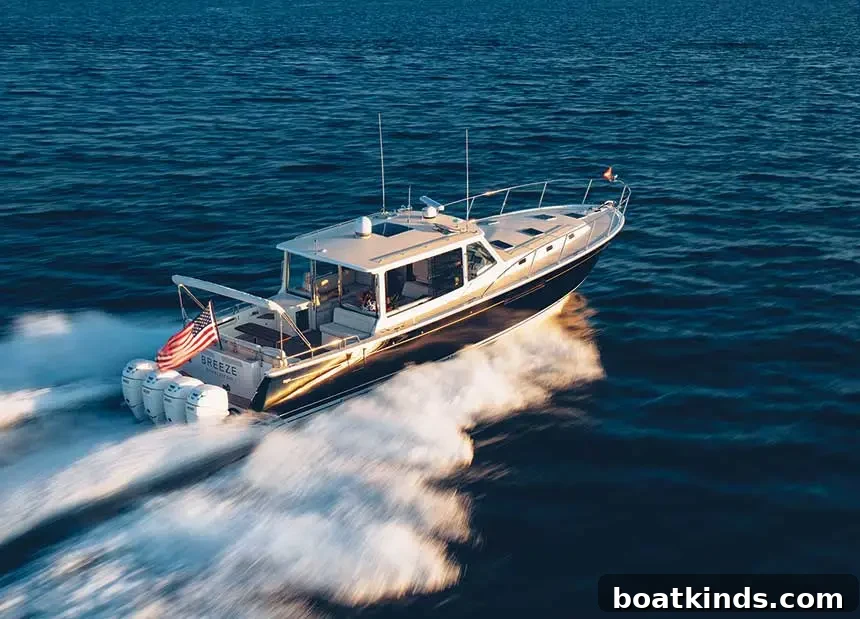
The 53z is MJM’s largest outboard-powered express cruiser to date and the brand’s third outboard model. It is derived from Doug Zurn’s inboard-powered 50z hull introduced in 2014, but differs belowdecks: where the 50z featured a convertible great room, the 53z offers a permanent dual-master layout. The space that once held triple Volvo Pentas on the 50z is repurposed on the 53z for extra fuel and storage.
The forward master stateroom features two portlights, a hatch, a porthole, hanging lockers, a 78-by-60-inch island berth and a desk/dressing table with a comfortable seat—a bright, airy space. The starboard stateroom has a 76-by-53-inch berth, a built-in seat and a large panoramic portlight. Two heads provide privacy with glass-enclosed showers.
The galley to port is modest but well-equipped: a ceramic induction two-burner, sink, microwave, two-drawer refrigerator and top-loading freezer. Natural cherry cabinetry shows tight joinery and the seating is upholstered in off-white Brisa Ultraleather. The overall fit and finish are simple, tasteful and classic.
We slip under the Newport Bridge and Bob eases the throttles forward. Laden with guests—more than a metric ton of people on board—the optional quad 400-hp Mercury Verados propel Breeze to about 40 knots; MJM lists a top speed over 44 knots with five aboard and full fuel.
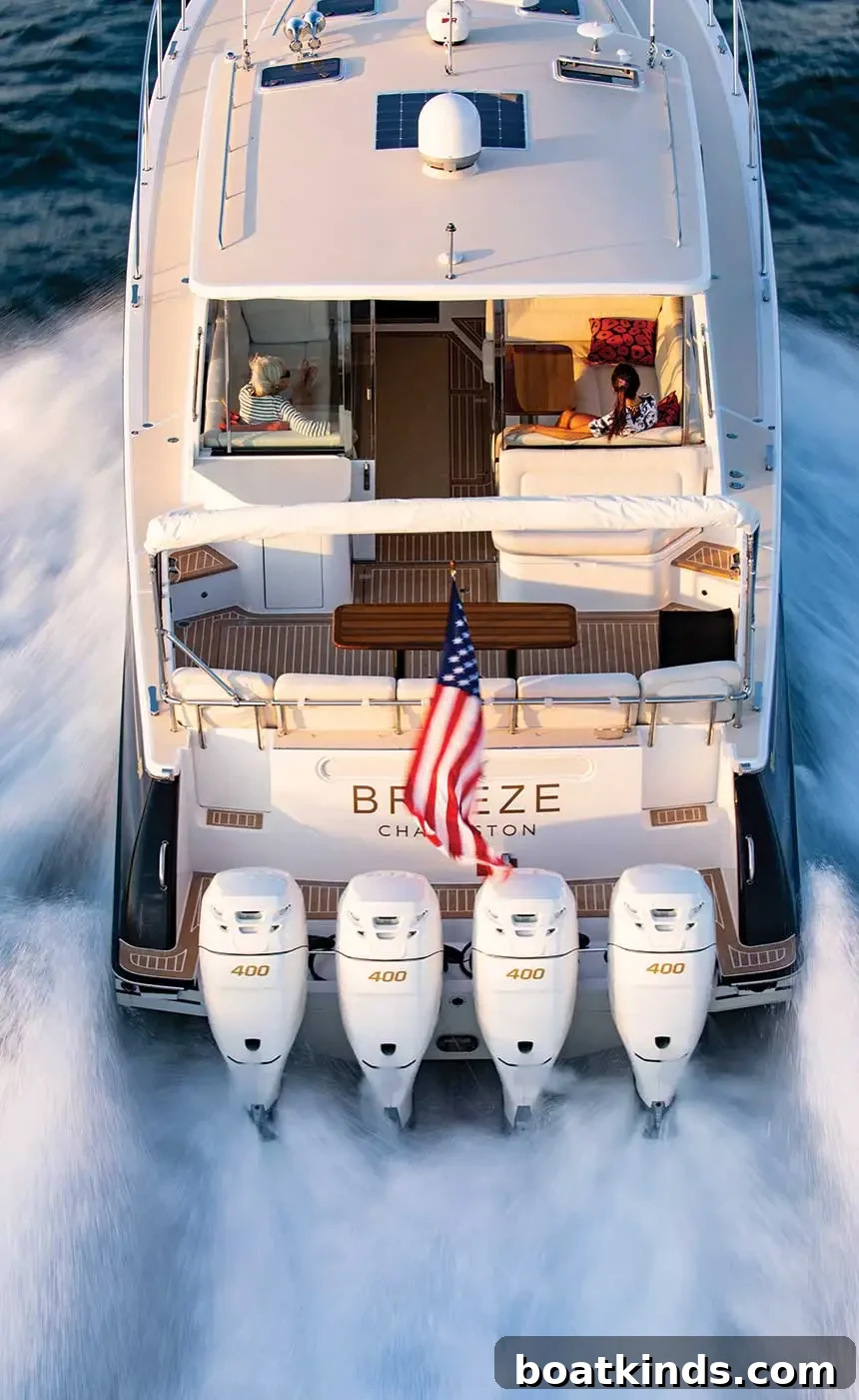
The water is glassy. On the stern, Ann Conner, who saw her first 12 Metre America’s Cup in 1964, relaxes and flips through a magazine as if she were in a living room chair. She arrived in Newport in 1961, shortly after the New York Yacht Club brought the America’s Cup to town and transitioned the competition from the J class to 12 Metres. Her late husband Robert served on the race committee for several America’s Cups, and they became close with Baron Bich, the French industrialist who pursued the Cup for years.
After Dennis Conner lost the Cup in 1983, Newport’s central role faded. By 1988 the America’s Cup had moved on from 12 Metres and the class faced lean years.
This 2019 World Championship—Newport’s first since 2009—signals more than a revival: with 21 Twelves attending, it’s a North American record and a true reunion. Riding the stern beside Ann is Barbara Lloyd, who covered the America’s Cup for several publications from the 1970s into the 2000s. Even “Captain Outrageous” Ted Turner, the flamboyant 1977 Cup winner aboard Courageous (US-26), is in town for the event.
BOAT SPECS: LOA: 56’3” / Beam: 15’0” / Draft (engines up): 2’3” / Displ. (half load): 33,669 lbs. / Fuel: 910 gals. / Water: 120 gals. / Power (standard): (4) 350-hp / Mercury Verados / Price (base): $1,935,000
On board, someone notes the average age of the crew on Defender (US-33) is around 60–65. Mauro Pelaschier, who helmed Italy’s Azzurra (I-4) in 1983, is back skippering Nyala (US-12) at 70, joined by many former teammates. Gary Jobson, who was Ted Turner’s tactician on Courageous in 1977, now serves as tactician again at age 68. Many Twelves carry veteran America’s Cup sailors alongside younger crew to grind the winches for the large sails.
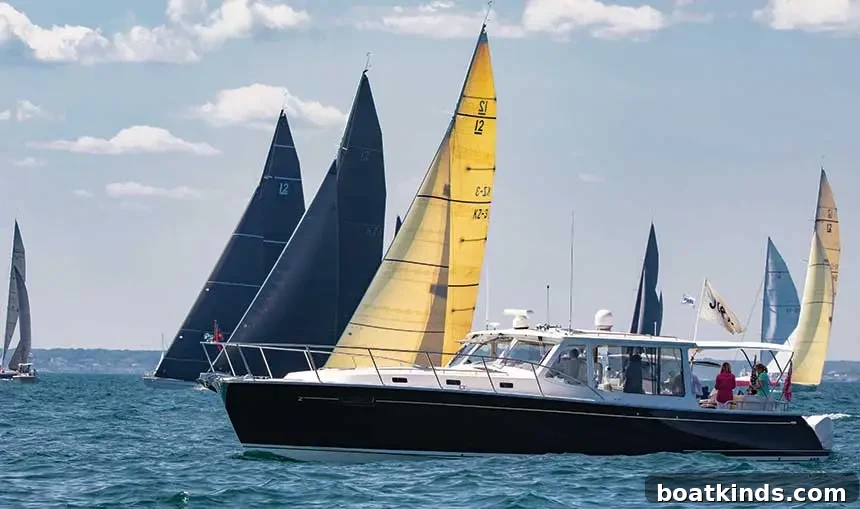
Approaching the starting line, Bob asks me to take the wheel while he closes a hatch. With Twelves converging from all directions I’m happy to steer conservatively, and when Bob returns he brings us past the race committee vessel—the 1964 motor yacht Serena—and positions Breeze at the opposite end of the line to observe the start.
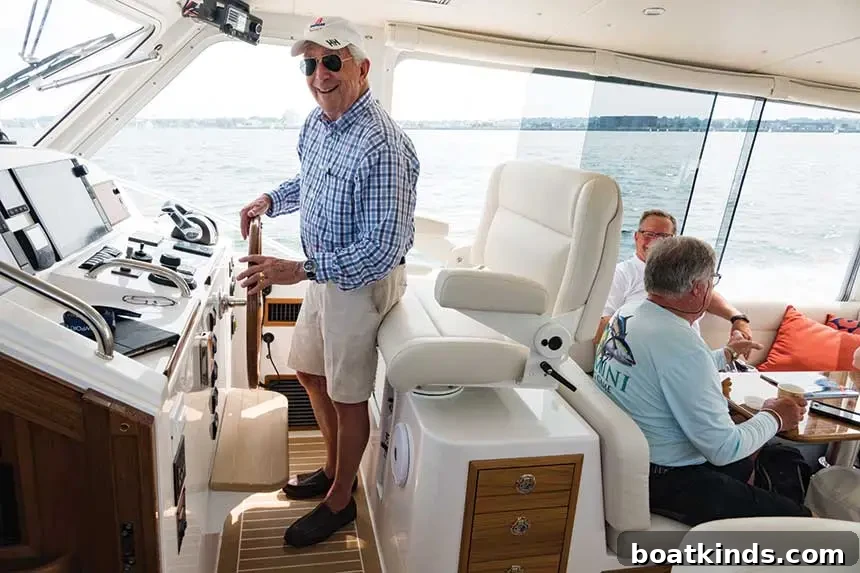
Photo boats clutter our sightline and the judges need a clear view. Bob opens the starboard window, gives a short whistle and, with a pointed finger, politely directs photographers to move. They initially ignore him, but he repeats the signal and they comply.
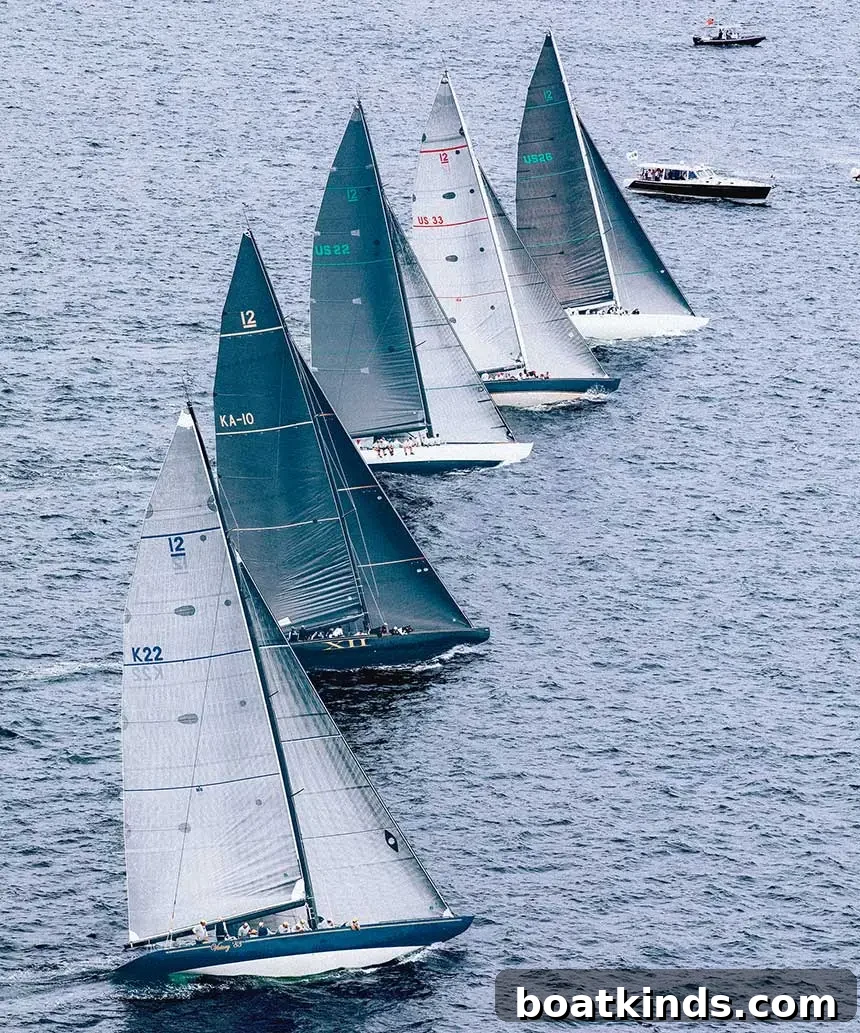
The first division starts and the rest follow in rolling fashion. To keep competition fair, boats race against peers of similar design era while conforming to the international 12 Metre rule. The “12 Metre” name refers to a rating formula involving length and sail area, not the boats’ overall length, which commonly ranges from 65 to 70 feet.
The 12 Metre class has roots going back to 1907 and was once an Olympic class. Official divisions include Grand Prix, Modern, Traditional and Vintage; this year a non-championship division called 12 Metre Spirit was added for two boats that no longer meet the formula.
The entry roster reads like America’s Cup history. Both Courageous and Intrepid, the only Twelves to successfully defend the Cup twice, are present. Other Cup winners like Freedom (US-30) and the 1958 champion Columbia (US-16) are entered as well.
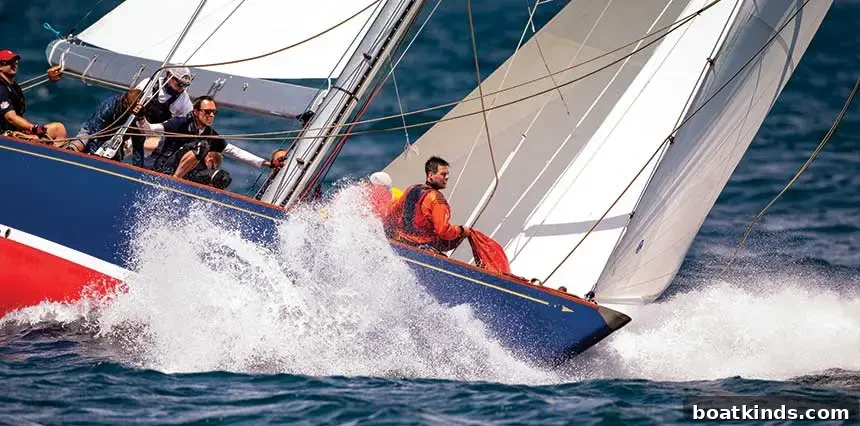
Patrizio Bertelli, CEO of Prada and the only Italian in the America’s Cup Hall of Fame, brought the 1938 Nyala and 1985’s Kookaburra II (KA-12). Six countries are represented—Denmark, Finland, Italy, Norway, Canada and the United States—with some Twelves shipped in from overseas and others chartered for the regatta.
Four wooden prewar Twelves sail in the Vintage division. Norway’s 1933 Vema III (N-11) and Finland’s 1937 Blue Marlin (F-1) compete alongside Nyala. The U.S. entry Onawa (US-6), built in 1928 and restored in 2000, is the oldest surviving American 12 Metre and still retains original stainless sinks—her interior feels like a time capsule.
The trio of fiberglass “plastic fantastic” Twelves—Kiwi Magic (KZ-7), Legacy (KZ-5) and New Zealand (KZ-3)—are also here. These innovative hulls stunned the late-1980s fleet of aluminum wing-keeled Twelves and played a pivotal role at the 1987 Cup in Fremantle.
After watching three division starts, Bob motors upwind to observe the fleet. His decades of J/Boats and racing experience guide him to places where we can see the action without interfering. The veteran passengers, many of whom raced during the sport’s heyday, drink it all in. “What incredible boats they are,” Ann says quietly. “This brings back a lot of good memories.”
At the conclusion of downwind legs the crews drop spinnakers, turn upwind and grind the winches to sheet in main and jib. The noise is dramatic as jibs are hauled and booms are winched down. Despite the intensity, the first series of races finishes without incident. At the downwind finish, Bob activates Breeze’s Skyhook station-keeping feature. The four outboards work independently to hold position—an impressive demonstration of modern outboard control.
Between races we have lunch while Twelves race past from every direction. The 53z’s standard Seakeeper gyrostabilizer keeps the boat steady. When Legacy rounds so close to our stern that her crew sees our outboards, everyone on Breeze laughs and captures the moment on smartphones and cameras.
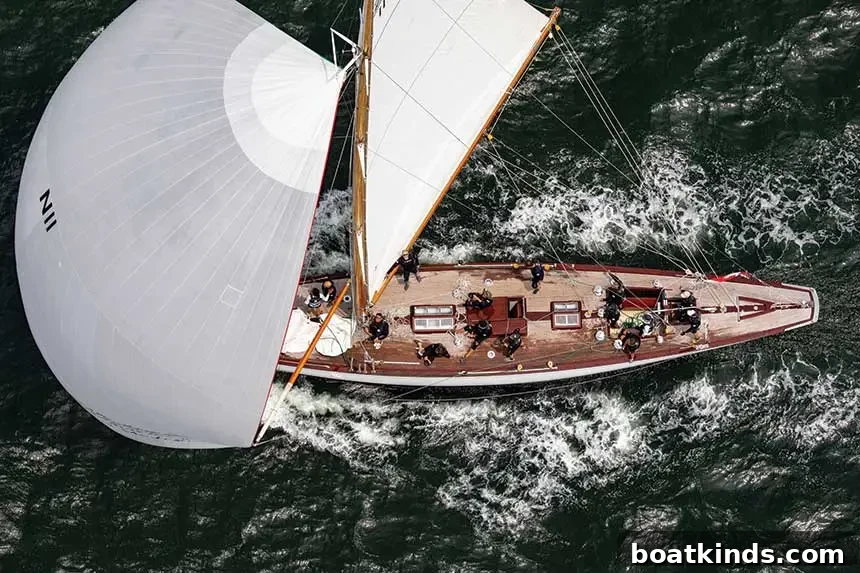
The afternoon brings real drama when Onawa’s wooden boom sweeps across deck and knocks a crewman overboard. The crew quickly drops the spinnaker and issues a VHF distress call; safety boats sprint to the area. For tense minutes we can’t tell whether the sailor is conscious. A photographer finally spots him through a telephoto lens and he’s recovered safe and reported OK—relief sweeping the boat.
After all divisions finish their second races, Bob turns Breeze back toward Newport. “That was fun, wasn’t it?” he asks. “We were right in the thick of it.” He’s hopeful Mary found a gown for the evening’s black-tie dinner dance, but his priority is getting guests ashore on time. With a grin he opens the throttles. “Now it’s our turn to win the race,” he says. “It’s time to win the hoist.”
This article originally appeared in the September 2019 issue.