
The Chicago Yacht Club’s race selection committee plans to re-evaluate both its participant selection process and the stability standards for competing boats after a US Sailing–led review into the deaths of two sailors during the 2011 Race to Mackinac. The tragic loss has prompted a renewed emphasis on boat suitability, crew experience and safety criteria for this challenging overnight race across Lake Michigan.
“Perhaps the committee should give greater weight to a boat’s suitability as well as the crew’s experience,” says Joseph S. Haas, commodore of the Chicago Yacht Club, which organizes the annual Race to Mackinac. Lou Sandoval, chairman of the 2012 race, says the committee will consult a naval architect or a sailing safety expert to advise on any needed changes to stability requirements. “We’re developing an action plan,” Sandoval explains. “The US Sailing report was complimentary about many of our practices but also identified areas we should examine.”
Haas stresses that any changes will be made before the next race, scheduled for July 21. To meet the race timeline, the club aims to finalize selection guidelines and parameters by February, since the notice of race is typically issued in late February or early March.
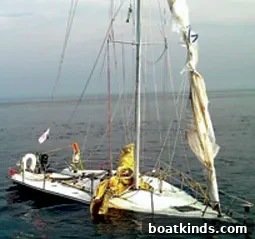
The capsize of WingNuts, a Kiwi 35, was the first fatal accident in the history of the Race to Mackinac, which starts at Chicago’s Monroe Harbor and finishes at Mackinac Island in Michigan. Entry in the race is by invitation from the yacht club. WingNuts was one of eight boats in the Kiwi 35 class, designed by O.H. Rodgers and built in 1984–85 with a fiberglass–Kevlar sandwich hull by Kiwi Boats in Plant City, Florida.
The two sailors who died were skipper Mark Morley, 51, and crew member Suzanne Makowski-Bickel, 41, both from Saginaw, Michigan. A competing crew aboard Sociable rescued six other crewmembers from WingNuts: Christopher Cummings, 16; John Dent, 50; Stan Dent, 51; Peter Morley, 47; Stewart Morley, 15; and Lee Purcell, 46.
WingNuts capsized in a violent thunderstorm that produced 4- to 6-foot seas and winds near 50 mph, roughly 13 nautical miles northwest of Charlevoix, Michigan, and about 10 miles east of South Fox Island. Sociable reported the capsize to the Coast Guard at 12:40 a.m. on July 18, and roughly eight hours later rescue divers recovered Morley and Makowski-Bickel.
At Haas’ request, US Sailing president Gary Jobson appointed a five-member independent panel of offshore sailing experts to investigate why the 35-foot sloop capsized during the race, resulting in two fatalities. The panel’s detailed 70-page report, released in late October, concluded that WingNuts should not have been allowed to compete in the 333-mile race. The report called the Race to Mackinac one of the longest freshwater events of its kind and noted the exposure to frequent violent thunderstorms.
The report’s findings state, “WingNuts was a highly inappropriate boat for a race of this duration—overnight, without safety boats—and in an area known to have frequent violent thunderstorms. Her capable crew and preparation could not make up for the fact that she had too little stability, which led to her being ‘blown over’ by a severe gust.”
Equipment not to blame
Chuck Hawley of Santa Cruz, California, chaired the review panel. Hawley has extensive experience researching man-overboard recovery, life raft design, anchor design and storm tactics. Panel members included Sheila McCurdy, Ralph Naranjo, John Rousmaniere and Leif R. Sigmond Jr. Their recommendations covered how the yacht club evaluates potential raceboats and crews, stability standards, safety regulations, training and disaster planning. The panel urged implementation of a minimum stability index and clearer standards for boat suitability and seaworthiness.
Haas noted the club had reviewed WingNuts’ stability before the race but did not identify any red flags at the time. “There were actually boats that had a stability rating that was less than WingNuts,” he said.
Local authorities conducted their own investigation. Charlevoix County Sheriff Don Schneider says the coroner determined the primary cause of both deaths was blunt force trauma to the head; drowning was listed as a secondary cause. Schneider attributes the fatalities primarily to the severe weather. His summary also raised concerns about inflatable personal flotation devices (PFDs) and tethers, noting that in some capsize scenarios these items can trap sailors beneath an overturned hull.
Schneider observed that Makowski-Bickel’s tether and inflated PFD may have complicated her recovery. “When my diver found the woman, her head and shoulders were still under water. She was still tethered to the boat and needed to be cut loose,” he said, adding that she carried a knife. However, because blunt force head trauma was the primary cause, Schneider said it’s unclear whether the tether-and-PFD combination was a direct factor in her death.
The panel’s report describes how, after the capsize, crewmember Stan Dent located Makowski-Bickel submerged under the stern and unresponsive but could not free her from the tether. Dent moved to the transom and cut Peter Morley free, then returned to search for Makowski-Bickel but could not see her. Later Peter Morley found Makowski-Bickel under water and lifeless; he did not find his brother Mark.
US Sailing’s panel concluded that neither inflatable life jackets nor tethers were the direct cause of the deaths. The report explains that during the capsize Mark and Suzanne were thrown together and to the ends of their tethers on the leeward wing, sustaining injuries likely rendering them unconscious before the boat settled upside-down. Nonetheless, the panel recommended the US Sailing Safety at Sea Committee study tether, life jacket and harness designs to identify combinations that balance security with ease of release. The report also noted one surviving crewmember’s tether lacked a required chest-end shackle, forcing another sailor to cut the tether to free him.
‘A little more scrutiny’
Naval architect Jim Teeters and panel member Ralph Naranjo provided technical analysis in the vessel design section. They concluded the Kiwi 35’s stability characteristics were a primary cause of the incident and a major factor in the fatalities. The boat’s extreme deck beam, required by its wing-like appendages, negatively affected its stability, leading the panel to judge the Kiwi 35 design inappropriate for such a long-distance race in an area prone to severe storms.
Gary Jobson praised the panel’s work and emphasized that recommendations must be implemented by race organizers. “All race committees need to be diligent to ensure proper boats are participating and that they’re carrying the correct safety equipment for the conditions they may encounter,” he said. Last year’s Race to Mackinac drew 355 boats and roughly 3,500 sailors, and Jobson warned organizers not to be overly permissive. “The lesson here is that organizers must apply a little more scrutiny,” he said.
Hawley, who is also vice president of product information for West Marine, responded to critics who said the report underplayed extreme weather. He noted the report includes substantial weather analysis and that strong thunderstorm cells are a recurring hazard on Lake Michigan during summer racing.
The WingNuts crew were experienced and closely connected: the boat was co-owned by the Morley brothers and first cousins Stan and John Dent. Mark Morley had extensive offshore experience, including multiple Mackinac races, Port Huron–Mac races and more than 80 qualifiers. Makowski-Bickel was competing in her third Mackinac and had completed 16 qualifiers and a trans-Atlantic passage.
See related articles:
– US Sailing weighs in on two other incidents
– Q&A: Preparedness
This article originally appeared in the February 2012 issue.