
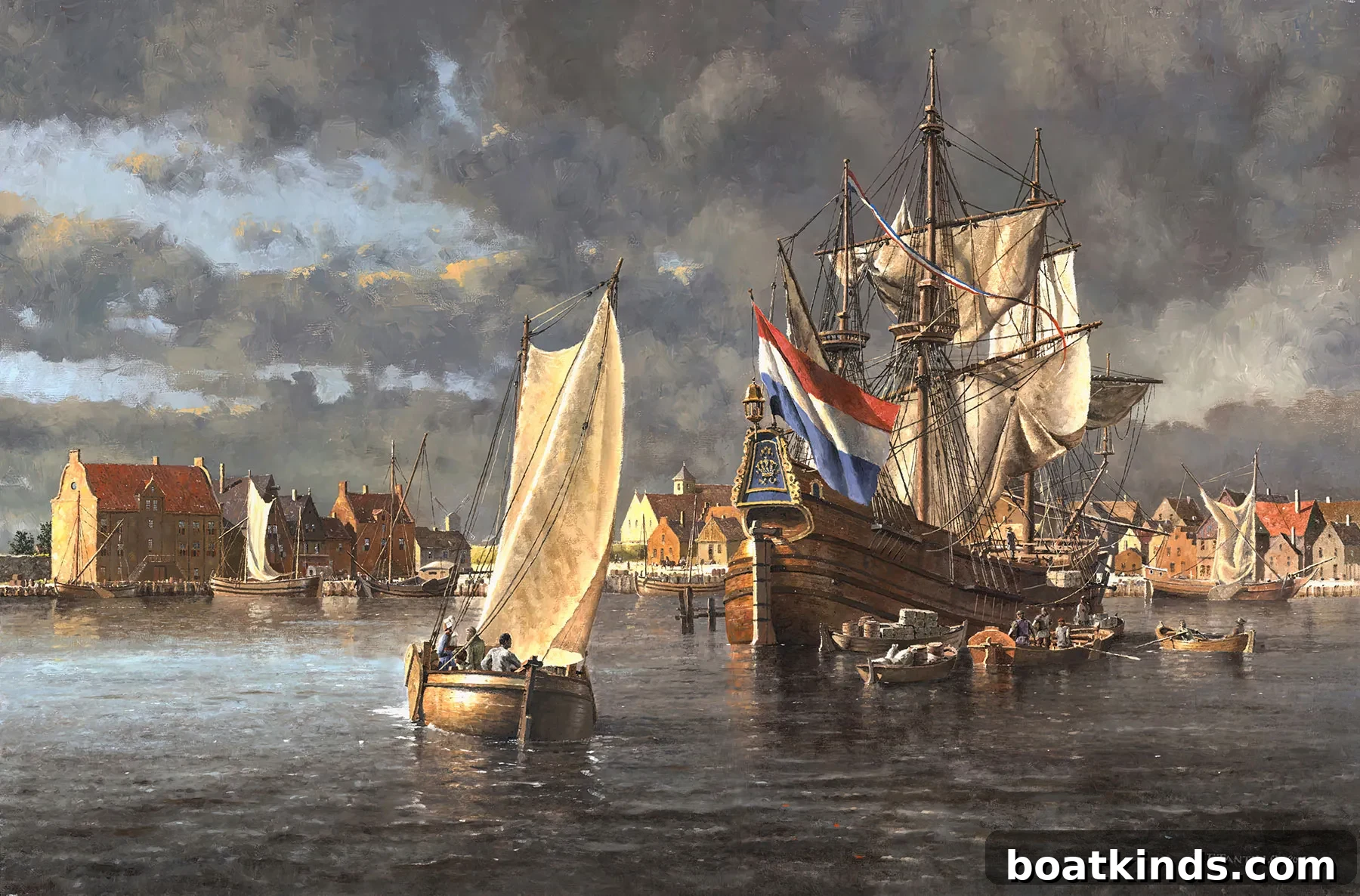
In “East River Manhattan, 1655,” artist Leonard Tantillo brings to life a bustling maritime scene from early New York when Manhattan was still New Amsterdam. The painting captures a fluyt, a distinctly Dutch cargo vessel, flying the Dutch flag as goods are unloaded onto smaller boats. Nearby, a ferry carries passengers across the East River from Brooklyn to Manhattan, while in the distance the skyline is punctuated by the Dutch West India Company’s government building and residence of Petrus Stuyvesant, the colony’s last director-general before New Netherland passed to English control in 1664. A Dutch church rises just behind the fluyt, and a windmill on the North River (today the Hudson River) appears on the far left, reinforcing the strong Dutch character of the settlement.
Tantillo’s depiction is the product of four decades of sustained study and painstaking reconstruction of 17th-century New York. He explains that much of his work is founded on a highly detailed late-1600s map drawn by a Belgian cartographer, which provides the cartographic framework for his reconstructions. From that historical base, he builds three-dimensional digital models informed by architectural knowledge and period evidence, then selects and composes the most compelling viewpoints to paint. His architectural training at the Rhode Island School of Design gives him the tools to translate flat maps into convincing, lived-in cityscapes.
The painting emphasizes maritime commerce and daily life along the East River. The fluyt, a common 17th-century Dutch merchant vessel known for its broad cargo capacity and efficient design, anchors the scene as crews and smaller boats bustle around it—an accurate and evocative portrayal of the port’s logistical choreography. The ferry’s steady movement between Brooklyn and Manhattan hints at the continuity of commuter and commercial traffic that has defined New York’s waterways for centuries. Together, these vessels and shoreline structures tell a story of trade, migration, and urban development at an early stage in the city’s history.
Tantillo’s artistic choices reflect a consistent interest in places that predate photography. “I like painting places that were never photographed,” he has said, conveying both the challenge and appeal of reconstructing vanished environments. His process combines historical research, architectural reasoning, and digital modeling to recreate building forms, street patterns, and maritime activity with a high degree of plausibility. The result is a painting that feels both documentary and imaginative—rooted in historical sources yet composed with an artist’s sense of light, scale, and narrative.
The artist’s connection to New York’s past is also personal. Raised in New Paltz, a town rich in stone houses and built fabric dating to the late 17th and early 18th centuries, Tantillo absorbed an awareness of the past from an early age. That upbringing, he says, made it impossible “to come from that town without being aware of the past.” His attraction to maritime subjects is further shaped by family history: his grandfather, a sailor from Procida, Italy, owned and worked aboard a small merchant vessel, a legacy that deepened Tantillo’s interest in ships, ports, and seafaring life.
Now 75, Tantillo continues to live and work in New York State, based in Rensselaer County, and remains deeply engaged with early New York as his central subject. Even after four decades, he finds the era inexhaustibly rich: every new painting opens up another facet of colonial life, architecture, religious and civic institutions, and the complex interactions between European settlers, indigenous peoples, and the built environment. The paintings function as visual hypotheses—carefully researched reconstructions that invite viewers to imagine how the city looked, moved, and sounded centuries ago.
East River Manhattan, 1655, stands as an example of how historical painting can merge scholarship and artistry to produce work that is visually compelling and historically informed. By relying on old maps, architectural analysis, and digital modeling, Tantillo produces scenes that feel authentic without overstating certainty. His work offers a vivid window into New Amsterdam’s maritime economy and civic presence, and reminds contemporary viewers that the layers of New York’s history remain visible to those who look closely.
This article was originally published in the June 2022 issue.