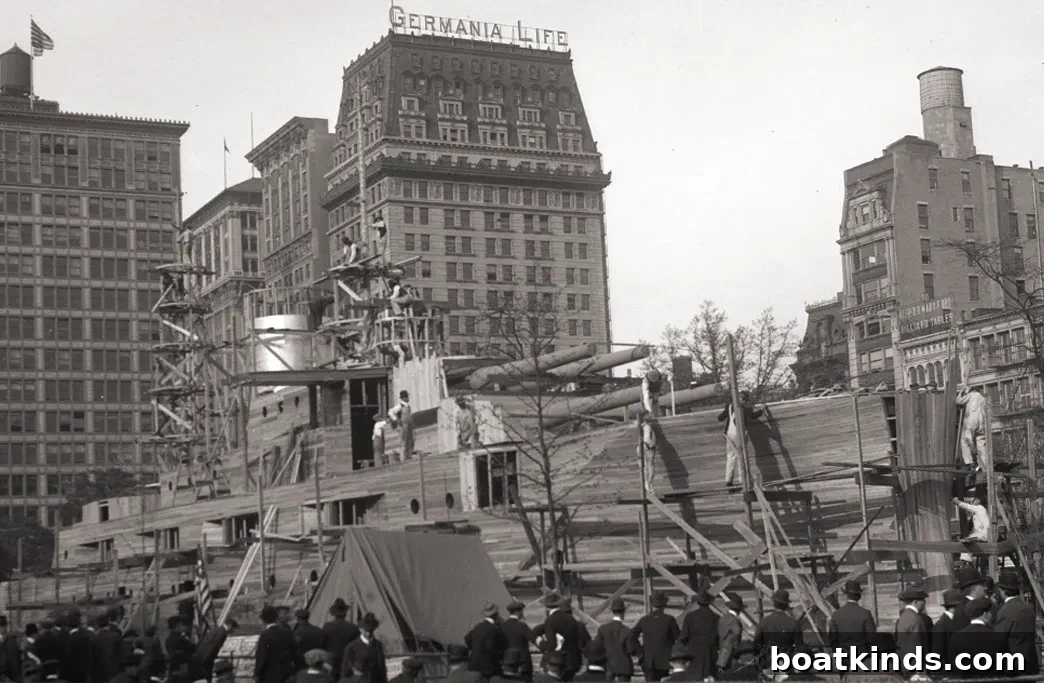
USS Recruit: The Wooden Battleship That Recruited in Union Square
In 1917, as the United States entered the First World War, a surge of patriotic fervor swept the nation and the demand for new recruits rose sharply. To meet that need and capture public attention, the Navy tried an unconventional recruitment tool: a full-scale wooden mock-up of a battleship erected in the heart of Manhattan. Known as the USS Recruit, this so-called “landship” was officially commissioned and staffed by Navy sailors, offering New Yorkers a striking, tangible symbol of naval service right in Union Square.
Why a Landlocked Battleship?
With recruitment a national priority, Navy planners sought creative ways to bring the service to the public. The Recruit was intended to look and feel like a real dreadnought-class warship, so it could educate, inspire, and persuade young men to enlist. Placed amid the office buildings and busy streets of Union Square, the wooden battleship became an eye-catching centerpiece that drew curious crowds and provided a convenient recruiting station where men could sign up for duty in the New York district.
Construction and Authentic Details
Although constructed of planking and framing rather than steel, the Recruit was built with attention to naval detail. The silhouette included the characteristic dreadnought cage masts, a conning tower, and a dummy smokestack, creating an unmistakable battleship profile. On deck, wooden mock-ups represented the ship’s typical armament—six 14-inch main battery guns and ten 5-inch guns—so visitors could visualize a warship’s firepower.
The interior was more than decorative. The Recruit contained officers’ quarters and crew cabins laid out to mirror real naval accommodations and could house a complement of about 40 men. The ship even featured what was described at the time as a “modern” wireless station, giving recruits and visitors a sense of contemporary naval technology and operations.
Active Service as a Recruiting Center
Commanded by Capt. C.F. Pierce, whose officers and crew were drawn from the Navy’s Newport Training Station in Rhode Island, the USS Recruit functioned as the Navy’s New York district sign-up headquarters. Pierce and his team not only staffed the recruit station but also escorted VIPs and gave public tours. These walkthroughs educated visitors about battleship operations, daily life aboard a ship, and the duties sailors would perform—an immersive experience designed to demystify naval service and encourage enlistment.
End of Service and Legacy
The Recruit’s role was tied directly to wartime needs, and with the armistice and demobilization that followed the end of the war, its mission concluded. The ensign was lowered for the last time in March 1920, and Navy personnel began to dismantle the structure. Plans were made to move the landship to Coney Island as an attraction at Luna Park, where it would live on as a novelty and reminder of the Navy’s wartime presence. Those plans, however, never came to fruition; the USS Recruit never reached the amusement park, and its ultimate fate remains unknown.
Despite that uncertain ending, the wooden battleship accomplished its primary objective. During its time “afloat” in Union Square, the Recruit helped draw approximately 20,000 men into the Navy, a significant contribution to wartime manpower. More broadly, it stands as an imaginative example of how the military used public spectacle and direct engagement to connect with civilians and fill its ranks.
This article originally appeared in the August 2017 issue.