Barnstable County Sheriff’s Office Receives Homeland Security Grant for Radiation Detection Patrol Boat
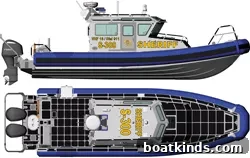
The Barnstable County (Massachusetts) Sheriff’s Office has been awarded a $445,965 Homeland Security grant to purchase and outfit a Safe 31 radiation detection boat. The vessel will patrol the waters around Cape Cod, Nantucket and Martha’s Vineyard, and the grant also covers training for personnel to operate the boat and its onboard detection equipment.
The U.S. Coast Guard, which helps coordinate the Department of Homeland Security’s maritime security efforts, has identified potential risks from malicious actors using small craft to mount attacks in and around Cape Cod’s busy waterways, Barnstable County Sheriff James M. Cummings says. These scenarios include assaults on ferry services between the Cape and the islands, attacks against vessels while underway, threats to cargo ships transiting the Cape Cod Canal, incidents involving visiting cruise ships during the busy summer and fall seasons, and protection requirements for waterfront critical infrastructure such as the Pilgrim Nuclear Power Station in Plymouth.
As part of the Coast Guard’s maritime security strategy, agencies are developing the capability to detect radiological threats, including so-called “dirty bombs” — conventional explosive devices intentionally loaded with radioactive material — as well as chemical or nuclear devices that might be concealed on small boats or inside shipping containers. “With over 400 miles of shoreline, numerous harbors and inlets, a large recreational boating community and many ferry routes, a vessel of this type is long overdue,” Sheriff Cummings said in a statement.
Cummings noted in a telephone interview that the Coast Guard maintains stations at Woods Hole, Chatham and Sandwich, plus an air station located inland in west-central Cape Cod. During the summer months, the Coast Guard often focuses its resources on responding to the high volume of calls from recreational boaters, and there are currently no other dedicated marine law enforcement vessels based on Cape Cod. “Law enforcement coverage on the water is definitely lacking,” he said. He also pointed out that there are no law enforcement boats equipped with radiological detection capabilities between Boston and Providence, Rhode Island.
The Safe 31 will be the sheriff’s office’s first marine patrol boat. The department already has personnel with maritime qualifications — including a deputy holding a 100-ton captain’s license and two former Coast Guard coxswains — so, once trained, the team can staff and operate the Homeland Security-funded vessel and its detection systems.
The regional ferry operator, the Steamship Authority, reported that its fleet carried nearly 3 million passengers and roughly 625,000 vehicles in 2014, underscoring the density of passenger traffic in the area. In addition, Massachusetts records indicate a large number of registered and U.S.-documented recreational boats, many of which frequent Cape Cod and the islands during the summer season, contributing to a busy and complex maritime environment.
Visibility and regular patrols are central to the sheriff’s intended use of the vessel. “Being out there on a regular basis and projecting a visible, deterring presence is half the battle,” Cummings said. The Safe 31 is expected to spend considerable time shadowing ferries to deter potential threats and will also respond to routine marine law enforcement calls and public-safety incidents.
Delivery of the boat was expected in January. The craft is an aluminum-hulled outboard built by Safe Boats International of Bremerton, Washington, a company known for designing and manufacturing vessels for military, law enforcement and fire-rescue use. The Safe 31 features a foam collar for added stability and a sealed aluminum cabin equipped with air filtration to help protect occupants from airborne contaminants. It will be fitted with chemical, biological, radiological and nuclear (CBRN) detection equipment and powered by twin 300-horsepower outboard engines.
Starting in the spring, the vessel will visit harbors across the Cape and the islands to introduce itself to the marine community and build familiarity with local boaters, harbormasters and ferry operators. “We’ll see how the community likes it and how busy it is,” Cummings said. If the new patrol capability proves valuable and in demand, the sheriff’s office indicated that additional marine patrol boats could be considered in the future.
This article originally appeared in the February 2016 issue.