Essential Onboard Tool Kit for Boaters
Repairs underway are part of owning and operating a boat. Even if you rely on a yard for routine maintenance, something can break while you’re on the water. Carrying a compact, well-chosen tool kit can turn a potentially serious problem into a manageable inconvenience.
Your exact toolkit will depend on the size of your boat and the type of cruising you do. A weekend runabout has different needs than a trawler that spends weeks cruising. The list below reflects tools that cover routine maintenance and common emergencies for small to midsize boats and are practical to carry on most vessels.
Buy the best tools you can afford. Cheap tools often fail at the worst moment. Build your kit over time, selecting multi-use tools that fit neatly into a plastic toolbox to minimize corrosion risk. Keep tools organized and stowed where they’re protected from salt spray and moisture.
WD-40 — Often treated like a tool in its own right, a penetrating oil/lubricant helps free seized parts, displace moisture, and provide short-term corrosion protection on metal fittings and anchor chains. It’s also handy for removing adhesive residue.
Duct tape — Durable and versatile, duct tape is useful for temporary repairs to canvas, hoses or broken fittings. It won’t replace proper repairs, but it can keep things functional long enough to get to a safe harbor.
Plastic insulation tape — Use vinyl electrical tape to insulate wiring and protect small electrical splices from moisture. It’s also useful for bundling and minor temporary fixes.
Tape measure — Accurate dimensions prevent mistakes. Whether measuring replacement parts, cutting line, or gauging available space, a compact tape measure is indispensable. Remember the rule: measure twice, cut once.
Pencil — A simple, reliable marking tool that works when a marker won’t. It’s especially useful on wet or dusty surfaces and for marking where to drill or cut.
Hand drill — A reliable manual drill that accepts bits up to 3/8 inch is invaluable when power isn’t available. A keyed chuck helps hold bits securely without slipping.
Drill bits — Carry a basic set from small sizes up to 1/4 inch for most fasteners and pilot holes. Larger diameters require powered drills, so plan accordingly based on expected jobs.
Matches — Include wind- and water-resistant matches in a survival kit and toolbox. They’re useful for emergency signaling and for sealing synthetic line ends by melting to prevent fraying.
Hacksaw — Useful primarily for cutting metal fittings, bolts, or tubing, a hacksaw also cuts fiberglass and wood in a pinch. Carry extra blades for different materials.
Hammer — A general-purpose hammer helps install or remove fasteners and coax stuck parts. Choose a size that’s effective without being unwieldy in a confined space.
Locking pliers — Also called vise-grips, these can act as a temporary vise, clamp or adjustable wrench when other tools aren’t available.
Mirror on a stick — A small telescoping mirror helps locate dropped hardware or inspect hard-to-see areas around the engine, bilge, and rigging.
Magnetic retrieval tool — A telescoping pickup with a rare-earth magnet is extremely useful for retrieving fallen screws and other ferrous items from tight spaces. Consider adding a claw-style retriever for non-magnetic items.
Multitool — A compact multitool on your belt keeps pliers, a knife, and small screwdrivers within reach for quick fixes and adjustments.
File — A double-sided file — one side for metal and the other a rasp for wood or fiberglass — lets you smooth rough edges or shape small parts.
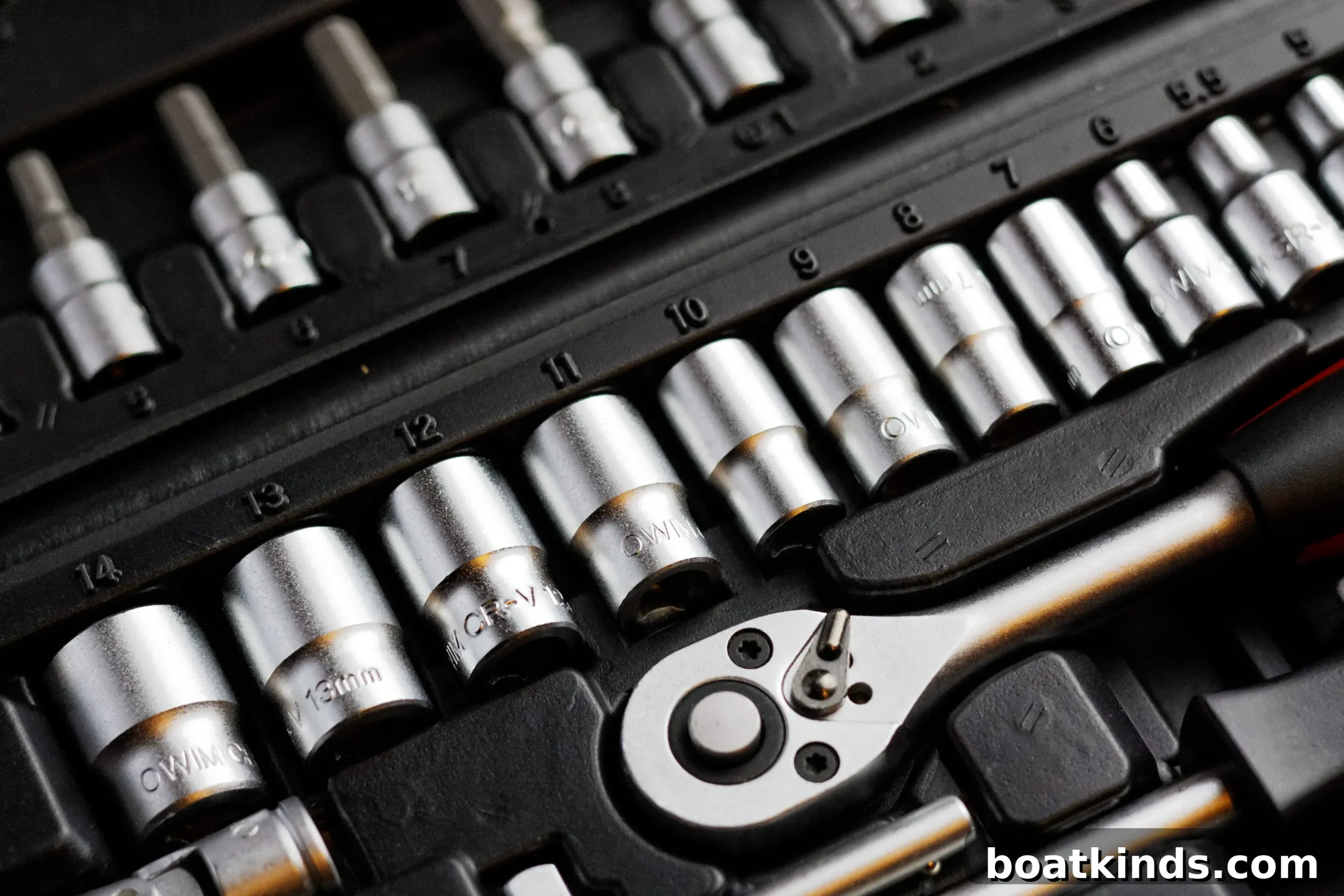
Socket wrench and sockets — A good ratchet set covers a range of nut and bolt sizes; include a spark plug socket if you carry a gasoline engine.
Multimeter — Essential for diagnosing electrical problems, a multimeter helps measure voltage, continuity and current. Learn its functions before you need it on the water.
Screwdrivers — Carry a selection of Phillips and flat-head screwdrivers in multiple sizes for cockpit fittings, electrical panels and general work.
Putty knife — Keep a stiff putty knife for scraping and a flexible one for spreading bedding compound, sealants and adhesives.
Circlip pliers — These are invaluable when disassembling pumps and other components that use retaining rings. The job is slow and awkward without them.
Rigging knife — A sharp knife designed for marine use makes quick work of rope, cordage and small chafe repairs.
Adjustable wrench — A high-quality adjustable wrench is versatile for many fasteners; stainless versions resist corrosion. Some models include convenient extras like shackle keys built into the handle.
Crimping tool — A good crimper cuts and strips wire and secures terminals for reliable electrical connections.
Wood chisel — A sharp chisel will shape wood and fiberglass when needed; keep it sharpened and protected to maintain edge quality.
Needle-nose pliers — Ideal for holding small parts, bending wire, and working in tight spaces; built-in cutters handle small-gauge wire and seizing wire.
Allen keys — Hex keys are the only tool for socket-head screws commonly used in marine hardware and instruments. Carry a small set of metric and SAE sizes if your gear varies.
These tools, combined with common consumables like spare hose clamps, fuses, electrical terminals, and a small roll of seizing wire, will cover most on-board emergencies and routine maintenance. Organize the kit so items are easy to find, check it regularly, and replenish consumables after each trip.
This article originally appeared in the December 2016 issue.