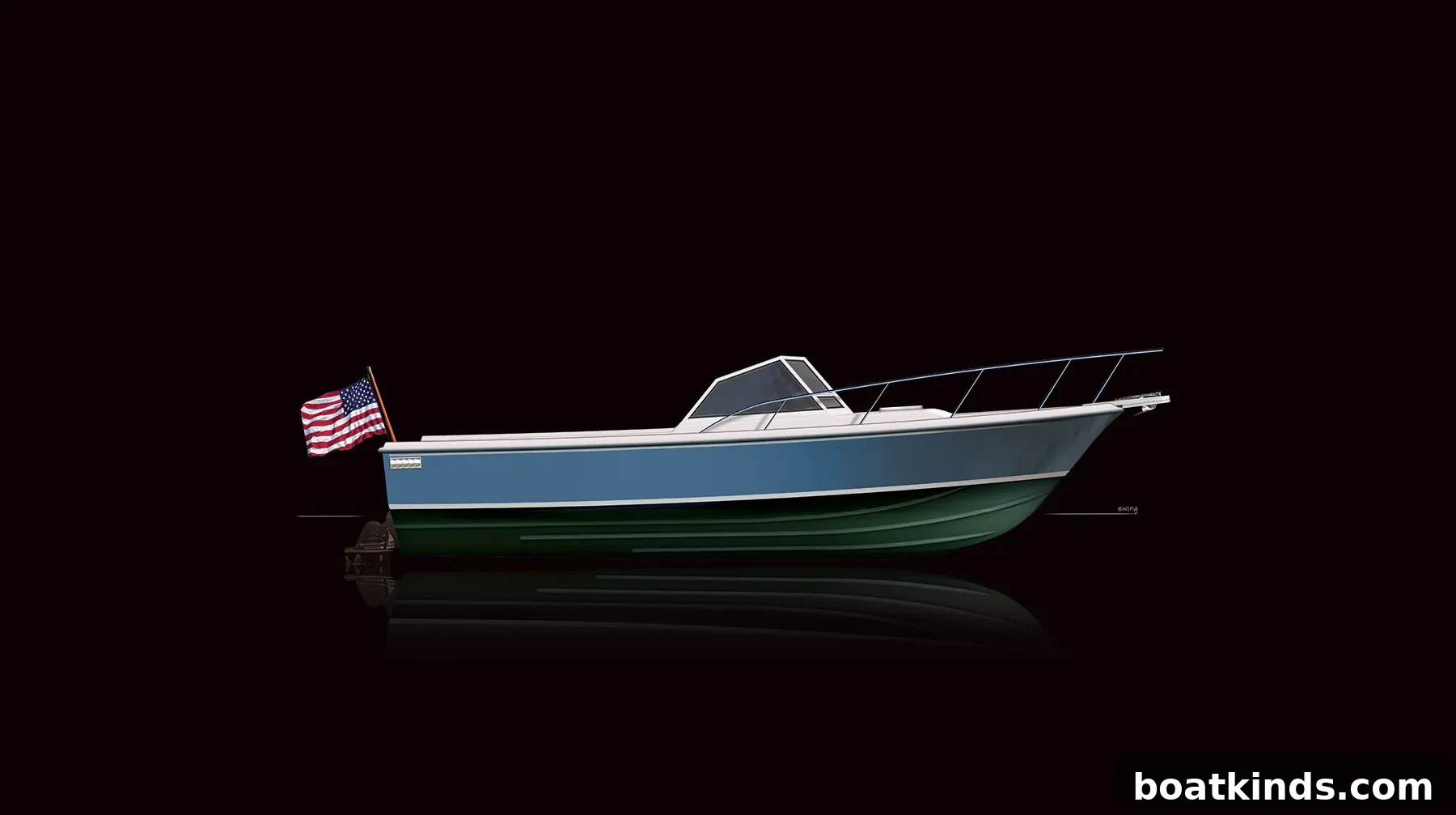
Limestone 24: Mark Ellis’s Fast, Handsome, and Durable Deep‑V Powerboat
When Mark Ellis began sketching the Limestone 24 in the mid-1980s, his brief was simple in spirit if not in words: create a boat that is fast, handsome, and durable. Although the Limestone 24 was Ellis’s first production powerboat from his own drawing board, the design reflects a lifetime of naval architecture experience—most notably the influence of John Deknatel and the deep‑V hull concepts developed under C. Ray Hunt Associates.
Ellis’s path to the Limestone design combined time spent with renowned designers and years of independent practice. Early in his career he worked for John Deknatel at C. Ray Hunt Associates, where he absorbed lessons about hull form and seakeeping. Later he built a strong reputation with George Cuthbertson and George Cassian at C&C Yachts and pursued successful projects under his own firm, Mark Ellis Design, including the Aurora 40 and the Niagara 35. A turning point came when his friend and owner Gordon Fisher encouraged him to create the Nonsuch 30, a 30‑foot catboat whose plug and mold were underwritten by Fisher. That collaboration led Ellis to George Hinterhoeller, a respected Canadian builder who would later construct the Limestone 24.
The Limestone 24 itself was born from a direct request by another friend and owner, Fred Eaton, who wanted a cuddy‑style runabout capable of handling the open waters of Georgian Bay. Eaton and several of his friends were prepared to buy the boat, and Eaton financed the tooling. The prototype launched from George Hinterhoeller’s yard in the summer of 1985, and the design quickly established a reputation for its combination of performance and seaworthiness.
At the heart of the Limestone’s performance is a true deep‑V hull. The deadrise begins steeply at about 55 degrees at the stem, easing to a constant 22 degrees around midships. Instead of a sharp keel line, Ellis used a radiused centerline—an approach learned while working with Deknatel—that adds both structural strength and favorable hydrodynamic behavior. These subtleties in the hull shape contribute to a comfortable ride in chop while permitting responsive handling and efficient planing.
Ellis incorporated three pairs of lift strips on the hull bottom, but they are not spray rails in the conventional sense. If seen from above, these lift strips angle down toward the stern rather than running parallel to the waterline. Working in concert with the design’s relatively wide beam and the chines that sit out of the water at rest, the lift strips help the boat get and stay on plane at lower speeds. In practice, the Limestone 24 will plane effectively down to around 16 knots, delivering a confident feel under power.
Early Limestone 24s were typically powered by a single 230‑hp MerCruiser sterndrive. Ellis specified a forward‑mounted engine connected to the outdrive via a jackshaft; that arrangement moved mass forward of the transom and reduced pitching, which helped the boat achieve a top speed near 40 mph while preserving composed handling. Production of the sterndrive versions continued for many years, and in total roughly 800 examples of the cuddy and express cruiser variants were built.
About four years ago the last sterndrive Limestone 24 came off the production line. More recently, the new owners of the Limestone tooling have pursued an outboard‑powered version to meet contemporary preferences, and Ellis has consulted with them to tune performance and handling. Even with the move toward outboards, he remains an advocate of keeping engine weight somewhat forward of the transom when possible to minimize pitching and optimize trim and sea‑keeping.
The Limestone 24 stands as a clear example of how naval architecture experience, practical feedback from owners, and careful hull detailing combine to create a versatile coastal powerboat. Its deep‑V form, radiused centerline, lift strips, and thoughtfully positioned propulsion package all reflect Ellis’s commitment to marrying speed with seaworthiness and a clean, attractive profile.
This article was originally published in the April 2024 issue.