Gyro Stabilization Is Becoming a Standard Feature on Many Boats
Several designers and boatbuilders predict that gyroscopic stabilization will become a common, if not standard, feature on many pleasure boats over the next decade. As the technology matures and costs fall, more builders and buyers are planning for gyros during the design phase rather than as an afterthought.
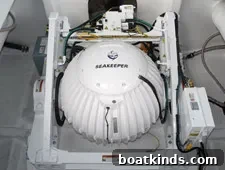
“I see in boats from 45 feet and up a continued growth of gyro stabilization technology,” says Bill Blount, CEO of Donald L. Blount and Associates in Chesapeake, Virginia. Blount adds that many sportfishing boats now routinely offer a Seakeeper option, and his firm designs vessels with space allocated for a gyro as a standard consideration.
Designer Michael Peters reports the same shift. “With every boat we draw now, we have to have a planned space for [a gyro stabilizer],” he says. Five years ago the idea was rare, he notes, but gyro systems have become a major development in comfort and safety. Builders of boats over 40 feet commonly ask where the gyro will be located, he adds.
Bill Prince of Bill Prince Yacht Design in Port Washington, Wisconsin, is working on a 44-foot model that may include a gyro. Although gyro units require space, Prince explains that new propulsion choices — such as pod drives — often free up the structural room needed, making installation more practical in modern designs.
Builders are already installing gyros in production models. Intrepid has fitted four gyro systems, including one on its new 475 Panacea, which was displayed at a recent Miami boat show, company president Ken Clinton says. Intrepid has also installed gyros in two 390 models and a 475 Sport Yacht, and plans to offer them on a 430 Sport Yacht next. Clinton believes wider adoption will follow as manufacturing efficiency improves and prices decline; after all, few owners would turn down the ability to greatly reduce pitch and roll in varied sea conditions.
Shepard McKenney, founder of Seakeeper in 2003, says early systems were expensive, but deliveries and production are scaling up. Seakeeper has delivered more than 1,300 gyro systems, including 374 units in 2013, with current models such as the M8000 and M26000 installed in vessels ranging from the high 30s to over 200 feet in single and multiple configurations. The bulk of installs have been M8000s on cruising and sportfishing boats between about 50 and 70 feet.
MJM Yachts has taken a forward step by making the Seakeeper gyro standard on its new 50z model. “I am amazed that after five years of the Seakeeper being available … that we are the first to make it available standard,” says Bob Johnstone, founder and CEO of Boston-based MJM. He explains that installing a gyro addresses a clear user need: improving comfort in seaways. Feedback from customers — including owners who sought a smaller yacht that still offered gyro stabilization — helped drive the decision.
Johnstone, who co-founded sailboat builder J/Boats, points out that integrating a Seakeeper into a powerboat requires thoughtful structural engineering similar to mounting a keel and mast on a sailboat. The gyro creates torque loads that the vessel’s structure must resist, so MJM designs the 50z’s internal grid from the outset to accommodate those forces.
Gyros are not the only option for reducing motion. Non-gyroscopic stabilizers such as active fins remain popular choices. Companies producing fin stabilizers continue to innovate, and designers caution that each technology has advantages and trade-offs. Choosing the right system depends on the yacht’s size, use, and the owner’s priorities.
Side-Power’s Vector Fin stabilizer, for example, won an international design award and was installed on a 105-foot Sunseeker in 2012 by IMTRA, a marine product supplier. The hydrodynamic fins can be positioned for greater efficiency, improving comfort at anchor and underway. “Adding these stabilizers has changed the boat’s overall performance and how we use it,” says Trevor Woodman, captain of the Sunseeker, noting that the crew can now go to sea in many more conditions without worrying about guests suffering from seasickness.
For owners concerned about motion sickness, comfort and safety at anchor or under way, gyro systems and advanced fin stabilizers both offer compelling benefits. As production ramps up and costs become more accessible, many industry professionals expect gyro stabilizers to move from high-end options to common equipment on mid- to large-sized boats, particularly those above 30 to 40 feet.
Related articles:
- The Golden Age is now
- Advances in innovation over the last 20 years
- A peek into the future
May 2014 issue