
When Peter Crenier restored his 13-foot Boston Whaler, he wanted it to mirror the look and feel of his larger Sabre 38.
Photos by Rich Armstrong
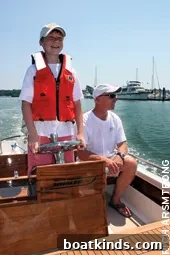
You can buy a kit with all the mahogany needed to replace the wood on an older 13-foot Boston Whaler, but Crenier had something different in mind for his 1984 model. He wanted the small Whaler to echo the color palette and wood type of his Sabre 38 — a classic New England-style express with a pilothouse and generous brightwork.
“I wanted the Sabre to have a ‘mini-me’ of itself,” says Crenier, 54, of Hingham, Massachusetts, referencing Dr. Evil’s sidekick from the Austin Powers films. “I wanted it to look very yachty, for lack of a better term, and different from the old Whalers.”
He also insisted on top-quality components throughout the refit. “The boat is going to be in the family for the rest of its life,” Crenier explains. “It’s going to be a family heirloom. I want to pass it down to my children and have them treat it as a project to hand on to their kids.”
Crenier’s project shows two big advantages of restoring an older boat: you can customize it to your tastes and you have more control over spending — even if that control can be optimistic. Owners who refit boats frequently find the budget growing beyond initial estimates, and Crenier admits he wasn’t immune to that. “I completely went over budget,” he says. “My wife will slap me around a little bit, but this is what we do. It is a disease one has.”
The final tab was far higher than his purchase price: Crenier bought the Whaler for $2,100 and spent roughly $13,000 on upgrades. “I’m a nurse, and the joke was I was going to have to take on more shifts to pay for this,” his wife, Linda Crenier, says. “Yes, he did go over budget, but he hides those bills, so I don’t know by how much.”
Beyond replacing all the wood, Crenier swapped the original 40-hp 1984 Johnson for a new Evinrude E-TEC 40-hp with electronic fuel injection, installed a custom fuel tank, had much of the hardware rechromed, replaced the steering system, and added a stainless-steel steering wheel and knob from a known marine parts supplier. He and his son also handled significant bodywork themselves.
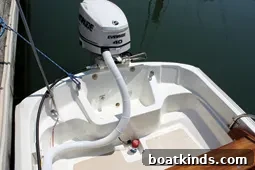
Peter and his 13-year-old son, John, ground the hull and other surfaces to remove stress cracks, and they used resin and fiberglass to repair dozens of fastener holes, chips and gashes. They even repaired a 3-inch hole in the starboard side. A friend and professional painter then applied an Awlgrip finish in the same oyster-white color as his Sabre, with Jeff Perette supervising the father-and-son team and completing all fiberglass finishing and fairing. The Creniers assisted with the painting as well.
“Peter and John wanted to really get into the project with their hands,” says Perette, 29, who recently launched East Coast Fiberglass in Marshfield, Massachusetts. Perette, who has been spraying Awlgrip since his early twenties, let the Creniers prime the boat themselves. “So I said, I’ll put the gun in your hand and you can prime the boat. Peter is a businessman, a shirt-and-tie guy. You put a grinder in his hands and he starts sweating.”
Crenier works as a senior vice president for a company that supplies technology to the investment industry. He has a strong sailing background and has raced a Frers 33 in Europe and around the U.S. “I raced all over the U.S. on the East and West coast,” he says, recounting a lifetime around boats that began in California and Hawaii before moving east.
‘Stuck in my mind’
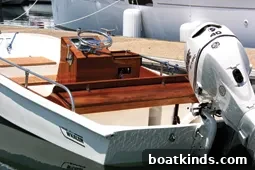
Crenier and his son weren’t shy about the hard work; Perette performed the final priming before the Awlgrip finish and used Awlgrip to paint the non-skid in a dark mustard-tan color that matches the Sabre. Perette wanted the Whaler ready for display at the New England Boat Show and enlisted Crenier’s help preparing it. “The response we got from people at the show was spectacular,” Crenier says. “Some didn’t even realize it was a Whaler or a retrofitted Whaler but a great-looking and unique boat.” That reaction was exactly what he hoped for.
“The boat looks awesome and it was a show-stopper,” Perette adds. “I am really stoked about how it turned out. It’s a great little boat. And it’s different — the colors are different.”
Getting the boat ready for the show proved the toughest phase. “I spent a couple weekends down there at Jeff’s shop when we were getting close to the show,” Crenier recalls. “I would be up until 4 a.m. It was stressful because a part would not come in when expected and you would lose a day of work. It was a rush, but tough.”
But the hardest part had a big reward: time with his son. “We would drive to Jeff’s shop; we would go to lunch,” Crenier says. “We worked until 4 or 5 p.m. and headed home. John actually was able to do the work and see what it entailed and we were just together.” The family also includes two adult daughters, Beth, 27, and Kate, 23.
The Whaler will be used for easygoing family time — water skiing, gunkholing and short runs near shore. “This isn’t the boat I would take out into the bay in 5-foot waves,” Crenier notes. “There is a lot to do within a short distance.” His son will use the Whaler to commute to a summer job at the local yacht club, though Peter jokingly warns, “If he even scratches it, I will cut off his left arm.”
Crenier found the Whaler on Craigslist in September 2011 and started the refit with John the following month, launching the boat in May. A friend’s retrofitted Whaler had planted the seed: the image of that highly varnished, teak-trimmed craft “stuck in my mind” and inspired him to look for a project boat. After checking Whalers across three states and inspecting about ten boats, they found a suitable two-owner example only two towns away.
Before trailering the Whaler to East Coast Fiberglass, Crenier sold the old engine and woodwork and stripped the bottom paint. The boat’s foam-filled hull contained no water, so no major structural repairs were needed. “When you have a good foundation to start with, the finished product is going to be that much better,” Perette says. He used a moisture meter to check the hull and weighed the boat, finding it close to the original weight of roughly 330 pounds.
Although dry, the boat needed attention. “I would say it was in fair condition, but fair condition in the 1984 Whaler vernacular is pretty good,” Crenier says. Many Whalers he’d seen were waterlogged or had severe cracking, patched poorly over the years. “You wouldn’t believe what people put on Whalers. Some of these boats looked like Swiss cheese.”
Teak-nically perfect
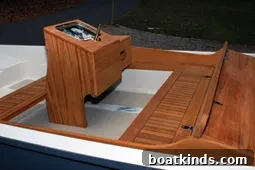
The woodwork became its own significant phase of the restoration. Crenier wanted true teak rather than a mahogany kit, and he hired Michael Ide of Ide Woodcrafts in Hingham, Massachusetts. Ide, a furniture maker who also does marine carpentry, based his design on the teak work from Crenier’s friend’s boat.
Using all teak increased costs, but Crenier wanted a first-class result. Ide spent roughly 45 hours on the boat, crafting joints without screws — dovetailing pieces like fine furniture for strength and longevity. “Peter wanted to do this first-class,” Ide says. “He wanted everything right and everything had to be perfect. And I think ultimately it was.”
For the tops of the anchor locker and the forward and aft bench seats, Crenier selected pre-manufactured teak decking from a specialist that produces modular teak deck kits. The company uses teak with a rubber-black seam compound instead of holly, and supplies adhesive and caulking for installation. Perette finished the teak with one layer of Epifanes varnish followed by three coats of Awlgrip Clear, producing a durable, high-gloss finish that Crenier says eliminates the need for annual varnishing.
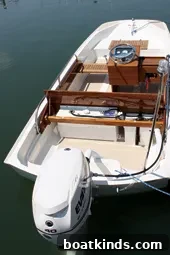
The finished woodwork immediately draws the eye. Bench seats span the boat’s 5-foot, 5-inch beam fore and aft of the starboard-side console. The aft bench includes a hinged backrest that lifts to reveal storage, and another compartment opens from the aft side of the backrest. The helm sports a carbon-fiber faceplate for key and switchgear, teak fiddles, a gauge cluster recessed behind UV-protected glass, and a stainless-steel frame. Stainless rails at midships provide security, while the console companion extends to the starboard gunwale.
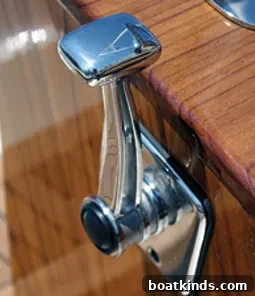
Crenier mounted the shift/throttle on the inboard side of the console. “No, I am not left-handed,” he jokes. “We just didn’t have a good spot for it on the starboard side.”
Like any project, the restoration wasn’t flawless — but the overall transformation produced a distinct, high-quality small boat that reflects its owner’s larger vessel and the family-focused intentions behind it.
This article originally appeared in the September 2012 issue.