
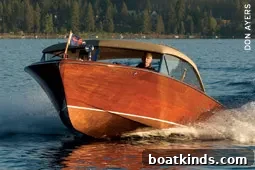
Editor’s note: The Tahoe Concours d’Elegance and Wooden Boat Week in Tahoe City, California, gathers roughly 100 impeccably restored classic wooden boats. While professional restorations often take the top awards, a remarkable exception came when Jack Bingham’s self-restored 1956 26-foot Chris‑Craft Continental Sedan won Overall Best of Show, First in Class, Best Non‑Professional Restoration, and Best Chris‑Craft of Show. “The little guy can still win big at this elite show,” says Bingham, 72, a retired airline pilot from Rio Vista, California. Below is Bingham’s firsthand account of restoring his boat.
By Jack E. Bingham
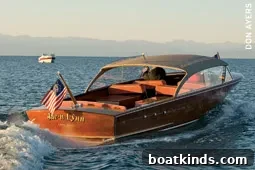
The Chris‑Craft Continental line represents the high-water mark of postwar wooden utility boats, evolving from simple dayboats into luxurious, well-appointed sedans. In 1956 Chris‑Craft stretched the Continental platform to 26 feet, producing the largest and most costly utility model the company offered at the time. Only 80 hulls of the 26‑foot Continentals were built between 1955 and 1959. Today, very few survive; to my knowledge only seven remain, three of them sedans. My wife, Lynda, and I own hull No. CL‑26‑027—our Jac‑N‑Lynn—a boat that has become very special to us.
Jac‑N‑Lynn was originally delivered on April 17, 1956, to Lee Craft Boats in Flathead, Montana. The original equipment list was modest by modern standards: a 20‑pound Navy anchor, 25 feet of manila line, one gallon of 30‑weight oil, and two J‑8 spark plugs. More importantly, she was fitted with twin MCL inboard engines rated at 175 hp each, capable of propelling the Continental to about 40 mph, along with a full canvas cover, sedan hardtop, ventilating windshields and side windows, a spotlight, and a windshield wiper. The boat remained in Montana until a Lake Tahoe family purchased her in 1975 for use on the clear mountain lake. We brought Jac‑N‑Lynn into our ownership in 2005.
This restoration was my third major project after completing an 18‑foot Chris‑Craft Utility and a 22‑foot Chris‑Craft Sedan; I first learned about building and finishing boats in high school assembling 14‑ and 16‑foot kit boats. For the Jac‑N‑Lynn project I kept a daily log and photographed every stage. Because I’m retired, I worked intensively—about 60 hours a week—for roughly ten months to complete the restoration.
Work began by stripping all deck hardware and sending it out for rechroming and polishing. I removed the hardtop and had its canvas redone with modern vinyl convertible‑top material; the wood and metal framing of the top remained structurally sound. The engines were not the originals, but they were new rebuilt 1956 MCL 175‑hp units; I pulled them for inspection and attention and had the original 50‑gallon steel fuel tank professionally cleaned.
With the interior out, I recruited a half‑dozen colleagues from the boatyard where I was renting space to assist in lifting the hull with a Travelift and carefully turning it upside down. Removing all bottom planks revealed an encouraging discovery: essentially no dry rot. However, both inner and outer mahogany planking had shrunk over the decades, and the boat did not float properly when we first acquired her. Chris‑Craft recommended re‑bottoming every six years in that era, and this hull had evidently never received that service. The bottom was the most laborious portion of the restoration; once planked, we fiberglassed the bottom to reduce future maintenance needs.
After painting the bottom with the original copper‑bronze paint, we righted the boat and tackled the hull sides. Many people assume an old wooden hull will require wholesale plank replacement, but I was able to save every plank except one fractured side plank—likely damaged in some kind of collision. That single replacement still kept the restoration within Antique & Classic Boat Society guidelines for preservation. I removed and refurbished the transom and reinstalled it.
By contrast, the interior was in remarkably good condition. Limited use and covered moorings had protected the upholstery and interior woodwork; a thorough cleaning and careful detailing made the cabin show‑ready. The decking was the final major step: after cleaning and reinstalling it, I stained the blonde wood layers first, then the red mahogany, applying two coats of stain to each. Between sanding and sealing, I applied 14 coats of Pettit Z Spar varnish to achieve a deep, mirror‑like “piano” finish.
With the hull and interior finished, we reinstalled the engines, the cleaned fuel tank, prop shafts and props, and all mechanical hardware, including the steering components. I repainted the generator and starters black for a neat, consistent appearance. Fortunately, when we relaunched Jac‑N‑Lynn, everything worked as intended.
The restoration required roughly $25,000 in parts and materials and the equivalent of many hundreds of hours of my labor. Outsourcing the entire job would likely have cost around $125,000—roughly the current market value were I to sell. But Jac‑N‑Lynn is not for sale; she’s a keeper, and we plan to enjoy her on Tahoe for years to come.
Related articles (titles only): “Classic Summer” and “Showtime.”
This article originally appeared in the June 2009 issue.