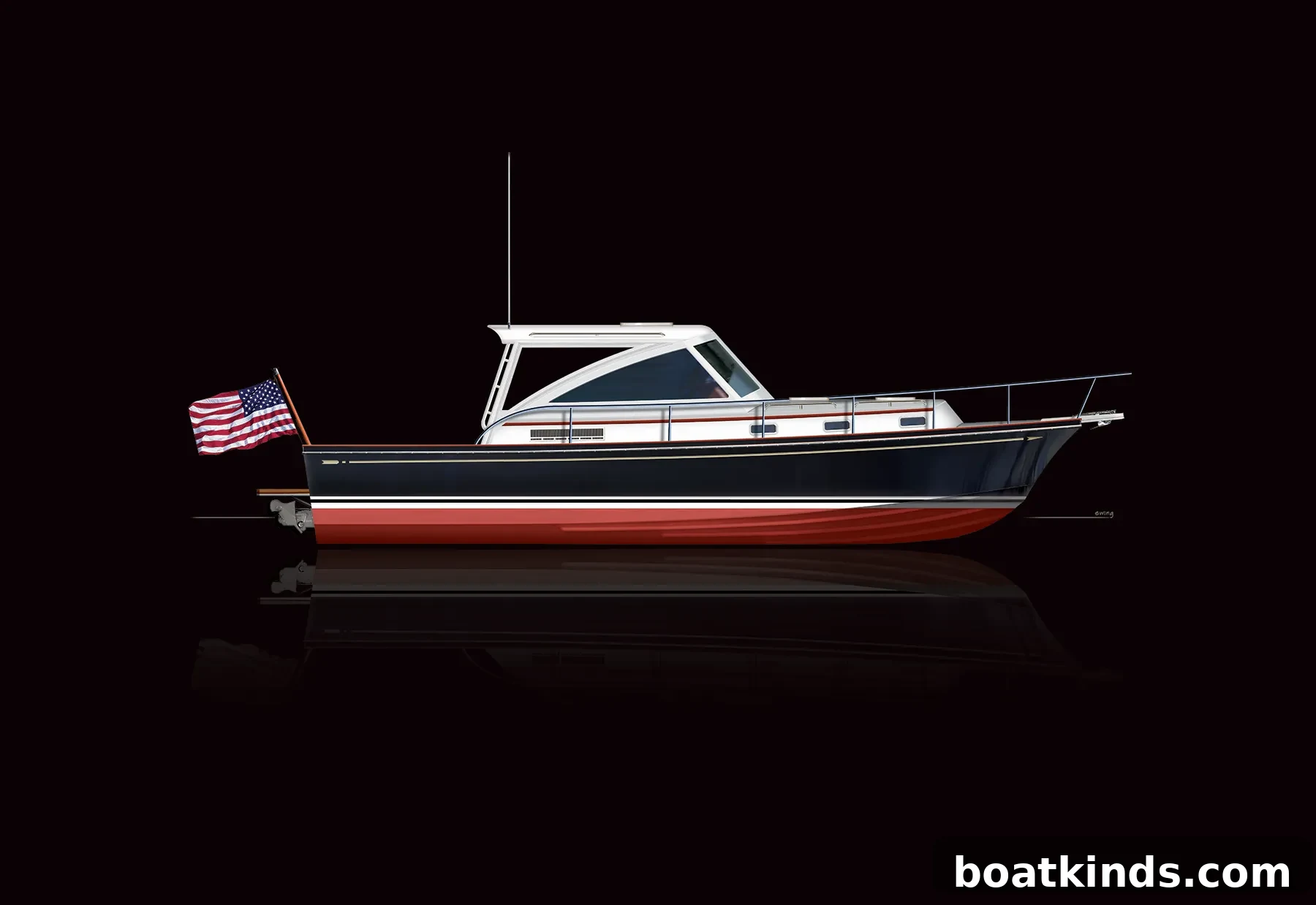
Ted Hood’s WhisperJet 38: A Waterjet-Powered Downeast Cruiser Reimagined
Ted Hood was already recognized as one of the sailing world’s most inventive minds when he turned his attention to powerboat design. Best known for rethinking sails, sailcloth and hull lines—and for helming the 12 Meter Courageous during the successful defense of the 1974 America’s Cup—Hood brought the same rigorous design approach to a Downeast-style cruising yacht powered by waterjets. After decades of building and racing sailboats, he moved into powerboat design in the 1990s, applying lessons learned from a lifetime on the water to create something distinct in the powerboat market.
Origins and Design Lineage
The WhisperJet grew from a proven deep-V sportfishing hull developed by Ray Hunt for the Luhrs Marine Group and later known as the Black Watch 30 (1986). Hood adapted that hull form for cruising use under the Little Harbor and Ted Hood Company banners, with guidance from Ray Hunt Design. As Winn Willard of Ray Hunt Design noted, Hood’s focus leaned more toward comfortable, seaworthy cruising than sportfishing, and that intention shaped the project from the start.
Hull Form and Underwater Design
Hood extended Hunt’s deep-V geometry across a range of four twin-diesel, waterjet-powered models from 36 to 52 feet, with the WhisperJet 38 occupying the midrange. The 38 features a well-raked stem and pronounced forward flare designed to run dry and soft in head seas, reducing spray and increasing comfort in offshore conditions. A series of three pairs of lifting strakes and long planing runs carry stern flow to a relatively flat running surface aft, finishing with about 17 degrees of deadrise at the transom—an arrangement that balances seakeeping, ride comfort and planing performance.
Hood experimented with chine shapes to refine both noise and lift characteristics. Early versions included hollowed chines to reduce slapping at anchor, while later restorations returned to flatter chines aft to enhance planing lift and directional control. Those subtle hull tweaks demonstrate Hood’s iterative approach—testing, modifying and optimizing the underwater profile for real-world use.
Construction and Materials
To keep weight down while retaining strength and impact resistance, the WhisperJet 38 used a hybrid Kevlar reinforcement in the hull laminate. Closed-cell coring in the hull and deck added stiffness and buoyancy while helping to prevent water intrusion and rot. Deck layouts were kept unobstructed and practical, with welded stainless-steel handrails providing secure movement and safe line handling when anchoring or docking.
Propulsion, Performance and Shallow-Water Capability
The WhisperJet 38 was designed around Hamilton waterjet drives paired with twin Yanmar diesel engines, available in configurations such as 330-hp or 440-hp per engine. This propulsion choice allowed the boat to cruise comfortably in the high-20-knot range with top speeds into the low 30s, depending on engine selection and load. More importantly for many coastal cruisers, the waterjet system produced a very shallow draft—maximum depth reported at just 1 foot, 10 inches—because there is no exposed running gear beneath the hull. That feature opens access to shallow bays, tidal flats and areas cluttered with buoy markers or lobster and crab gear that would be off-limits to prop-driven boats.
Deck Layout and Practical Cruising Features
Hood’s design emphasized hands-on seamanship and comfort. The slightly cambered foredeck and cabin trunk ensured efficient water runoff, while unobstructed side decks and substantial handrails improved safety when moving forward or handling ground tackle. The combination of a dry-running bow, strong construction and thoughtful deck ergonomics made the WhisperJet 38 equally capable for short coastal hops, day trips or extended cruising in variable conditions.
By applying proven deep-V hull concepts to a waterjet-driven Downeast-style cruiser, Ted Hood created a boat that blended offshore capability, shallow-water versatility and refined build quality. The WhisperJet 38 reflects his habit of rethinking conventional solutions—taking established ideas and refining them to suit a specific, practical mission on the water.
This article was originally published in the February 2024 issue.