
Essential Sea Trial Checklist for Buying a Boat
Conducting a thorough sea trial is one of the most important steps when buying a new or used boat. When done properly, a sea trial provides the data you need to buy with confidence or to decide to walk away. Done poorly, it can leave you with a boat that doesn’t fit your needs or the conditions you’ll be running in.
A good sea trial requires active, observant participation. It is not just a leisurely ride — there’s a method and sequence to follow. The checklist below outlines the most important items to test and observe, and explains how to record the results so you can analyze them afterward.
Before you go out, prepare a printable checklist or notebook with plenty of space to write legible notes. Take photos during the trial and write clarifying captions so the pictures are useful later. Writing up your observations soon after the trial helps clarify strengths and weaknesses, even if your boat knowledge is still developing.
Preparing for the Sea Trial
Bring these basic tools to collect objective data and document what you see and hear:
- Handheld GPS to record true speed and distances.
- Stopwatch to time turns and maneuvers.
- Sound-level meter to measure interior and cockpit noise.
- Small digital camera to photograph gauges, visibility, heel angle, wake, and any issues.
- Notebook or pre-printed checklist to record observations and measurements.
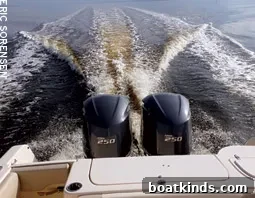
Photos are especially valuable for recording heel angle in hard turns, semiplaning inception, and the effect of trim devices on speed and visibility. To capture heel, include the horizon in your shot and measure the angle at home. Take successive photos of the GPS, tachometer and wake at different RPMs to document performance accurately.
Try to run the trial in realistic conditions — windy and choppy if that’s what you expect to encounter. If the boat is lightly loaded, freshly cleaned, or has near-empty tanks, be sure to adjust your speed and range expectations for a fully loaded, in-service vessel. Aerodynamic drag from towers, canvas enclosures or side curtains also reduces real-world speed, especially into wind.
Helm Station
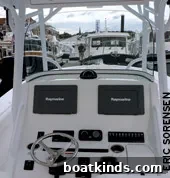
- Are instruments and controls within reach and properly angled for both standing and seated positions?
- Can you read gauges and displays in bright sunlight?
- Is the systems-monitoring console easy to scan and understand?
- Can the fire-suppression system be monitored and activated from the helm?
- Do the engine-shift controls and throttles operate smoothly and hold set positions?
- Can you comfortably drive with one hand on the wheel and the other on the engine controls?
- Are trim-tab controls and tab-angle indicators located near the throttles?
- Is the steering responsive, with an appropriate number of turns lock-to-lock for the boat’s speed?
Visibility
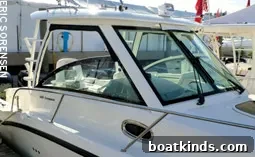
- Do windshield mullions, arches or curtains create obstructions wider than a few inches?
- Do you lose sight of the horizon when the bow rises to get on plane?
- How close to the bow can you see water while seated at the helm?
- Does any deckhouse or arch block critical sightlines, reducing situational awareness?
- Is visibility adequate for docking, backing into slips, and communicating with deckhands?
- At night, do helm lights or glossy surfaces cause glare that interferes with night vision?
- Do windshield wipers and washers clear the area you look through effectively?
Performance, Ride and Handling
- Does the boat track well in following and quartering seas with minimal helm correction?
- Does it accelerate and slow down smoothly through waves, or does speed fluctuate excessively?
- Is the ride seakindly, without sharp snapping or deep rolling?
- Do trim tabs or interceptors help the boat get on plane promptly, and do they cause undesirable bow drop on following seas?
- For multi-engine boats, test speed and cooling on a single-engine run.
- Use reciprocal runs to average speed into and with a current to record realistic performance at various RPMs.
- Determine semiplaning inception speed by observing wake and RPMs; note the clean-wake speed for comparison.
- At what speed does pounding or shuddering begin? Compare this to typical expectations for boats of similar size.
- Have someone else do hard rudder turns while you observe body balance; a true, balanced turn indicates better passenger comfort and safety.
Controllability
- On a twin-engine boat, does it turn equally well in both directions? Time 720-degree turns in each direction for comparison.
- Is steering responsive enough for tight harbor maneuvers, and can you dock without excessive reliance on thrusters?
- Can you back down with control, including backing into wind or current?
- If equipped, does a bow thruster work effectively in crosswinds or currents?
- Do engines shift smoothly at idle, and can the boat crawl slowly when clutched in at idle?
- Do trim tabs correct heel and list promptly at speed, and are they sized appropriately to control speed and steer the bow when needed?
- With one engine shut down, can you still turn reliably toward the running engine?
Noise, Vibration and Comfort
- Measure noise levels at cruising speed. Interior levels in the low 70s dBA are ideal; low 80s dBA is acceptable for shorter runs.
- Is there enough room to move comfortably beside someone seated at the helm?
- Are vibration levels around the cockpit or aft deck excessive, which may indicate propeller or shaft issues?
Anchoring and Deck Operations
- Test the windlass operation and visibility to the bow from the helm. Can you communicate with crew at the anchor?
- Can the anchor deploy from its chute by gravity and hold when you back down at high idle?
- Is there adequate rode and chain storage with washdown capability, and can the anchor be secured underway?
- Divide rode length by six (adjust for chain) to estimate appropriate maximum anchoring depth based on your gear and conditions.
On Deck and Cockpit
- Do rails, side-deck width and non-skid provide secure movement forward?
- Are bow rails sufficiently high and robust for safety when leaning against them?
- Is centerline access to the foredeck safe, with steps and handholds where needed?
- Are cleats adequate in number and size, positioned to avoid chafe and needless line runs through hawse holes?
- Can you reach stern cleats from the cockpit without awkward trips to the swim platform?
- Can a boarding ladder be deployed from the water so a single person can re-board?
- Does engine exhaust get drawn into the cockpit at speed? Are exhaust noise levels acceptable?
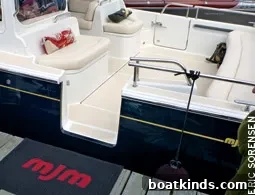
- Is the cockpit layout safe to move around at cruising speed, with secure coamings, handholds and practical transom doors?
- Is access to the flybridge safe, and are bridge rails tall enough for passenger safety?
- Is seating adequate for your needs?
Interior
- Do cabinet doors and drawers stay securely closed in rough water?
- Do hatches, doors or components rattle under way?
- Is the stereo and other accommodations usable at cruising speed?
- Is at least one cabin hatch wide enough for emergency egress, and is there a step or berth to assist climbing through it?
- Are grab bars and overhead rails provided in the saloon and cabin for safety?
A sea trial is a practical, hands-on evaluation of systems, performance and safety. Use it to find reasons to buy or reject a boat. Don’t be swayed solely by cosmetics — prioritize systems, handling and safety for you and your passengers. Bring this checklist, gather objective measurements, take lots of photos with clarifying notes, and write up your impressions promptly after the run. That process will help you identify the boat that best fits your needs and the conditions you’ll be running in.
About the author: Eric Sorensen is a consultant to boat and ship builders, owners, and government clients. He was the founding director of the J.D. Power and Associates marine practice and is the author of a guide to evaluating powerboats. He can be contacted through his website.
This article originally appeared in the April 2012 issue.