
Michael Peters Yacht Design
Michael Peters is an internationally recognized yacht designer. His firm, Michael Peters Yacht Design, based in Sarasota, Florida, has produced designs for more than 350 vessels ranging from 20 to 160 feet. Peters’ portfolio spans race boats, luxury yachts, rugged fishing boats and high-performance sportboats, establishing his reputation across both recreational and competitive marine markets.

Peters began building boats as a teenager while spending summers on Catalina Island, California. He drew his first design — an 8-foot sailing dinghy named Miss Take — at age 14. Five years later he designed Maelstrom, a 19-foot stepped-hull deep-vee powerboat, which launched his career as a professional designer.
Throughout his career, race-boat technologies and lessons have informed many of Peters’ pleasure-boat designs. He has created striking custom yachts and efficient sportboats, including the Alpha-Z, a mahogany runabout capable of 95 mph. Prominent builders such as Cabo, Hinckley and Sea Ray have engaged his firm, and he played a major role in rebranding Chris-Craft, helping restore the company’s classic, retro aesthetic. In his off hours Peters and his family cruise the Intracoastal Waterway aboard a rebuilt 25-foot 1971 Bertram.
Q: What race-boat characteristics do you often carry over into pleasure boats?
A: Historically, innovations from racing flowed into recreational boats — the deep-vee hull being a prime example. More recently, catamaran technologies and stepped hull concepts from racing have influenced center consoles and high-performance hulls. We’ve also advanced structural design and weight reduction, moving from traditional wood and aluminum construction to modern composites. One notable example is our work that influenced the Invincible series: 33- and 36-foot center consoles for the kingfish tournament circuit that use a twin-stepped hull with a small tunnel to improve performance and efficiency.
Q: You describe your approach as combining art and science. How does that show up in your work?
A: Boat design demands both artistic sensibility and a solid foundation in naval architecture. Aesthetics and visual appeal matter, but so do proven engineering principles. Too many young designers today rely solely on 3-D modeling and the initial “wow” factor without grounding their work in fundamental hydrodynamics and structure. Our studio focuses on excellence in both styling and technical performance — which is why we’ve been recognized for awards in both areas.
Q: Which project challenged you the most?
A: I’m most intrigued by projects that push me into unfamiliar territory. Those require rigorous research, revisiting past solutions and careful testing. Recently we worked on a large motoryacht that combined diesel-electric propulsion with Voith Schneider drives; every subsystem on that boat required fresh investigation. Another demanding project was Plumduff, a 71-foot motoryacht built about a decade ago. It featured a cold-molded wooden hull, a fiberglass superstructure, and a mahogany overlay — a blend of materials that posed complex construction and aesthetic challenges. We were fortunate to work with an excellent builder, Admiral Marine, to realize that vision.
Q: Which client or company has had the greatest impact on your career?
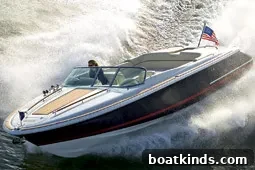
A: Rebranding Chris-Craft stands out. The company had a long history but needed a refreshed identity and consistent design language. Winning the brief to reestablish Chris-Craft’s iconic character was hugely influential for us — you can clearly see the before-and-after transformation in the brand and its product line. Restoring that classic look while creating a unified image across the range was one of our most significant contributions to the industry.
Q: When you walk the docks at a boat show, what pleases you and what concerns you?
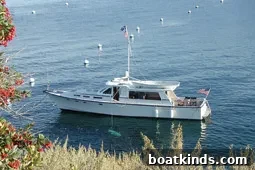
A: I’m drawn to clean, simple, understated designs and often prefer traditional proportions over fleeting trends. What troubles me are designs driven primarily by marketing rather than seamanship — boats that prioritize maximum interior volume and headroom at the expense of practical handling. My family jokingly calls some of these “pregnant boats” because they look inflated to create more space. I’m also concerned when styling overrides sound naval architecture, such as poorly executed stepped hulls or full, plum bows on high-speed boats. Those choices can create unsafe or poor-performing boats when they ignore established hydrodynamic behavior.
Q: How do you see boats evolving over the next 50 years?
A: Surprisingly, I expect continuity more than radical change. Boaters tend to return to conservative, proven designs after experimenting with extremes. While designers will explore spaceship-like shapes and bold concepts, practical, traditional forms will endure. Innovations will likely be incremental — cleaner integration of new propulsion systems, materials and efficiency improvements — rather than wholesale stylistic revolutions.
Q: What projects are you working on now?
A: Our current projects are varied. We’re collaborating with a major defense contractor on a Navy project, developing a larger version of the Invincible stepped-hull center console, designing a custom 55-foot RIB for a Mediterranean client, and advancing the Echo 45 — a concept focused on fuel efficiency and quiet propulsion. After years of demonstrating high-speed performance, we’re increasingly committed to showing how well boats can perform at slow speeds with minimal environmental impact.
Q: With volatile fuel prices and a focus on efficiency, will deep-vee hulls give way to modified-vee forms?
A: Simply flattening the stern to reduce deadrise has trade-offs. A flatter stern can plane earlier, but historically the deep-vee evolved for reasons beyond rough-water handling: hull entry, tracking and safety in stern-quartering seas matter. Reducing deadrise too far can cause poor tracking and unpredictable behavior. Over the past 25 years deadrise angles have moderated — the classic 24-degree deep-vee is now often 18–20 degrees — but extreme reductions to 6–8 degrees are generally not a good solution. Designers should focus on weight, balance and hull efficiency rather than only altering bottom geometry to chase fuel savings.
Q: Is there a boat you’d like to own from your past designs?
A: One that I’ve long admired is a 48-foot ULDB (ultra-light displacement boat) I designed in 1986 for George Griffith. With an 11-foot beam and about 14,000 pounds displacement, it cruises efficiently: with twin 145-hp diesel engines it can run 26 knots and produces minimal wake at 18–20 knots — ideal for the Intracoastal Waterway. George still cherishes and uses the boat; he’s 88 and devoted to its upkeep, so I’m still waiting for my chance to own it.
This article originally appeared in the July 2009 issue.