Mark Richards — Founder and CEO of Palm Beach Motor Yachts
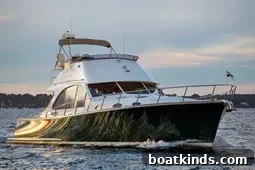
Mark Richards is the founder, president and CEO of Palm Beach Motor Yachts. A renowned figure in both the sailing and powerboat communities, Richards recently showcased two models at the Fort Lauderdale International Boat Show: the Palm Beach 55 Flybridge and the new Palm Beach 45.
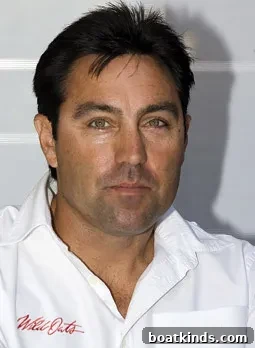
At 46, Richards is equally recognized as the skipper of the six-time Sydney–Hobart race winner Wild Oats XI and as a highly regarded yacht designer and builder. He led Australia to victory in the Admiral’s Cup in 2003 and has competed in two America’s Cup campaigns. In 1995 he sailed on oneAustralia in the Louis Vuitton Cup, a state-of-the-art International America’s Cup Class yacht that tragically broke in two off San Diego — an extreme example of the engineering risks inherent to top-level yacht racing.
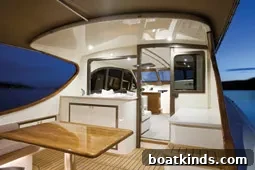
Following that era, Richards founded Palm Beach Motor Yachts in 1995 and transitioned his experience into powerboat design, debuting the Palm Beach 38 in 1999. To date he has overseen the construction of 87 powerboats ranging from 32 to 65 feet. His company, staffed by 65 employees, focuses on crafting elegant, traditionally styled motor yachts that marry aesthetics with practical engineering.
Palm Beach Motor Yachts has earned industry recognition, winning Best New Powerboat at the Newport International Boat Show for two consecutive years with the PB 50 and PB 55. Richards attributes his success to a lifetime of boating, the early support of his adoptive parents, and growing up around Pittwater in the Palm Beach area of Australia, where he began learning to sail at age six and later ran the launch at his local yacht club. He currently resides in Sydney, Australia.
From Racing to Powerboat Design
Q: Has your sailing background influenced your approach to powerboat building?
A: Absolutely. Although sail and powerboat design are different disciplines, the sailing world taught me crucial lessons about loads, weight savings and weight distribution. Racing requires pushing structures to extremes, so you learn to eliminate unnecessary weight and position mass so the boat sits and performs exactly as intended. Many builders shuffle tank locations to correct a list; we focus on getting the balance right from the outset so each boat we launch floats correctly and predictably.
Reflections on High-Profile Failures
Q: How do you view the oneAustralia sinking after two decades?
A: I don’t dwell on it unless asked. The America’s Cup pushes engineering limits, and sometimes things go wrong. Those failures become part of your education — they teach you what not to do and make you determined to avoid repeating the same mistakes.
Early Years and Restoration Projects
Q: When did you begin building boats?
A: From about 15 to 20 years old I was buying old launches, trawlers and oyster tugs, refitting them and selling them to move up to larger projects. It was hands-on learning and the start of my passion for converting working vessels into pleasure craft.
Q: Do you have a favorite restoration?
A: We restored a 31-foot oyster tug called the Kingfisher. It was a classic vessel with great character — a genuine old ship that was a lot of fun to bring back to life.
Q: Do you personally design every Palm Beach boat?
A: I collaborate closely with a naval architect who has been with us for years and handles hull-form engineering. I lead the aesthetics, layout and interior design and am involved in every detail of each boat, ensuring the final product aligns with our design intent.
Design Philosophy and Future Models
Q: How do you see your yachts evolving over the next decade?
A: Exteriors will remain timeless — our profile is classic and I don’t expect major changes to that. On the construction side we keep designs straightforward and avoid unnecessary complexity. Racing yachts need high-tech solutions; our motor yachts benefit more from simplicity and durability.
Q: What innovations do you expect to adopt?
A: Pod drives like Volvo Penta’s IPS are excellent in the right contexts and we offer both IPS and shaft-drive packages. My guiding principle is simplicity: lower maintenance and higher reliability. I’m cautious about rushing into new tech because rectifying mistakes is costly, and reliability is paramount for owners.
Q: What’s currently on your drawing board?
A: We are developing the Palm Beach 52 with walkaround side decks aimed at an older clientele. We are also building a 60-foot pilothouse designed for exceptional range — with efficiency that rivals much larger vessels — and the ability to cruise economically anywhere between 10 and 25 knots. That will rely on a warped-hull shape and advanced construction to keep weight low and performance high. The hull has been tank-tested and we’re confident in the results.
Warped-Hull Benefits and Construction Methods
Q: Why do you favor the warped-hull design?
A: For boats operating below 30 knots, a warped hull offers unmatched fuel efficiency. Unlike planing hulls that ride on top of the water, a warped hull is optimized to cut through the water with a shallower aft draft and efficient deadrise, delivering buoyancy and economical performance where most boats spend their time.
Q: What materials and methods do you use?
A: We use consistent, proven materials across all our models — glass and foam kits CNC-cut for precision. Boats are hand-laid; the centerline and penetrations are solid fiberglass while other areas are cored for weight savings. We favor proven construction techniques that produce strong, reliable results and often outperform more automated processes like infusion in our application.
Operations and Outlook
Q: Do you expect Palm Beach Motor Yachts to grow?
A: We currently employ 65 people and will maintain a stable workforce. We’ve been booked out for years and focus on consistent quality over rapid expansion. In uncertain economic times, steady operations and controlled growth help preserve quality and protect customers.
Q: How do you balance your passion for sailing and powerboating?
A: Sailing is my competitive passion — racing Wild Oats XI is exhilarating and we’ve achieved speeds above 40 knots. Powerboating is my recreational love: building beautiful, comfortable yachts and enjoying relaxed weekends on the water are hard to beat. Both disciplines fulfill different parts of my life.
Q: Any hobbies?
A: Boats, boats and more boats — it’s in the DNA.
January 2014 issue