
Raising the Mainsail: Ruth Montgomery and the Carrie Winslow
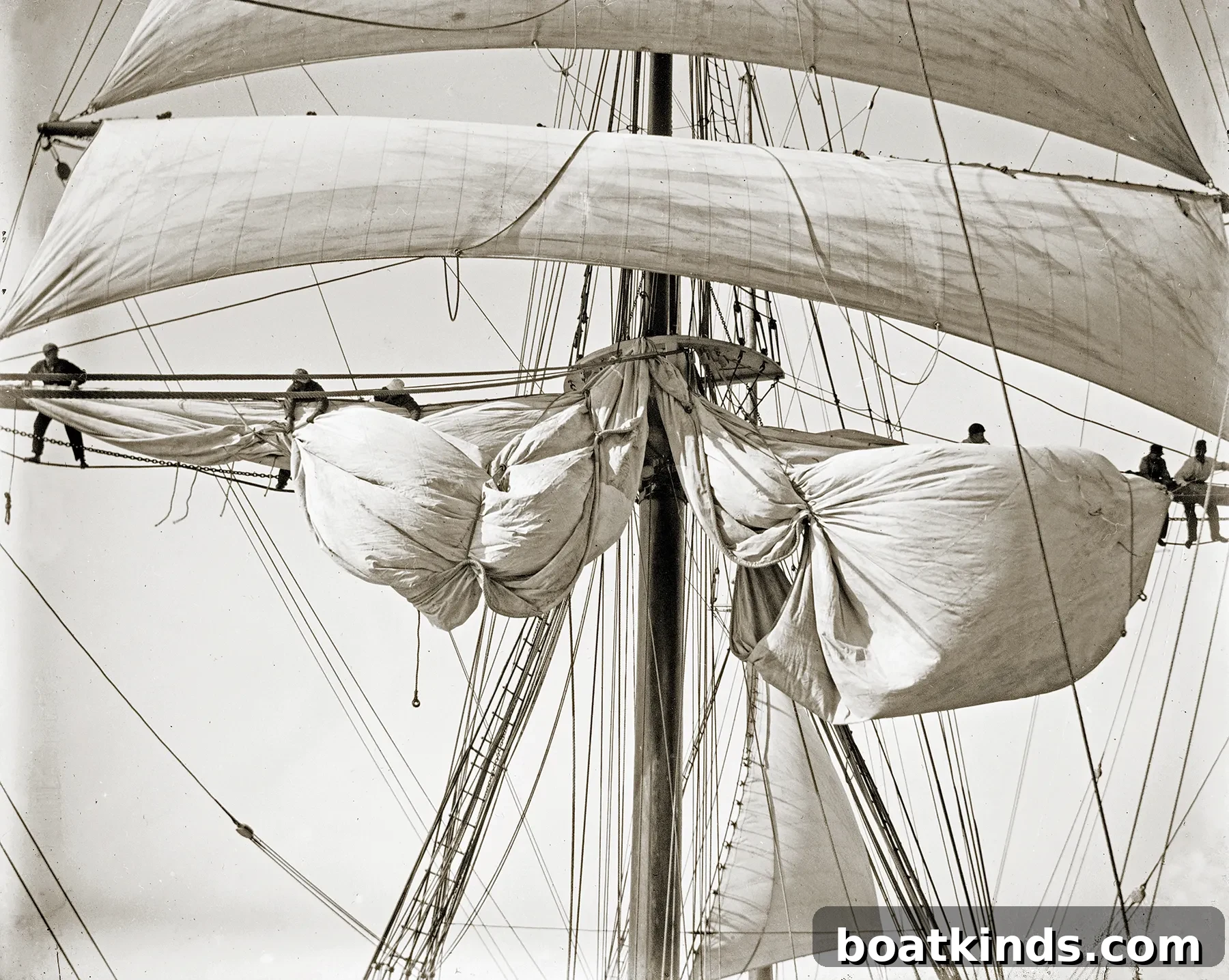
A new mainsail is being raised aboard the bark Carrie Winslow in a remarkable photograph taken before the ship departed Portland, Maine, for Buenos Aires in 1903. The mast stands in silhouette against the bright sky, the lower mizzen just visible. The image, shot by Ruth Montgomery from the port rail with wind coming over the starboard side, captures half a dozen men clinging to the yard as they work to unfurl the sail. Considering the era—bulky cameras on tripods, fragile glass plates and slow shutter speeds—the photograph is extraordinary. Action photography on the rolling deck of a tall ship was difficult to achieve, making Montgomery’s composition and timing notable achievements in early maritime photography.
Early Life and Seafaring Beginnings
Ruth Montgomery was born in 1880 in East Boothbay, Maine, the daughter of Captain Adelbert Montgomery. She first went to sea at the age of five and returned to life aboard ship at 15, when her father assumed command of the Carrie Winslow and its Atlantic and South American routes. From that time she accompanied her father on every voyage, living the daily life of sailors and passengers on a working cargo bark. Her early and ongoing exposure to shipboard life informed both her eye and her choice of subjects.
Photography Aboard a Working Bark
Montgomery began taking photographs in her teens and amassed more than five hundred glass plate negatives while aboard the 173-foot Carrie Winslow. Her surviving work mainly documents three voyages—in 1899, 1901 and 1903—between Portland and Buenos Aires. Those images demonstrate a sophisticated understanding of light, shadow and the geometric forms of rigging and spars. She balanced documentary detail and artistic composition to give viewers a clear sense of the vessel’s structure, the crew at work and the rhythm of life at sea.
Subjects and Scenes
Much of Montgomery’s photography focused on daily life aboard the Carrie Winslow: shipmates at work, informal family moments, and the ship’s dog, Topsey. She also recorded scenes ashore during stops in Buenos Aires and Rosario, Argentina, offering a rare view of places visited by American merchant sailing vessels at the turn of the 20th century. Her images are both intimate and informative, providing historians and enthusiasts with visual evidence of seamanship, clothing, shipboard equipment and the social dimensions of sailing life.
Preservation and Legacy
The collection of Montgomery’s negatives and prints is now preserved by the Penobscot Marine Museum in Searsport, Maine. Those images are valued today not only for their historical content but for their technical accomplishment—capturing motion and atmosphere with equipment that required care and patience. Montgomery stopped taking photographs when her father retired from the sea around 1903; the family then moved to Boston, where she lived and worked for a time before returning to East Boothbay. She died in 1967 at the age of 87.
The Fate of the Carrie Winslow
Ten years after Montgomery’s last documented voyage on the bark, the Carrie Winslow was lost in a storm off Cape Hatteras in January 1913. Fortunately, all members of the crew were rescued. The photographs Montgomery made aboard the ship remain a poignant visual record of the vessel and its voyages, preserving the memory of a seafaring bark that might otherwise live only in written logs and registry entries.
Why These Images Matter
Ruth Montgomery’s work occupies an important place in maritime history and photography. Her glass plate negatives bridge personal recollection and public documentation, revealing the textures of life aboard a working ship while demonstrating technical skill under difficult conditions. For historians, sailors and anyone interested in the age of sail, her images provide primary visual testimony of a world that has since passed: the rigging and sails, the crew at work, and the everyday moments that defined life at sea.
This article was originally published in the August 2023 issue.