
Why Orcas Are Ramming Sailboats Near the Iberian Peninsula
Since about 2020, sailors around the Iberian Peninsula—including in the Strait of Gibraltar—have reported an unusual and worrying pattern: orcas approaching and ramming sailboats, frequently damaging or removing rudders. Attempts to deter these interactions have ranged from repainting hulls to blasting loud music, but so far those measures have provided little consistent protection. Recent research from the Bottlenose Dolphin Research Institute suggests a clearer explanation for the behavior and offers practical advice for boaters.
Bruno Díaz López, director of the Bottlenose Dolphin Research Institute, led a study that combined spatial distribution models with testimony from boaters to identify why these orcas target sailboats. Their results, published in the journal Ocean and Coastal Management, indicate that the orcas are not attacking boats out of aggression or confusion but are engaging in play-like behavior that helps juveniles practice the cooperative skills needed to hunt Atlantic bluefin tuna.
The research team found that this local orca population moves through a larger area than previously believed, concentrating in spring and summer around the Strait of Gibraltar but extending across a broader marine region. “The populations that we know around the world are highly specialized,” Díaz López explains. “They choose their prey. In Canada, for instance, it’s salmon. In this population, they are focused on the bluefin tuna. All their behavior and movements are linked to that species of fish.”
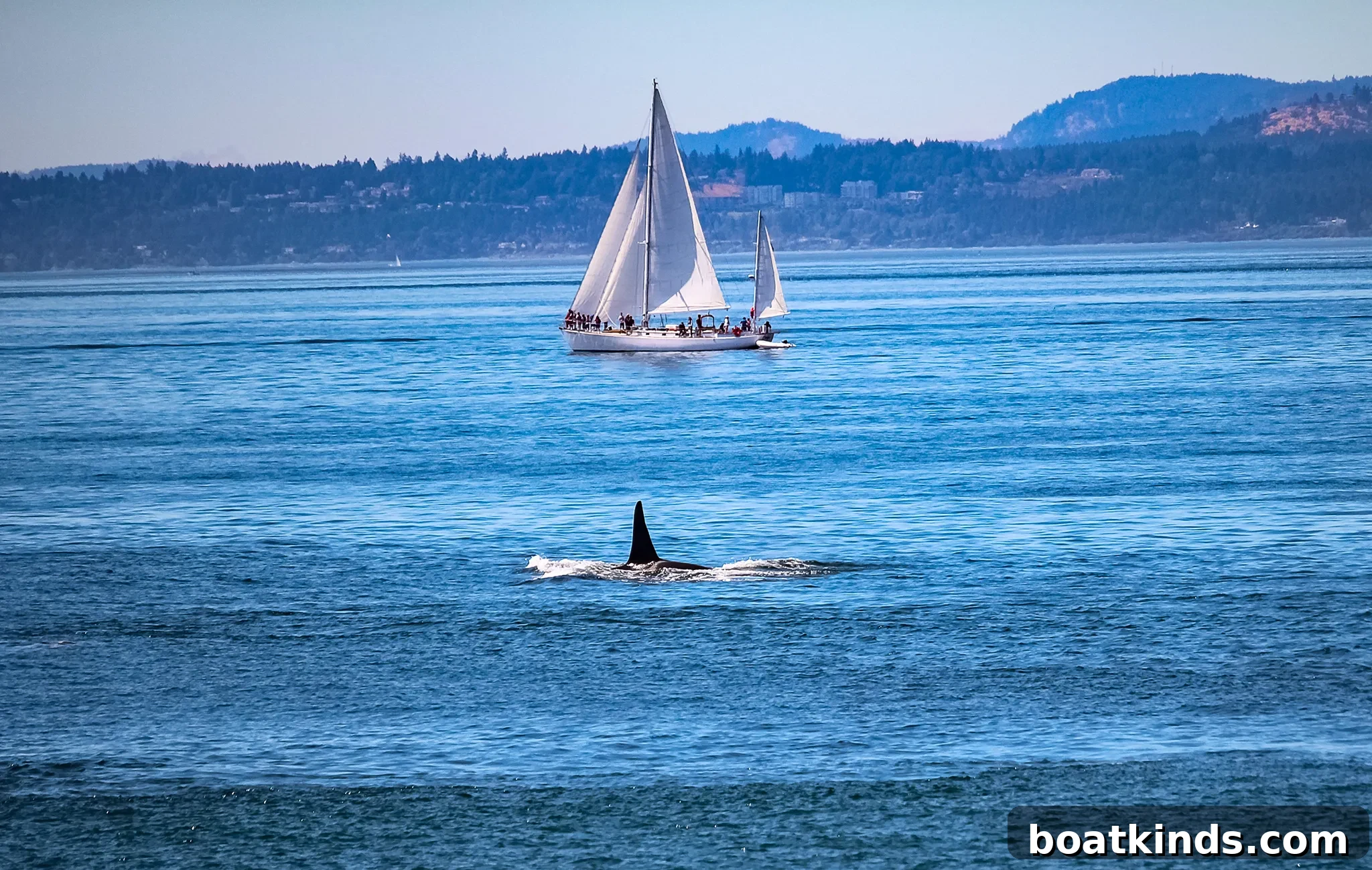
Interviews with sailors revealed a consistent detail: orcas were often targeting the rudders of sailboats. One sailor told CNN in 2023 that juveniles were biting the rudder while adults monitored nearby—an account that matched field observations of juvenile orcas practicing hunting behaviors. Díaz López and his colleagues concluded that juveniles use boats as proxies for tuna during play and training. The rudder’s size and softness on many sailboats make it an appealing target for these exercises.
There are clear parallels between the orcas’ practice behavior and their actual hunting technique. Atlantic bluefin tuna are extremely fast—capable of reaching roughly 40 knots—and they travel in schools. To capture a single tuna, orcas must coordinate and separate an individual from the group, a complex, cooperative tactic similar to how lions cooperate to catch gazelles on land. Practicing on a slow-moving, stable object such as a sailboat rudder allows juveniles to learn and refine those cooperative skills without the immediate demands of a real hunt.
Importantly, Díaz López stresses that the whales are not mistaking rudders for food. Rather, the interaction is akin to a terrestrial predator playing with a toy; the object is not consumed, but engaging with it builds necessary hunting skills. In the dataset he and his team reviewed—over 100 documented incidents—almost all attacks involved sailboat rudders rather than smaller motorboat rudders, supporting the idea that target size matters in these practice sessions.
Practical Advice for Boaters
Boaters hoping to prevent encounters with orcas might consider many options, but Díaz López advises caution about solutions that assume the orcas are simply after tuna detectable by standard fishfinders. Bluefin tuna are too quick and fleeting for that to be a reliable mitigation strategy. Instead, the most effective measures combine shared situational awareness and sensible route planning.
He recommends that sailors monitor social channels and maritime apps where local boaters report orca sightings. When boaters inform one another about orca locations, incidents have dropped because captains can avoid known areas of recent whale activity. “If you know they are in the area where you are sailing, be careful,” Díaz López says. He adds that these orcas tend to frequent waters deeper than 40 to 50 meters, so choosing shallower routes when feasible can reduce the chance of an encounter.
Other practical tips include treating orca alerts like weather checks: consult multiple information sources before and during a voyage. If you do spot orcas nearby, the recommended immediate action is to start the engine, lower the sails, and move away from the animals as quickly and safely as possible to minimize interaction. Avoid lingering, and give the whales plenty of space.
Above all, prevention by avoidance remains the best strategy. Slightly longer voyages or small route adjustments are a worthwhile trade-off for safety and reduced chance of damage to your vessel. With continued cooperation among local boaters and ongoing monitoring, sailors can significantly reduce the risk of encountering these fishing-practice interactions.
January 2025