
AC40 One-Design Class Enters Production
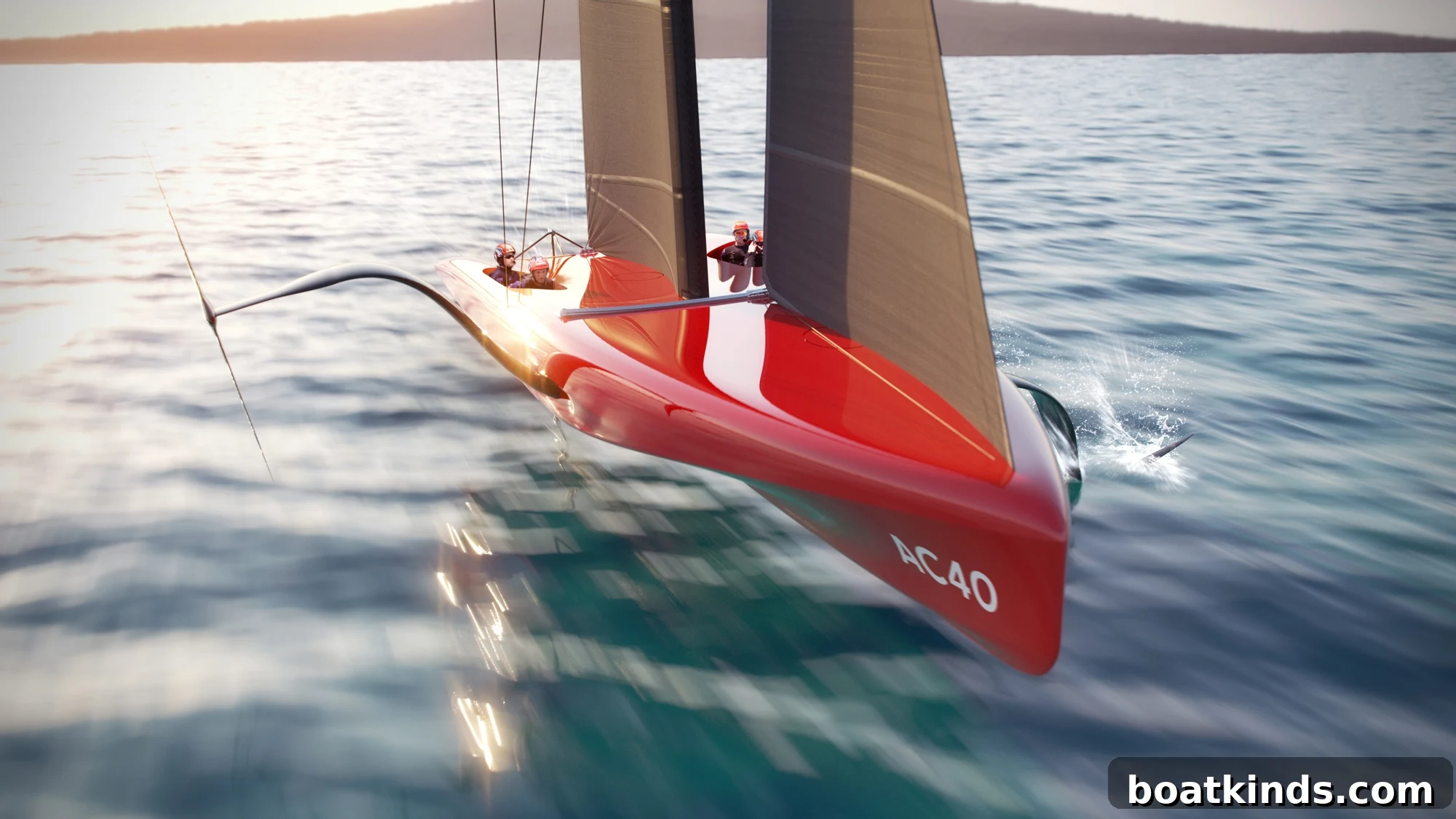
The AC40, a scaled-down sister to the AC75 race yachts used in the 36th America’s Cup, has begun production. The new one-design class is intended to provide a high-performance, accessible pathway into America’s Cup-style foiling for a wider pool of sailors, including more women and younger competitors.
Hull tooling for the AC40 is being cut on a 7-axis CNC machine at McConaghy Boats’ facility in China. That advanced CNC capability ensures precise, repeatable molds for a class that depends on strict uniformity to keep competition focused on tactics and crew skill rather than bespoke hardware. The AC40 hull form is derived from Te Rehutai, the New Zealand AC75 that successfully defended the America’s Cup, carrying the design DNA of a proven foiling platform into a smaller, more manageable package.
Production responsibilities are split among established suppliers from the America’s Cup ecosystem. Southern Spars will supply the rigs, Emirates Team New Zealand will provide the foil arms, and McConaghy Boats will construct the hulls and decks. North Sails Marine Group is responsible for the aero packages. This collaboration brings together proven manufacturers to deliver consistent, race-ready boats for a one-design fleet.
Eight AC40s have already been ordered. The first hull is scheduled to ship to Emirates Team New Zealand’s base in Auckland in July for commissioning in August, with subsequent boats planned for delivery at a steady cadence—approximately one new boat every five weeks. That production schedule aims to support a rapidly growing fleet and allow teams to train and race on identical boats.
The AC40 is designed for a four-person crew. A self-tacking headsail simplifies upwind maneuvers and reduces short-handed workload, while battery power replaces the traditional leg-powered grinders used to operate winches on larger America’s Cup boats. Flight control will be managed by an autopilot system, enabling the small crew to focus on helming, trimming and tactical decisions while the control system keeps the foilborne platform stable.
Performance projections for the AC40 are impressive for a one-design foiler of this size. In light wind conditions the class is expected to reach speeds up to around 26 knots upwind and 30 knots downwind. In stronger conditions—at about 20 knots of true wind speed—speeds could climb to approximately 39 knots upwind and 44 knots downwind. Those performance figures illustrate how the AC40 captures the thrilling, high-speed foiling experience of the bigger AC75s but in a more compact and standardized package.
The one-design approach serves several strategic aims. By standardizing hulls, rigs, foils and aero packages, the AC40 reduces the arms race of bespoke development and lowers the barrier to entry for teams and clubs. This makes it easier for national sailing programs, yacht clubs and youth development squads to invest in competitive foiling without the escalating costs associated with cutting-edge one-off prototypes. The class is explicitly positioned to widen opportunity, attract more women and young sailors, and create consistent training and racing platforms connected to the America’s Cup pathway.
From a training perspective, the AC40 offers a direct, transferable experience for sailors who aspire to campaign in larger high-performance foiling classes. Skills developed on the AC40—boat handling at foilborne speeds, foil trim and tuning, coordination between helms and trimmers, and tactical decision-making on a foiling platform—translate well to larger America’s Cup yachts and other foiling circuits.
With production underway and an initial delivery schedule in place, the AC40 one-design class is poised to expand the pool of foiling sailors and deliver close, high-speed racing that emphasizes crew skill and strategy. As the fleet grows and more boats enter operation, the class will likely become a central stepping stone for sailors aiming to join America’s Cup programs or to race professionally in foiling classes worldwide.