
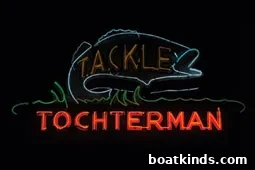
Suspended above a narrow sidewalk in an historic row-house neighborhood of East Baltimore hangs an iconic art-deco neon sign that lights up the night. It shows a hooked striped bass, outlined in bright white, leaping from a green-crested wave. The word “TACKLE” stretches in yellow across the fish’s arcing body, and below, in bold red neon, the family name “TOCHTERMAN” announces the shop that has been a neighborhood landmark for nearly a century.
Just blocks from the Northwest Harbor of the Patapsco River and only a short distance from local creeks, Tochterman’s is a classic bait-and-tackle store that dates to 1916. It’s the place where the legendary Maryland angler Lefty Kreh bought his very first rod and reel. Over the years the shop has attracted an eclectic clientele — from Hall of Fame ballplayers like Ted Williams to visiting dignitaries, Maryland governors and well-known outdoor writers.
On a recent cold early-spring Saturday, Tochterman’s at 1925 Eastern Ave. in historic Fells Point buzzed with anglers preparing for rockfish season. Bundled against the chill, they moved through aisles packed with gear, confident they would find the exact tackle, bait or advice they needed to sharpen their plans for the water.
Up a creaky wooden staircase, past an antique dumbwaiter and down a narrow corridor, a three-hour classroom on trolling for stripers was in session. Instructor Dave Bradley spoke to a group of a dozen men and a 12-year-old girl about rigging parachute rigs, trolling baits, bottom bouncing, towing planer boards and tying reliable knots. Reels, lines and tackle were handed out as props and takeaways so students could practice with real gear.
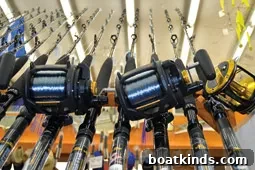
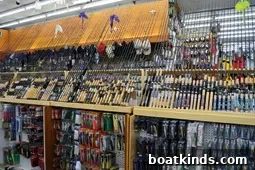
The store itself is a fisherman’s paradise—shelves and counters brim with equipment, and a forest of fishing rods rises from floor to ceiling. Every inch of wall space is covered with tackle hanging in plastic packages or displayed in locked glass cases. Small parts are stored in stacked bins, sliding trays and drawers, many so tiny they could slip through a man’s fingers. The variety and depth of inventory mean anglers can usually find even the most obscure piece they need.
Tony Tochterman, 65, is the third-generation owner of what many consider one of America’s oldest family-run bait-and-tackle shops still operating in its original location. A compact man with neatly combed gray hair, Tony moves quickly from counter to counter, winding line, servicing spinning reels and answering questions. Some of the parts catalogs on hand rival the thickness of old telephone directories, and many items are cataloged only in the staff’s collective memory.
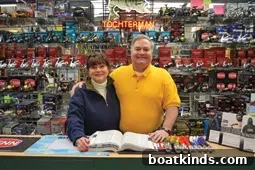
Dee, Tony’s ever-smiling wife, scurries around the store tending the manual cash register and greeting regulars with warm hugs and familiar nicknames like “hon” and “sweetie.” By late April she takes on the seasonal role often referred to as “The Worm Girl,” managing the demanding live bloodworm trade. In a small adjoining cubbyhole, Gene King has been repairing reels for 27 years. Parts and supplies are organized in rows of overhead drawers and bins that require a ladder to reach.
Writer Bill Heavey recently profiled Tochterman’s in Field & Stream, quoting long-time salesman Rich Holewinski: “I’ve seen guys barge in here with busted-up tackle, claiming it’s defective. No receipt, sometimes stuff we don’t even carry. Tony helps them. They come in angry but leave smiling. Because that’s what Tony does. Another time, a guy’s brother died, left some old reels. He offers them to Tony for $30. Tony comes back with a $200 check. Tells the guy, ‘If I bought them at $30, I’d be stealing.’” That mix of fair dealing and personal care has kept customers loyal for generations.
Modern inventory systems never really took hold at Tochterman’s, and how the family keeps track of so much stock remains something of a mystery. The upper floors of the conjoined row houses hold boxes and crates of gear accumulated over decades. The attic-like storage contains an undocumented trove of antique tackle and memorabilia, much of it packed away since the mid-20th century.
When Tochterman’s first opened in 1916, Thomas and Anna Tochterman ran a mom-and-pop shop that sold snacks, soft-shell crabs, live bait, hooks and lures. The family lived above the store and were virtually always on call during the season. Their children, Tommy Jr. and Antoinette (Toni), later operated the business as T.G. Tochterman & Sons and expanded into an adjacent row house. Anthony (Tony) took over in 1981, and he and DeAnne (Dee) continue as the third-generation owners, living nearby and keeping the family-run tradition alive.
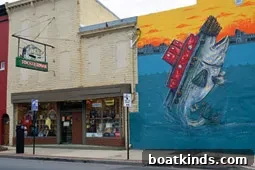
In earlier decades, the Tochtermans sold live bait right on the sidewalk and trusted customers to pay on the honor system. That practice is no longer feasible. While some row houses on side streets are being restored, Eastern Avenue’s commercial corridor has lagged; traffic congestion, limited parking and occasional crime remain challenges for local businesses.
T.G. and Toni used to keep the store open from 5 a.m. until 11 p.m. in season. “The store was their whole life,” Tony says. “If customers wanted something and the store was closed, they simply phoned or knocked on the front door, and they would open. Hey, who needs more than five hours’ sleep? But this was their work ethic.”
Tony and Dee upheld that round-the-clock availability for a time, but they eventually set clearer boundaries to preserve family life. “We would get random calls at home at all hours just to talk shop or ask where the fish were biting. We had to get an unlisted number, keep our front room unoccupied and never answer the door,” he explains. “After all, we’re open seven days a week [May to January], and that’s enough. Soon our customers got the message. But even when anglers spot us out for dinner, they sometimes sit down at our table to talk fishing. We love them like family, but we get enough fish-on talk as it is.”
Customers return across generations, often bringing grandchildren to buy the rods and bait that were part of their own childhoods. That continuity creates a strong sense of ownership and affection for Tochterman’s; many patrons feel the store preserves and revives their best memories of fishing and family.
Tony began working behind the counter at age 12, following in his father’s footsteps. He is the last of the family line working full time in the store, but he has no plans to retire or relocate. This year he is expanding the shop’s fishing apparel selection and adding new departments. He also hopes to open a small fishing museum in an upstairs room to display historic gear and documents. “We have so much old stuff — some pieces date back to the early 1900s. I’m just starting to sort through the horde,” he says.
Tradition is central to the business. When the classic neon sign was restored, the original craftsman who made it in 1938 came out of retirement to refinish it, a detail that underlines the shop’s deep ties to its past.
One small curiosity: despite the store’s famous striper logo, caps bearing that design were not on the shelves the day I visited. Likewise, photos of anglers holding trophy fish are few; Tony laughs that they’d need an entire upstairs floor to display the thousands of snapshots customers have taken over the years.
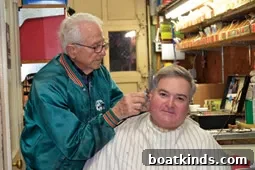
Another neighborhood tradition is purely local color: “Nooney” Lamantia, a 90-year-old barber, still drives across town to give Tony a trim. Nooney began cutting Tony’s hair about 50 years ago and continues to stop by about once a month, carrying on a friendly custom that feels emblematic of this community-run business.
At Tochterman’s, many traditions refuse to die. The store remains a living piece of Baltimore’s fishing and neighborhood history, where anglers of all ages can find gear, guidance and a welcome that has lasted for generations.
June 2015 issue