
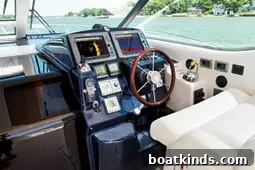
The helm is the heart of safe, enjoyable boating. A well-designed helm station gives the operator precise control of the vessel while providing excellent situational awareness. These are two separate but equally important goals. This article focuses first on helm ergonomics — the logical layout and placement of the wheel, engine controls, switches, gauges and navigation electronics — and then on exterior visibility from the helm.
Ideally, a boat should be comfortable to run whether you are standing or sitting. Standing helps you stay alert and absorb motion with your legs when the boat is riding hard or accelerating onto plane. It also generally improves visibility. At the same time you want the option to sit for long passages. Many boats fail to do both well: seats are sometimes too high, too low, or set too far back to allow comfortable access to the wheel, throttles and displays.
Seat-to-wheel geometry matters. A common complaint is wheels mounted vertically on a bulkhead at waist height, a layout borrowed from sailboats that works poorly on powerboats. That layout forces the operator to lean forward and steer from the shoulders and back, which gets tiring; it often pushes people to rely on autopilot when manual control would be safer. A lap-style wheel positioned so it can be used while standing or sitting, with adequate fore-and-aft seat adjustment, is far more comfortable and intuitive — much like driving a car.
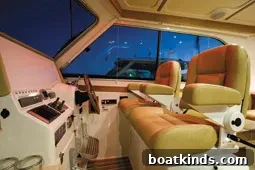
To support both seated and standing driving, the operator’s eye height should change little between positions. A seat with 4–6 inches of vertical adjustment and 10–12 inches of fore-and-aft travel gives the flexibility to align eye height, reach the wheel easily, and keep the electronics and controls at a consistent angle and sightline. Plenty of standing room between the wheel and the seat is also essential. Flip-up bolsters help, but only if the seat base and console don’t block your feet when you shuffle aft to counter bow rise during acceleration.
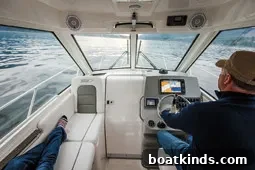
Bow rise is a common dynamic that makes you want to step farther aft momentarily. A practical test is to assume the driving position, open the throttles, and mark with tape where your feet naturally move to maintain balance without holding the wheel. No seat base or structural element should be forward of that line; otherwise the helm will interfere with natural movement and balance in rough conditions.
Seats should be tall enough so that when you stand or hop off, your eye height remains nearly the same. That keeps the wheel, throttles and displays in roughly the same positions relative to your eyes and hands, so you don’t have to hunt for controls or peer around the dash. Adjustable or tilting consoles that bring displays into the operator’s line of sight are an excellent idea and would be a welcome feature on more boats.
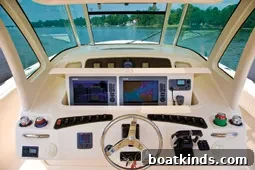
Once comfortable seated and standing positions are sorted, prioritize layout. Navigation displays — chartplotter, radar and depth — should occupy the prime real estate; they provide the most critical information for safe piloting. Engine data and ancillary gauges belong nearby and readable, but they can be lower priority if the GPS/plotter displays engine parameters. Traditional, oversized analog gauges can be relegated to backup status if the integrated displays cover essential engine information.
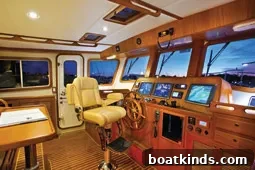
A well-designed helm groups electronics, gauges and switches on panels oriented toward the skipper, forming a semicircular, driver-centric layout similar to a bus or truck cockpit. Wide, flat consoles that stretch across the helm and lie at awkward angles place critical displays too far away and out of comfortable sightlines. Some manufacturers get these angles right on sedans and pilothouses; others need to rethink ergonomics.
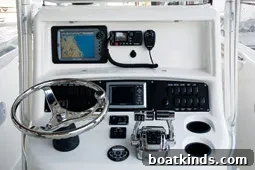
The wheel and engine controls should sit close together at a compatible height. Throttles work best aligned even with or slightly aft of the wheel. For craft intended primarily for seated operation, locate throttles a bit farther aft; for standing operation, even alignment feels more natural. Angle the engine control binnacle about 15–30 degrees so shifting uses the arm muscles rather than relying on wrist torque. Some designers tilt controls laterally toward the centerline to achieve a smoother motion when changing direction.
Control placement for joysticks and thrusters depends on sightlines and operator preference. At a starboard helm a right-side joystick is intuitive for most right-handed operators, provided you can turn and see aft clearly. If stern visibility is better from centerline or port, place thruster controls accordingly. Docking often requires only thrusters and engine control, so grouping those where the operator can see the transom and stern at a glance simplifies close-quarters handling.
Switches should be prioritized by operational importance. Keep critical items — horn, wipers/washers, trim tabs or interceptors, autopilot, navigation lights and searchlight — close at hand. Noncritical circuits like deck lights, bilge pumps and livewell pumps can sit a little farther away but should remain visible and labeled. A compact pod combining engine controls, tabs, horn and wiper functions is a tidy, operator-focused solution.
Outside the boat
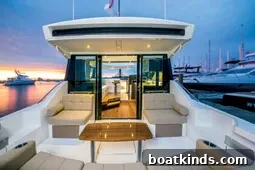
Good visibility from the helm is essential — you can’t avoid what you can’t see. Most builders place the helm to starboard for a reason: under the Rules of the Road the give-way sector runs roughly from ahead to two points abaft the starboard beam, so you gain a visual advantage by sitting on the starboard side. A centerline helm can work if it provides an unobstructed view to starboard. Helm placement to port reduces your ability to judge and respond in your primary responsibility sector and is a questionable design choice for piloting.
Window frames, mullions and structural features should be kept as narrow as practical. Mullions wider than about three inches, depending on their proximity to the helm, create blind zones. Large radar arches and heavy cockpit covers can block meaningful portions of the horizon; a vessel on a collision course remains on a constant bearing and will grow behind any such blind spot. Maximize clear window area in aft canvas, pull back curtains, and reduce horizon blockers wherever possible.
Glare is another hazard. Bright white dash surfaces and shiny overheads reflect sunlight into the helm and obscure visual cues, especially at night when ambient lighting and running lights dominate. Commercial and military craft use matte black or subdued tones in pilothouses to minimize reflections. If your dashboard is glossy, consider a matte cover, non-glare paint or tailored upholstery to cut reflection and improve visibility of unlit hazards close aboard.
Being able to see the horizon over the bow while the boat is on plane is vital. If the horizon disappears for more than a second or two when the bow rises, the design should be reconsidered. Likewise, clear sightlines to the transom are important when backing into a slip; if stern visibility is limited, an auxiliary control station aft or a dedicated lookout can make docking safer. Remember the operator remains responsible for the bow even if an aft control station is used.
Modern electronics and integrated displays have made navigation and piloting more precise and less stressful, but they never replace the need to look outside. Always monitor wind, current and tide, and verify how set and drift are affecting your track. Keep the windshield wiper sweep and washer capability in mind: the wiped area should include the portion of the windshield you naturally look through at eye height, and boats used in saltwater should have wipers with washers to clear salt spray and film. Good visibility — from ergonomically placed controls to unobstructed sightlines — makes the helm a safer, more enjoyable place to be.
March 2015 issue