WATCH DOG
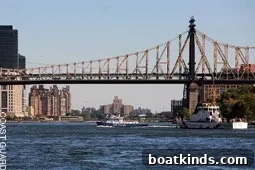
The Coast Guard cutter Ridley, a patrol boat home-ported in Montauk, New York, maintained a visible security presence in the East River on Sept. 20 while the United Nations General Assembly met in the city. A permanent security zone has been in place since Sept. 11, 2001, restricting vessel traffic within 175 yards of Manhattan in the west channel of the East River. As part of those safety measures, commercial vessels must check in with the Coast Guard Vessel Traffic Service New York on VHF channel 12 before entering or transiting the channel. The Ridley’s patrol and enforcement of the zone are part of routine maritime security operations designed to protect waterfront infrastructure, commercial traffic, and public safety during high-profile events.
C.G. partners with Canadians for rescue
Command Center Boston
On Sept. 13, the U.S. Coast Guard, working closely with the Rescue Coordination Center (RCC) Halifax in Nova Scotia, conducted a successful at-sea rescue of three people from the Canadian fishing vessel Winddancer II. The incident took place approximately eight miles south of Grand Manan Island. The coordinated response demonstrates close international cooperation in search and rescue (SAR) operations along the northeastern seaboard.
The rescue sequence began when Winddancer II issued a mayday call on VHF channel 16 at around 2:30 p.m., reporting that it was taking on water. RCC Halifax received the distress call and promptly notified U.S. authorities to request assistance through the First Coast Guard District Command Center in Boston and Coast Guard Sector Northern New England. Rapid information sharing between RCC Halifax and the Coast Guard ensured that both Canadian and U.S. assets could be mobilized in a timely manner.
Coast Guard Sector Northern New England activated local resources and tasked Coast Guard Station Eastport, which launched a 25-foot rescue boat at approximately 2:45 p.m. In addition to the Eastport boat crew, Canadian assets including a C-130 aircraft and a rescue helicopter were directed to the scene. The combined response, with surface and air units working in concert, allowed rescuers to locate and recover all three people who were aboard Winddancer II by 3:21 p.m.
This operation is an example of how cross-border coordination enhances maritime safety. When vessels report emergencies on international waters or near shared search-and-rescue regions, RCC Halifax and U.S. Coast Guard command centers routinely exchange information and request mutual aid. Deploying a small coastal rescue boat alongside long-range aircraft and helicopter support provides complementary capabilities: the boat enables close-in recovery and medical assessment, while the aircraft offer rapid area coverage and situational awareness.
After survivors are recovered, standard Coast Guard and RCC procedures include medical evaluation, debriefing, and ensuring the safety of the disabled vessel where feasible. In this case, all three people on Winddancer II were successfully recovered by the coordinated response team. Incidents like this emphasize the importance of maintaining clear VHF radio practices—using channel 16 for distress calls and channel 12 for vessel traffic coordination in New York Harbor—and of keeping watchstanders alert to calls for assistance.
Both the East River security enforcement and the Winddancer II rescue highlight the breadth of Coast Guard responsibilities: enforcing security zones, managing vessel traffic, and executing life-saving search and rescue missions. Whether patrolling waterways near major urban centers or responding to distress calls in offshore waters, Coast Guard units and their international partners are routinely engaged in protecting mariners and the public. Mariners should remain familiar with local security zones, follow VHF communication procedures, and report emergencies immediately to ensure a rapid, coordinated response.
This article originally appeared in the Connecticut and New York Home Waters section of the December 2010 issue.