
Panga Skiffs: Practical, Efficient, and Growing in Popularity
A Panga may not win any beauty contests. Its bow sits high, the beam is relatively narrow, and the basic versions used by small-scale fisheries in developing countries often amount to little more than a simple hull with no frills. Yet the Panga’s strengths are practical and hard to ignore: seaworthiness, load-carrying capacity, shallow-water ability and fuel efficiency.
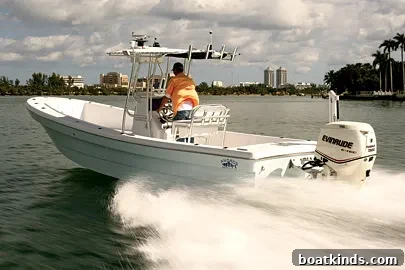
“It’s not a shape you instantly fall in love with at first sight,” says Gerritt Walsh, president of Angler Boat Corp. in Miami, which produces the Angler Panga 22 and Angler Panga 26 in addition to bay boats, walkarounds and dual consoles. “You have to understand the boat to fully realize the benefit of the design.”
Panga-style skiffs have been around for more than three decades. The hull form originated as a World Bank–supported project that promoted a simple, economical craft for fishermen in developing nations. The design proved versatile: it handles both shallow inshore waters and open-water conditions, carries heavy loads without sacrificing stability, and runs efficiently when planing. The combination of a sharp entry, a flat riding surface aft and a relatively narrow beam reduces wetted surface area at speed, allowing smaller outboards to achieve faster cruise speeds and better fuel economy than many other skiff types.
The Panga’s affordability and durability made it a favored choice across coastal communities worldwide. Roughly seven years ago the Panga-style skiff began to gain traction in Florida, and since then a number of U.S. builders have adapted the basic form to meet American anglers’ expectations. Rob McDaniel, president of Panga Marine in Sarasota, Florida, first began importing Panga-style boats from Mexico in 2001. About three years ago he started producing modified, fiberglass versions that include the features U.S. fishermen expect—center consoles, bait wells, fishboxes and rod holders—while retaining the core Panga attributes. McDaniel reports steady growth, noting the company is approaching 200 boats per year across its product line.
In the U.S. market Panga Marine introduced a simple, fiberglass Panga Skiff in a clean, no-frills 18-foot configuration. That model remains true to the traditional Panga concept: an inner liner molded to the hull with foam flotation, a self-bailing cockpit, a Kevlar-reinforced keel and concave running pads—slight tunnels in the hull—to improve performance and fuel economy. McDaniel says the basic 18-footer has resonated with buyers who want an uncomplicated, reliable platform; forty of the initial run have already sold.
Angler Boat went into production with its Angler Panga 26 in 2002 and has built more than 250 of them. Offered with single or twin outboards up to a combined 225 hp, the center-console Panga 26 cruises at about 32 knots. Where the Angler Panga 26 remains intentionally Spartan, Angler’s Panga 22 incorporates more of the accessories and appointments that appeal to U.S. anglers. Construction details common to Angler’s Panga boats include a one-piece deck and liner with injected foam between deck and hull for flotation; the foam also helps deaden sound and stiffen the structure. Angler builds using hand-laid biaxial fiberglass and polyester resins.
Andros Boatworks of Sarasota built its first Panga-style boat in 2006 and expanded to include 23- and 26-foot models; earlier this year the company added an 18-foot Backwater model. The owners set out to identify a single hull that could run shallow, tolerate offshore chop and perform efficiently on a single outboard. “There was really only one that stood out, and it was the Panga,” says Andy Eggebrecht, company president. Andros calls its approach a hybrid; they’ve modified the original Panga shape to better suit U.S. anglers while preserving the hull’s core advantages.
Andros has built roughly 130 boats so far, with the Tarpon 26 proving the most popular. The Tarpon 26 includes features such as a 40-gallon aft live well, insulated fishboxes and a custom hydraulic jack plate with 21 inches of travel. With a 300-hp Suzuki four-stroke the boat cruises around 30 knots (approximately 34 mph) and returns about 3.9 mpg at 4,000 rpm. Andros constructs the hulls with hand-laid biaxial fiberglass and vinylester resin for strength and durability.
Buyers are drawn to the Panga for several straightforward reasons: a proven hull form that handles a wide range of conditions, efficient planing performance that saves fuel, and a simple, robust construction that minimizes maintenance. Builders tailored the basic Panga for the U.S. market by adding amenities anglers expect—live wells, fishboxes, comfortable consoles and modern power options—while keeping the hull’s efficient, seaworthy characteristics intact.
Walsh describes the Panga’s arrival in the United States as a “Florida phenomenon,” but he and other builders have watched demand broaden geographically as dealers and anglers become more familiar with the hull’s capabilities. The growing interest reflects a practical shift: many boaters are choosing hulls that emphasize utility, efficiency and toughness over cosmetic appeal.
This article originally appeared in the September 2008 issue.