
On a recent trip to Europe I followed the development of autonomous sailing vessels — a technology that has matured from hobbyist tinkering into a commercial effort, driven by the same forces that propelled delivery drones and self-driving cars. The promise is familiar: remove expensive, fallible humans from repetitive or hazardous tasks. Autonomous sailboats, or sailing drones, are emerging as a practical way to gather ocean data, support scientific missions and push autonomous navigation into a new domain.
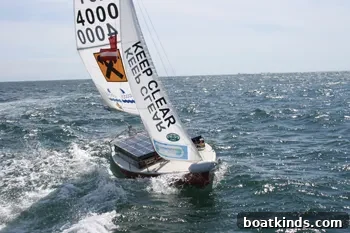
In a bare office on Vienna’s northern edge I met Roland Stelzer, a soft-spoken engineer who earned his Ph.D. from the University of Leicester. His research project, known as Roboat, is a 12-foot autonomous sailboat based on Jan Herman Linge’s Laerling hull — a design originally intended for youth training. Instead of a human skipper, Roboat is controlled by an on-board computer, sensors and actuators running artificial intelligence and specialized algorithms. The result is a small, appealing vessel that looks familiar and unthreatening yet performs complex tasks at sea.
From 2007 to 2012 Stelzer and a team of programmers who also sailed actively campaigned Roboat in competitions, winning the World Robotic Sailing Championship multiple times. Competing against other autonomous boats in tasks such as station-keeping, collision avoidance and fleet racing, the little red keelboat proved its capability. Development was funded through grants and donations rather than venture capital, but the project nonetheless demonstrated what a well-engineered autonomous sailboat can do.
“Zero-handed” sailing may sound like a novelty, but Roboat’s challenges are similar to those of any autonomous vehicle: it must be robust, efficient and able to cope with unpredictable conditions. Unlike road vehicles, sailing drones don’t contend with traffic lights or pedestrians, but they must handle puffs of wind, waves and the possibility of mechanical failure. A jammed sheet or a twisted block can render a vessel helpless, so the rig and control systems must be simple, reliable and energy-efficient. Limited opportunities to recharge at sea make power management and renewable energy sources essential.
Stelzer keeps much of Roboat’s electronics in a waterproof Pelican case he calls “the brain” — a portable controller containing processors, memory and wiring that can be disconnected and worked on off the boat. Programming the autonomous skipper is a constant process of refining rules and responses. Sensors provide wind and motion data, but the software must interpret those inputs and react to dynamic events like botched tacks or being caught in irons. Roboat’s control logic, for example, will reverse the rudder while backing to push the bow through the wind and complete a failed tack — a practical tactic that mimics how a human sailor would recover.
The cockpit houses batteries, actuators, multiple sensors, a fuel cell backup and solar panels capable of generating about 285 watts. Sail controls run on an electric sheet winch driven by a bicycle chain — a clever, low-cost hack that reduces complexity and power draw. The team retained the aluminum mast and Dacron sail plan that were designed for the hull; that setup naturally depowers as the boat heels in gusts, which lessens the energy needed for active sail trimming. Other small refinements, like a prebalanced rudder, further cut power consumption.
Stelzer’s energy breakdown for Roboat was roughly 40 percent for the on-board computer, 32 percent for weather sensors, 28 percent for sail actuation and a tiny fraction for the custom rudder. Improvements in computer efficiency and sensor technology in recent years have made such missions more feasible, enabling longer deployments on renewable energy alone.
Roboat’s practical achievements included assisting its creator: when Stelzer’s inflatable chase boat ran out of fuel during an Adriatic test and radio calls went unanswered, he reprogrammed Roboat to come alongside and tow the boat back to shore. In 2012 Roboat also towed a hydrophone autonomously in the Baltic Sea to help locate porpoises, and when weather worsened she was reprogrammed to seek shelter. A strong gust later disabled her sail controls, and the mother ship had to tow her to safety — a reminder that while the platform can perform impressive feats, resilience and further development remain important.
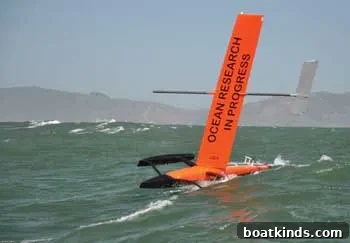
Across the Atlantic in Alameda, California, Saildrone has taken a different, more heavily funded approach. Led by Richard Jenkins, Saildrone builds orange trimarans equipped with innovative wing sails and extensive sensor suites. The company has logged tens of thousands of miles collecting oceanographic and climate data, monitoring fish stocks and testing long-distance autonomous crossings. With substantial venture backing, including a multi-million-dollar financing round, Saildrone operates at production scale in a way that small research teams cannot.
The differences between projects like Roboat and Saildrone illustrate two paths in autonomous sailing: lean, experimental research versus capital-intensive productization. Stelzer’s work was constrained by funding and by legal uncertainties around autonomous vessels that made large-scale investment risky. He ultimately shifted focus and founded HappyLab, offering tools such as 3-D printers and CNC routers to entrepreneurs building prototypes. Saildrone, by contrast, used venture capital to scale operations, push hardware development and pursue commercial and scientific contracts.
Stelzer still believes in Roboat’s potential and suggests the little red boat could attempt an autonomous ocean crossing like the Microtransat Challenge — the symbolic “Holy Grail” of robotic sailing. Whether that happens under a new owner or as part of a more funded effort, the story of Roboat highlights both the technical promise and the practical hurdles of autonomous sailing: durable hardware, efficient energy use, robust software and funding to turn prototypes into reliable, deployable vessels.
This article originally appeared in the January 2017 issue.