The ship will retrace the 1831–1836 voyage that produced the naturalist’s “On the Origin of Species”
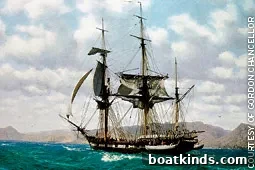
One of maritime history’s most famous vessels, the HMS Beagle, played a central role in shaping Charles Darwin’s theory of evolution. In commemoration of Darwin’s 200th birthday in 2009, plans have been announced to build a full-scale replica of the Beagle and re-create her landmark circumnavigation as a living, educational exhibit.
Britons Peter McGrath, 43, a professional skipper, and David Lort-Phillips, 70, an organic farmer with family ties to the original vessel, are leading a roughly $10 million effort to construct the replica. They are joined by American sailor Norman James, 76, founder of Friends of the HMS Beagle in Barrington, Rhode Island, who is helping to mobilize support and funding in the United States.
“We hope to build her at Milford Haven docks in Wales, near where David lives,” McGrath said in a telephone interview. “Externally she will be a faithful reproduction of the original Beagle, while internally she’ll be fitted with modern systems for safety, navigation and education.”
The original HMS Beagle was a 90-foot Cherokee-class brig, launched on May 11, 1820, at Woolwich Dockyard on the River Thames. Initially kept mostly in reserve, she was converted in 1825 for survey work and re-rigged as a bark. Her first major mission, from May 1826 to October 1830, involved detailed charting of the southern tip of South America, including the exploration and naming of the Beagle Channel and surveying around Tierra del Fuego.
Robert FitzRoy commanded the Beagle on the famous 1831–1836 circumnavigation that carried a young Charles Darwin as a naturalist and companion. That voyage provided many of the observations and specimens that later formed the foundation for Darwin’s On the Origin of Species, published in 1859.
“Darwin and FitzRoy did not always agree,” McGrath noted. “FitzRoy held strong religious convictions, and their debates were intense. FitzRoy later wrote his own account of the voyage, attempting to reconcile his beliefs with what Darwin observed.”
Lort-Phillips brings a personal link to the original ship: his great-great-grandfather, John Lort Stokes, served as a junior officer aboard the Beagle and shared a cabin with Darwin. Stokes later commanded the vessel during its 1837–1843 survey voyage to Australia. After her survey career, the Beagle served as a watch vessel on the River Roach near the Thames Estuary, mainly to deter smuggling. By 1870 she was sold for breaking up.

The replica project aims to honor both the ship’s historic design and its scientific legacy. McGrath plans to build the hull and frames from oak, restore the bark rigging, and discreetly integrate two 220-horsepower inboard engines to ensure reliable, modern propulsion for safety and scheduling. Construction would use traditional methods where visible to visitors, while hidden accommodations and systems will meet contemporary standards for long-distance sail training and public outreach.
McGrath and Lort-Phillips began collaborating three years ago over their mutual interest in the Beagle and have been developing the concept since. Their search for U.S. partners led to an unexpected connection: Norman James, born in Wales in 1932 and now living in the U.S., met Lort-Phillips last May while visiting Pembrokeshire. They happened to stay at Knowles Farm, the organic farm owned by Lort-Phillips, and their conversation sparked James’s involvement.
“When I learned about the project, I wanted to help,” James said. “My background in project management, combined with a lifelong interest in sailing and education, made this a natural fit. Restoring the Beagle gives us an extraordinary platform to teach children and the public about Darwin’s observations and the development of evolutionary science.”
James recalls an experience teaching in Rochester, New York, in 1958, when he was discouraged from discussing evolution because of agreements between school administrators and some parents. That memory reinforced his conviction that a high-profile, sea-going educational resource like the Beagle replica could play a vital role in public science education.
Friends of the HMS Beagle has been formed to support the reconstruction effort, and James and his colleagues are pursuing 501(c)(3) non-profit status to enable tax-exempt donations. At press time, they hoped to secure that designation by February to better attract philanthropic and institutional backing.
“American support has made the project seem much more achievable than it did a few months ago,” McGrath said. “We want this to be a global educational initiative that brings Darwin’s work and the story of natural history to life for people of all ages.”
McGrath has begun discussions with prospective donors. For information or to donate to the project, contact Norman James at (401) 289-0823.
This story originally appeared in the January 2009 issue.