
The Landing School: Thirty Years Training Boatbuilders, Designers and Marine Technicians
When The Landing School opened in Arundel, Maine, in 1978, its founders faced skepticism. Undeterred, they set out to create a hands-on institute focused on boatbuilding, yacht design, marine systems and composites. Three decades later the school has proven its model, turning out skilled craftsmen, designers and technicians who staff the marine industry worldwide.
The school’s first class met in a converted dairy barn and built two dories and two 18-foot sailboats as part of the curriculum. Those modest beginnings reflected a practical philosophy: teach the skills and the theory, and prepare graduates for long-term careers in the marine trades.

“A lot of people said, ‘You can’t do that — it doesn’t make sense,’” remembers co-founder John Burgess, now a trustee. He and Helen “Cricket” Clark (now Clark Tupper) started the school with just nine students. Burgess attributes the school’s survival to energy, conviction and a commitment to quality instruction. “We were young, we worked hard, and we focused on building a strong educational foundation,” he says.
Today the independent, accredited institute offers concentrated, practical programs that combine rigorous technical training with hands-on boat construction and system work. The Landing School’s approach emphasizes both craftsmanship and the engineering knowledge behind boat design — teaching students not only how to build, but why structural choices, systems integration and materials selection matter.
The Landing School (thelandingschool.org) teaches boatbuilding, yacht design, marine systems and composites. Alongside its established one-year programs, the school is expanding into a two-year associate degree program in marine systems, approved by the State of Maine and pending accreditor approval. This addition formalizes advanced coursework and management training while retaining the core, shop-based learning that defines the school.
Burgess’s personal path into the marine trades began after college. He left a family photo-engraving business to work in Maine yards, developing a passion for wooden boats and high-quality craftsmanship. He taught boatbuilding before returning to Maine to co-found The Landing School. From the start, the founders prioritized bringing naval architects and engineers into the classroom so students would understand the scientific principles underlying boat construction.
That emphasis on education has remained central. The Landing School’s mission has always been to prepare men and women for careers — not just jobs — in the marine industry. Students are trained to enter the workforce at an entry level and then progress into positions of greater responsibility through experience and continued learning.
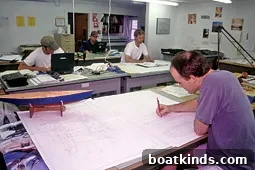
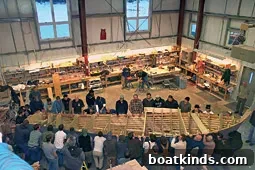
Enrollment at the nearly year-long program averages around 75 students across four focused study areas. The campus occupies a 50,000-square-foot facility that includes two boatbuilding shops, a design studio, a systems laboratory, a composites shop, classrooms and a library. Over the course of the school year students typically build about 10 boats, undertake repairs and repowers on production craft, and design more than two dozen original vessels. This blend of production, repair and original design work ensures graduates leave with both practical shop experience and design competence.
In March the State of Maine approved the two-year associate’s program in marine systems. The new curriculum will keep the one-year marine systems certificate while adding a second year focused on higher-level technical work, management courses and 16 hours of general education supplied through the University of New England. School leadership expects to expand associate degree offerings if this program proves successful.
More than 1,200 Landing School alumni are employed in the marine industry around the world. Many graduates say the program makes them more marketable by combining technical theory, hands-on construction skills and familiarity with regulatory standards such as those from the American Boat and Yacht Council. Employers value the practical experience graduates bring to roles in design studios, shipyards, repair facilities and marine systems companies.
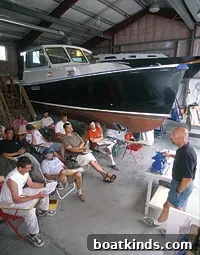
Alumni profiles illustrate the school’s influence. A 2001 graduate credits the program with strengthening his resume and preparing him for engineering and operations roles in the commercial rigid-hull inflatable industry. A 2005 graduate who studied yacht design arrived with a degree in physics and left with both the design fundamentals and the practical studio experience that helped her land positions with established design firms.
School president Barry Acker emphasizes that even in challenging economic times graduates typically find placement in the field. He attributes the school’s resilience to a broad curriculum that appeals to a wide range of students and to a strong alumni network that supports new graduates entering the industry.
Looking ahead, founders and leaders want to preserve the core mission while continuing to adapt to new materials and technologies. Burgess envisions an endowment and ongoing investment in equipment and curriculum so the school can keep evolving without losing its roots in quality instruction and hands-on learning.
From a converted barn to a purpose-built campus, The Landing School has grown into a respected center for marine education. Its combination of craftsmanship, technical instruction and career-focused training has established a durable role in preparing the next generation of boatbuilders, designers and marine systems professionals.
This story originally appeared in the February 2009 issue.