Steve Weiss: A Semiplaning Yacht Designer Focused on Efficiency, Comfort and Quiet
Many thoughtful boaters have been searching—sometimes without realizing it—for the right yacht designer to match their priorities. Steve Weiss is that designer for many. Grounded in traditional sail- and powerboat design and early CAD techniques, Weiss brings an aesthetic that favors harmony with the environment and a functional elegance that is evident across his work.
Weiss graduated from the Yacht Design Institute in 1983 and has worked with respected yards including Lazzara Yachts in Florida, Morris and Hinckley in Maine, and Oyster Marine in the U.K. After a stint as a yacht broker, he founded his own design practice in Trenton, Maine, in 2008. Having worked in 2D and later 3D CAD since the early 1990s, he is fluent in computer-aided design and clearly enjoys the creative possibilities these tools offer while remaining rooted in classical boatbuilding principles.
What stands out in Weiss’ portfolio are the highly realistic 3D renderings that bring concepts to life in ways that were not possible a few years ago. With modeling tools like Rhino, a design can be fully visualized, refined and tested long before any molds or patterns are cut. The digital process enables rapid iteration of hull shapes, deck arrangements and interior volumes so a boat can be optimized for the intended use.
Weiss’ designs emphasize economy, quiet, comfort and refined appearance rather than outright speed or excessive beam. His powerboats are conceived to cruise comfortably in the mid-teens on a single diesel engine, with a hull form of modest beam compared to today’s wide, full-planing designs. That moderate beam-to-length ratio balances seakeeping and low resistance, letting a modest-horsepower diesel move the boat efficiently.
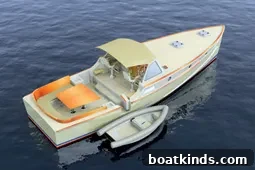
Hull resistance and the operating speed target are central to his approach. Weiss designs hulls to minimize resistance around a speed/length ratio (s/l) of about 2.5. The 38 DayBoat exemplifies this: with a waterline length of 36 feet 7 inches and a waterline beam of 9 feet 11 inches, it yields a length/beam ratio and a displacement/length (d/l) ratio — the latter being a key indicator of how easily a hull moves through the water. A relatively low d/l suggests efficient propulsion and less power required to exceed displacement speed.
In practice, a low d/l hull like the 38 DayBoat will rise onto a semiplaning condition smoothly, benefiting from both buoyancy and dynamic lift without excessive drag or a pronounced “hump” at the transition. For cruising speeds below about 16 knots, round bilges provide comfortable motion and reduced slamming; at higher speeds, hard chines can help reduce wetted surface and frictional drag by separating flow from the hull.
Details of the 38 DayBoat demonstrate Weiss’ concern for both performance and human comfort. The design keeps the center of gravity low with a short, elevated bridge deck that sits flush over the engine. Cockpit and cabin soles are low to the water, which reduces accelerations felt by occupants when rolling and makes life aboard more comfortable. A fine entry aids comfort in a head sea, while spray rails forward help manage spray in the absence of aggressive chines or flare.
Aft, the boat carries a skeg and relatively flat sections that assist coursekeeping and provide grounding protection for the running gear. The skeg helps the boat lie with her quarter to the wind when drifting and improves low-speed control with a large rudder. Weiss notes that in a semiplaning boat the modest drag from a skeg is an acceptable trade-off for these handling and protective benefits, whereas such drag would be prohibitive on a high-speed, 30-knot craft.

Efficiency is a recurring theme: a slippery hull designed to cruise at 15 knots on a single diesel consumes a fraction of the fuel required by a comparable beamier twin-engine planing boat. The smaller engine not only saves fuel but is quieter, enhancing passengers’ ability to enjoy the sounds of the sea, birds and wildlife—part of Weiss’ intent to create boats that harmonize with their surroundings.
An ergonomic detail Weiss champions is the hull-side boarding door. These doors make getting on and off the boat easier and more dignified for older or less agile guests arriving by dinghy. Practical considerations like this reflect his focus on how people actually use boats, and they improve the boarding experience without demanding athleticism.
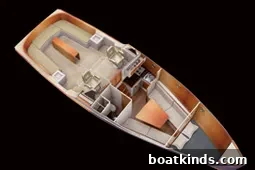
Although the 38 DayBoat is optimized for day use, its cabin affords flexibility. A larger hull yields more deck space and allows the vessel to function comfortably as a weekender or coastal cruiser. The cabin bunk, Weiss points out, is valuable for children and adults alike: kids under 12 are likely to nap belowdecks during long outings, making the berth functional for family use.
Weiss contrasts his round-bilge semiplaning hulls with typical lobster-boat conversions. Modern lobster boats are built to carry heavy loads and make tight turns, not to cruise efficiently at semiplaning speeds. He aims to advance the semiplaning powerboat beyond that “lobster yacht” paradigm, focusing on hulls that reduce wetted surface and improve overall propulsion efficiency.
Design proportions and visual mass also matter to Weiss. Superstructure size, window placement and the relationship between hull and cabin define a boat’s visual balance and help conceal necessary headroom in shorter hulls. Thoughtful window design can elongate a profile or downplay height, helping even modest-length boats appear sleek and purposeful while still offering comfortable interior volumes.
Weiss is surprised at how few semiplaning powerboats exist on the market given their practical advantages. He argues that 15 knots is often a sensible cruising speed—fast enough to cover distance comfortably, and frequently optimum for offshore conditions—without forcing passengers to be strapped into seats during rougher passages.
His larger designs often mirror center-cockpit sailboat arrangements, with a walk-in engine room and an aft owner’s cabin that is separated from the main interior. The design process typically begins with hand sketches of sheer, stem profile, cabin heights and engine placement. Those lines are translated into Rhino for hydrostatic calculations, displacement estimates and stability analysis. From there the design spiral proceeds, refining sections, waterlines, deck camber, cabin tumblehome and windshield angles until the design meets both performance and aesthetic goals.

Weiss offers a clear, coherent alternative to the 30-knot mindset: a quieter, more efficient and more livable approach to powerboat design. Whether you prioritize fuel economy, comfortable motion, sensible ergonomics or a boat that lets you experience the landscape rather than block it out, his designs are worth a close look.
See related article: A semiplaning take on efficiency
December 2012 issue