
How Snowflakes Form: The Science Behind Snow Crystal Shapes
The National Oceanic and Atmospheric Administration (NOAA) has published a clear, science-based explanation of how snowflakes form. Understanding snowflake formation is fascinating for anyone who watches winter weather, whether you’re a casual observer or a serious meteorology enthusiast. Below is a concise, readable explanation of the natural processes that shape snow crystals and the factors that determine their variety.
Snowflakes begin as tiny ice crystals that form in clouds when water vapor freezes directly onto a microscopic particle, such as a speck of dust, pollen, or other airborne material. These tiny seed particles act as ice nuclei, providing a surface on which water vapor can deposit. The process of vapor deposition — where water vapor changes directly into solid ice — is the primary mechanism that builds a snowflake’s crystal structure.
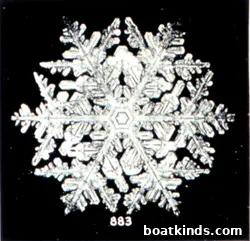
One of the most characteristic features of snowflakes is their six-fold symmetry. This hexagonal structure arises from the molecular arrangement of water molecules as they freeze. Water molecules bond in a way that naturally forms a six-sided lattice at the microscopic level, and that hexagonal crystal lattice scales up as the ice crystal grows. While perfect six-armed symmetry is common in simple crystals, complex branching and environmental changes produce the extraordinary diversity of snowflake shapes observed in nature.
Temperature and humidity within the cloud are the two main environmental variables that determine a snowflake’s shape. Different temperature ranges favor different crystal habits: for example, plate-like crystals may form at certain cold temperatures, while columnar or needle-like shapes appear at others. When supersaturation with respect to ice is high — meaning the air contains more water vapor than the ice crystal can immediately accommodate — crystals tend to grow rapidly and develop elaborate branches or dendrites. Conversely, lower humidity and slower growth can result in simpler, more compact crystals.
As a nascent ice crystal falls through the cloud, it encounters microscopic variations in temperature and humidity. Because the six arms of a developing snowflake are exposed to very similar conditions as the crystal rotates and tumbles, the arms often grow in a similar pattern, producing a striking, symmetric appearance. However, even slight differences in the microscopic environment encountered by each arm can lead to the unique, individualized details that result in the common saying that no two snowflakes are exactly alike. Collisions and interactions with other crystals can also cause aggregation, where multiple crystals stick together to form larger snowflakes.
Additional processes can further modify a snowflake after its initial growth. Riming occurs when supercooled liquid droplets in a cloud freeze onto the ice crystal, coating or stiffening its branches and altering its shape. Melt-refreeze cycles closer to the ground can round or obscure the original crystalline features. These post-growth changes contribute to the wide range of snow types that we experience on the ground, from light, powdery snowfall to heavy, wet clumps.
Researchers study snowflakes using high-resolution photography, electron microscopy, and cloud sampling to observe crystal shapes and growth under controlled conditions. Observational programs and educational resources from organizations such as NOAA help explain the science in accessible language and provide visual records of snow crystal diversity. Photographs of individual snowflakes reveal the intricate symmetry and branching structures that form under varying atmospheric conditions and help communicate why snow crystal morphology is both a matter of physics and a record of a crystal’s journey through a cloud.
Understanding how snowflakes form has practical applications beyond satisfying curiosity. Snow crystal type influences snowpack properties, avalanche risk, and hydrological behavior of melting snow. Weather forecasters and researchers consider crystal habits when interpreting radar and satellite signals and when modeling snowfall and accumulation.
In short, snowflakes form through a combination of molecular structure and atmospheric conditions: vapor deposition on ice nuclei produces hexagonal crystals, temperature and humidity determine the crystal habit, and microscopic environmental variations create branching and uniqueness. The next time you watch snow fall, consider how each flake is a tiny record of the cloud conditions it passed through — a natural micro-architecture shaped by the physics of water and ice.