Tropical Waters: Joseph McGurl’s Atmospheric Marine Painting
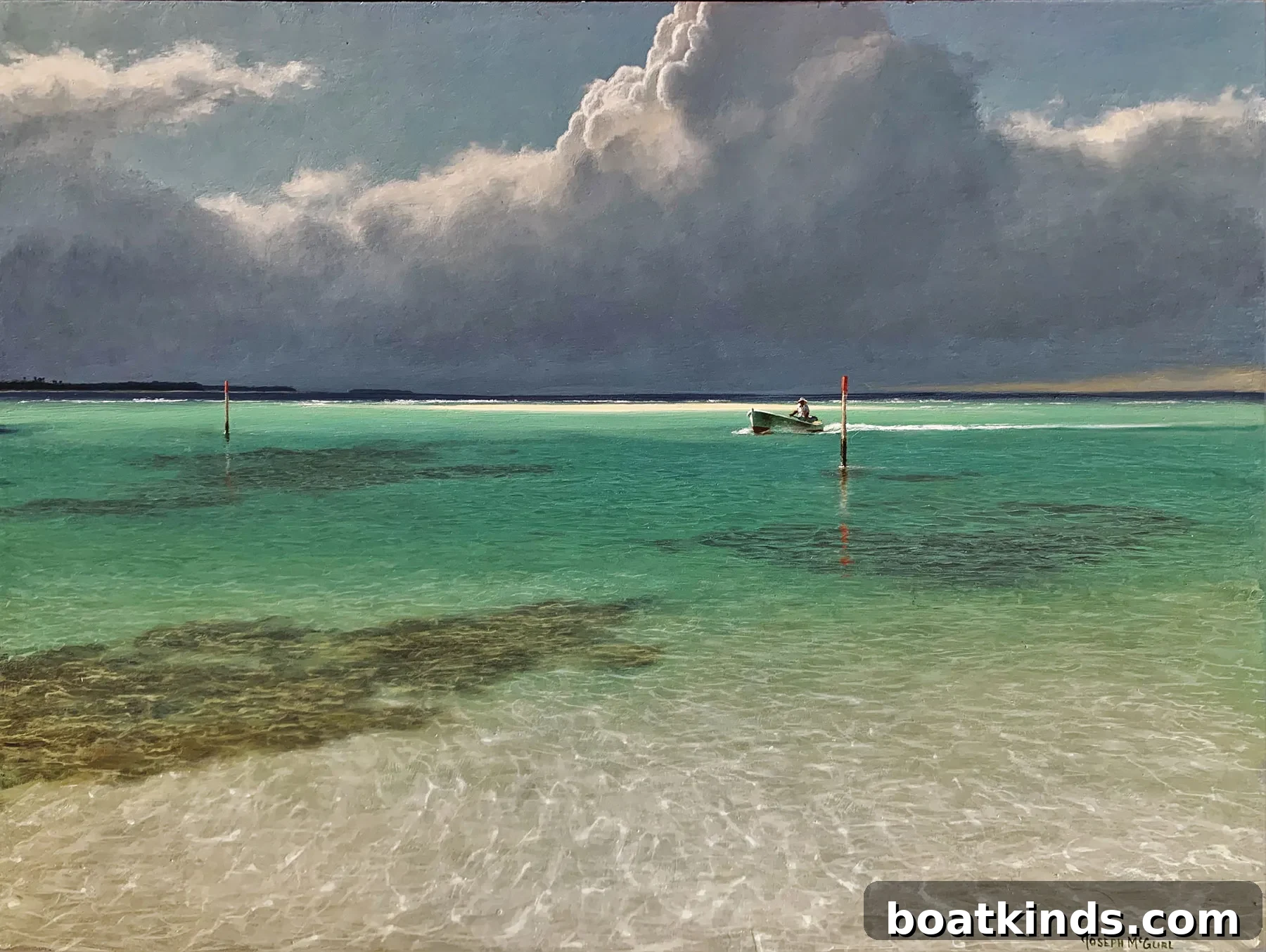
A dark sky presses low over pale green water in Joseph McGurl’s oil-on-panel work titled “Tropical Waters.” The painting shows a lone waterman returning from a morning on the sea, set against a dramatic horizon. That stark contrast between a storm-forward sky and tropical-colored water is precisely the sensation McGurl sought to evoke when he composed this imagined scene.
Imagined Place, Authentic Feeling
McGurl stresses that “Tropical Waters” is not a depiction of a particular place. Instead, it is an imaginative synthesis of coastal impressions he has gathered over years spent in Florida, the Keys and the Bahamas. He works often from memory and imagination as much as from sketching on location. For McGurl, the primary goal is not geographic accuracy but the recreation of a lived feeling—putting the viewer in the moment he wants to convey.
“I made it up, so it’s not any place in particular,” he has explained. “I’ve spent a lot of time in Florida and the Keys and the Bahamas, so it’s based on things I’ve seen there.” Whether painting from a small field sketch, a boat, or purely from memory, McGurl composes to capture mood, light and the emotional sense of being on the water.
Background: From Quincy Bay to Cape Cod
McGurl’s life on the water began in childhood, boating around Quincy Bay and Boston Harbor. He later studied at the Massachusetts College of Art, guided in part by the influence of his father, who worked as a muralist. After college he spent several years working as a yacht captain before committing to painting professionally. Although he chose art as a vocation, he never left the water behind. Over the years he has owned a succession of sail and power boats; his current vessel is a 44-foot Alden-designed ketch built in 1965, from which he frequently paints on location.
Plein Air Practice and Marine Authenticity
McGurl’s direct experience at sea informs his paintings in ways that extend beyond the accurate rendering of rigging and hull lines. He emphasizes atmosphere, the shifting state of the sea, and a sense of movement—qualities that come from firsthand observation. Painting en plein air, whether from a sketchbook or from the deck of his boat, allows him to internalize the interplay of light, wind and water and then translate those impressions back into the studio.
“With marine art, having direct first-hand experience with the subject gives it authenticity,” he explains. “It’s not just having the rigging correct, but the atmosphere, the state of the sea, getting that emotional sense of movement in the water.” Those priorities shape McGurl’s approach to composition, color and brushwork: subtle shifts in hue, the direction of brushstrokes and the placement of the horizon all serve to place the viewer at sea rather than at a distance.
Technique, Palette and Composition
In “Tropical Waters,” McGurl uses oil on panel to create a controlled surface that supports both fine detail and expressive marks. His palette in this work emphasizes the juxtaposition of cool, light greens and aqua tones in the water against the heavy, brooding tones of the sky. That contrast amplifies the narrative tension—a quiet, sunlit sea under the threat of an approaching squall, and a solitary figure returning to shore. Compositionally, McGurl often frames his scenes to invite the viewer into a specific vantage point, giving equal weight to horizon, sea and human presence.
Putting the Viewer in the Moment
Whether painting from sketches made on location or composing entirely from memory, McGurl’s intent is consistent: to place the viewer in the spot he imagined. He draws on a reservoir of experiences—landfalls, calm mornings, changing weather, and the rhythms of small-boat life—to construct scenes that feel familiar and immediate. The result is marine painting that communicates both technical competence and an emotional core, inviting viewers to recall their own moments on the water while experiencing the artist’s particular vision.
This article was originally published in the March 2022 issue.