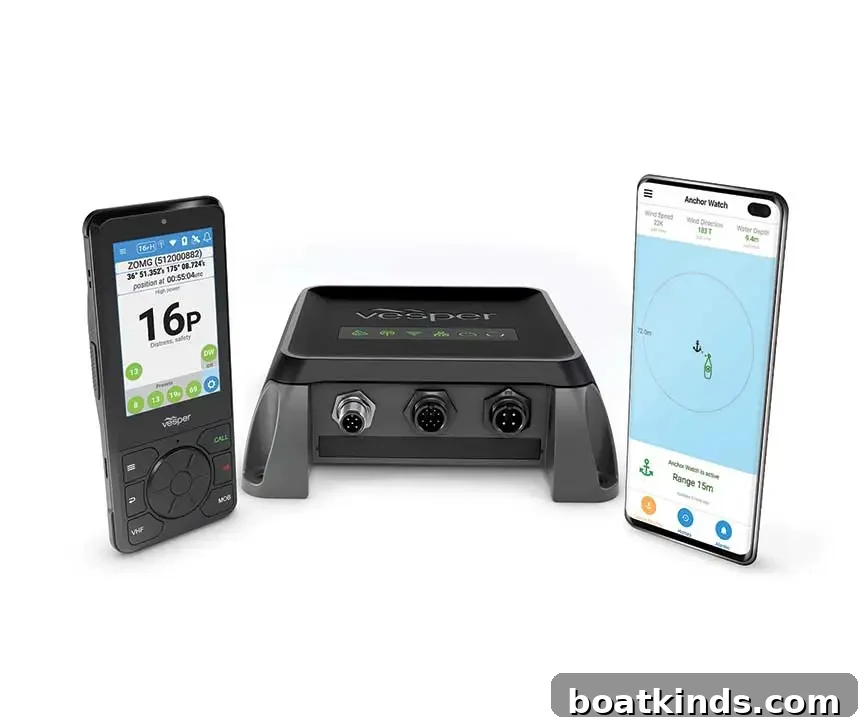
At the National Marine Electronics Association show last September, New Zealand-based Vesper Marine introduced Cortex, a modular communications and monitoring platform the company bills as “VHF reimagined.” Cortex centers on a compact M1 base unit and expands with H1 or H1P handsets and a mobile app. The system can be purchased as a basic M1 for AIS and vessel monitoring, with audio VHF capabilities activated when you add one or more H1/H1P handsets.
Using an H1 handset made the concept immediately clear: common actions are available directly on the screen. On the AIS target display, for example, each target has a one-touch “call” option. That direct access stands in stark contrast to many conventional VHF radios that require numerous button presses to place a DSC (digital selective calling) station-to-station call. Cortex simplifies that workflow by integrating AIS target data and VHF calling into a single user interface.
Most marine radios today operate with two VHF channels, which forces compromises: one channel handles DSC signaling while the other carries live audio. When a radio monitors channel 16 as a priority while you listen to a working channel, it briefly switches to 16 to check for a signal, causing an audible interruption on the active channel. Cortex avoids that by using an eight-channel VHF architecture that dedicates channels to specific functions: two channels for audio, one for DSC, two for AIS, and three reserved for future features. Because each function has its own channel there is no pausing or audio dropouts when multiple services run concurrently.
THE AIS functionality in Cortex uses a Class B/SO transponder, providing more frequent position updates for faster-moving vessels and stronger-transmission behavior to improve message delivery in congested waters. AIS traffic is viewable in bird’s-eye, plotter, or list formats, and tapping a target reveals detailed information. All AIS data is published via the M1’s NMEA 2000 connection, so existing multifunction displays and compatible apps can present full AIS details without extra hardware.
Because AIS, DSC and VHF are tightly integrated, initiating a station-to-station DSC call to a vessel shown on your AIS list is as easy as selecting that target and pressing the on-screen “call target” button or using the H1 handset. The streamlined workflow saves time and reduces user error compared with many traditional setups.
MONITORING Cortex expands beyond radio and AIS into comprehensive boat monitoring and control. The M1 base includes a high-accuracy, rapid-update GPS that supports advanced anchor watch and man-overboard features. Unlike earlier Vesper products that limited alarm notifications to the boat or required a separate external alarm, Cortex includes a cellular radio so anchor and safety alerts can be delivered to your phone wherever cellular service is available.
The system monitors anchor status, GPS position, battery voltage, bilge level, temperature, shore power, security sensors, bilge pumps, heading, wind, depth and barometric pressure. It can also control relays for lights, refrigeration or other onboard devices. Monitoring combines a five-channel analog I/O port on the M1 with data provided over NMEA 2000, which should make integration with engines and other major systems straightforward.
Cortex devices include twice-daily sensor status updates by default. For more frequent checks and active control, a paid monitoring plan is available: $10 per month billed annually, or $20 month-to-month. Paid plans update every five minutes and deliver real-time alarm notifications plus the ability to control onboard systems remotely.
COMPONENTS The M1 is the heart of Cortex. This small, IPX7 water-resistant unit combines Wi‑Fi, cellular connectivity, an eight-channel VHF transceiver, NMEA 2000 networking, a GPS input, an analog I/O port, and sensors for heading, barometric pressure and battery voltage. It also includes a no-loss antenna splitter so a single antenna can serve two VHF radios and AIS without degrading reception.
To enable VHF audio you must pair at least one H1 or H1P handset to an M1. The H1P adds a rechargeable battery for portability; up to 10 handsets can be paired to each M1. Handsets connect over 2.4 GHz Wi‑Fi, a reliable onboard wireless method that Vesper has used successfully in other products.

Each Cortex handset features an optically bonded touchscreen protected by Gorilla Glass and designed to work with wet or gloved hands. The display is bright with wide viewing angles. Non-corded handsets sit in a charging cradle that secures them when not in use. Battery life exceeds 12 hours under typical use. Physical controls include six backlit buttons around a rotary wheel and central select button, volume and power keys on the side, a transmit key on the left, and a protected DSC distress button on the rear. An 85-decibel speaker provides audible alerts, and spoken alerts are supported as well.
THE FINE PRINT Vesper emphasizes Cortex’s software-driven upgradability. Planned features announced by the company include additional scanning modes, audio recording or buffering, weather alerts, hailing and fog signals, and intercom between handsets. Alerts appear on the handset display, are spoken by the handset speaker, and can be routed to a smartphone.
A few advanced features remain pending, but Cortex’s built-in antenna splitter allows it to operate alongside an existing VHF radio so owners can retain any capabilities not yet implemented in Cortex until software updates arrive.
Pricing varies by configuration. A package with one H1 handset and the M1 base—providing AIS, monitoring and VHF radio—was priced at $1,800. The M1 base alone, offering AIS and monitoring, was $1,300. Additional handsets cost $600 each and can be added later to enable more VHF-capable stations.
This article originally appeared in the December 2019 issue.