
About 10 percent of FLIR Maritime’s annual revenue is allocated to research and development, and a significant portion of that budget goes to on-water testing. Most marine engine and electronics manufacturers operate their own test boats. In a two-week span I boarded two such vessels: a 54-foot test platform owned by Cummins and a 42-foot FLIR Maritime test boat that Raymarine uses extensively.
“Nothing can replace the experience of using the products so we can see how they actually operate,” says Gordon Pope, Raymarine’s director of engineering. FLIR Maritime and Raymarine rely on daily hands-on trials at purpose-built test boats in England and California. These boats are fitted with full systems that can be swapped for other configurations. It’s a large investment, Pope notes, but one that delivers substantial returns through improved reliability and performance.
Laboratory work and analytical modeling are essential, but they don’t tell the whole story. “The equipment will never reach its full potential until you put it through its paces on the water and subject it to various conditions, especially challenging ones,” says Tyson Schey, technical project manager for Cummins Recreational and Light Commercial Marine.
My visit to Cummins’ marine sales, marketing and engineering headquarters in Charleston, South Carolina, focused on the company’s new Inboard Joystick. This helm control system works with a bow thruster or with both bow and stern thrusters to provide precise low-speed maneuvering.
Thruster performance is a key selling point. Cummins engineers designed these thrusters for extended duty cycles—reportedly up to three times longer than conventional thrusters. Introduced at the Miami International Boat Show, the Cummins Inboard Joystick supports four Cummins diesels: the QSB6.7 (250–550 hp), QSC8.3 (500–600 hp), QSL9 (285–410 hp) and QSM11 (300–715 hp). All meet EPA Tier III emissions standards.
Boatbuilders such as Carver and Sea Ray have expressed interest in offering the joystick as an option on select models. At the Miami show, a 51-foot Sea Ray 510 Fly equipped with the Cummins system was on display.
“Cummins Inboard Joystick was developed as a system, applied as a system and serviced as a system,” says Robert Mirman, Cummins strategy and marketing leader. “That integrated approach is unique and provides real value to customers. It’s part of a broader effort to expand non-engine offerings that complement our propulsion packages.”
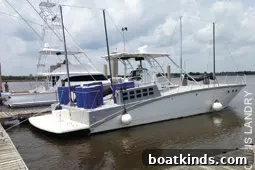
I tried the joystick aboard Cummins’ test boat docked on the Stono River. The boat, nicknamed Worst Case Scenario, is a stripped-down former express cruiser rebuilt as a modular test platform. Engineers intentionally outfit it with marginal equipment to stress-test systems; plywood, fiberglass and resin construction emphasize function over form. A wooden box was even installed over the bow thruster to increase load during trials.
The test hull was fitted with twin 715-hp QSM11 diesels and deep-ratio ZF transmissions. Its configurable ballast—about 28,000 pounds of tankage—lets engineers vary displacement from roughly 38,000 to 66,000 pounds. Fore and aft sails add windage to simulate superstructures, and the platform carries three bow thrusters, one stern thruster and five battery banks for electrical load testing, according to Cummins customer engineer Jack Funkhouser.
Cummins’ team invited me to run as many trials as I wanted. In a strong outgoing tide just outside the marina I spent about 45 minutes testing the joystick. I’ve used joysticks linked to pods, sterndrives, outboards and other inboard systems, including the Hinckley jetboats. The Cummins system handled Worst Case Scenario with authority—moving the boat forward, astern and laterally with controlled precision.
The boat rotates when you twist the knob on top of the joystick; the knob and stick work smoothly together. On the Stono River’s intense current I could even walk the boat sideways, although progress was slow when current struck the hull side. Engineers welcomed feedback: I mentioned a bit of resistance near the joystick corners, and they explained that springs push the stick out of those positions because propulsion effectiveness is lowest at the extremes. Aside from that deliberate design choice, the system performed very well, allowing clean slips and precise dock approaches despite the current.
FLIR’s Raymariner
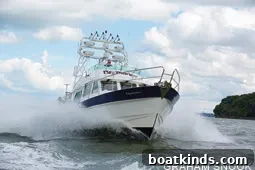
A week later I flew to England and boarded FLIR Maritime’s longstanding test vessel, the Hardy 42 Raymariner, powered by twin 470-hp MAN diesels. Built as a semidisplacement trawler, she can reach about 27 knots but is most economical around 8–10 knots. FLIR has used this hull for years to validate marine electronics across a wide range of conditions.
The pilothouse contains six testing stations, each with large flat panels that accommodate multiple multifunction displays and instrument screens. Product assurance engineer Drew Gorman counted 25 GPS units on board during my visit—a clear sign of the thorough instrumentation. The boat also carried six radar antennas, dozens of MFDs ranging from 5.7 to 19 inches, five autopilots, four AIS units, three fixed-mount VHFs and 20 through-hull transducers arrayed athwartships in four rows.
Raymariner has hull “moonpool” panels that can be removed while the boat remains in the marina so through-hull transducers can be swapped without hauling the vessel, Raymarine product support manager Derek Gilbert explained. That feature speeds testing and adds flexibility.
Test systems are deliberately isolated from the vessel’s operating systems to ensure the skipper retains full control. Raymariner’s helm runs an Evolution autopilot while parallel test systems evaluate other autopilots, software versions and drive units. FLIR Maritime assigns a crew of nine testers who log at least 1,000 hours on the water each year during trials off England’s south coast. “She’s a very good sea boat with good bow flare,” Gilbert said. The hull’s design displacement is about 12 tons, but extensive test equipment—including generators, inverters and a large battery bank—adds considerable weight to support the instrumentation and engineering teams’ laptops.
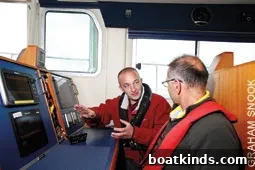
Most test equipment sits inside the pilothouse; only antennas and FLIR thermal cameras are mounted externally. I rode on the flybridge companion seat as Gilbert piloted Raymariner out of Cowes toward a wreck site to trial the Raymarine CP100 CHIRP sonar. Gorman emphasized the importance of software validation—ensuring firmware and applications meet specifications and performance standards. Raymariner will range as far as 60 miles offshore to test equipment, including sonar in deep water.
During my time aboard I noticed that the Evolution autopilot ran continuously; Gilbert only took manual control when maneuvering over wrecks. “It’s so easy to use and so reliable,” he said. “It can hold a course far better than I ever can, even in short, sharp swells.” Given the many hours Raymariner spends at sea, a dependable autopilot is essential, and the crew treats the system as a trusted crewmate.
At a Raymarine press event the company also showcased systems aboard five private boats docked at the Royal Southern Yacht Club in Hamble. I tested gear on a 30-foot Cheetah power cat with twin 300-hp Suzukis and a Beneteau Prestige 500 sport cruiser fitted with Volvo Penta IPS600s. The Prestige carried Raymarine’s EV-2 Evolution drive-by-wire pilot, a FLIR T400 thermal camera, CP100 sonar module, four multifunction displays and high-definition color radar—demonstrating how integrated marine electronics enhance everyday boating.
Beyond Raymariner, FLIR Maritime works with owners of about 60 private commercial and recreational vessels worldwide to test products across diverse hull types and operating environments. Test fleets include sailboats, convertibles, express cruisers, center consoles, RIBs, power cats and trawlers chosen to represent different conditions. For instance, Singapore’s congested waters are ideal for AIS and radar validation.
“It all comes down to on-the-water use,” Gilbert said, reflecting on his 27 years with Raymarine. The team routinely takes Raymariner out in conditions up to Force 7 and will remain at sea if conditions rise to Force 8 while already underway. That commitment to real-world testing ensures products are proven in the environments where they must perform.
August 2014 issue