
John Burgess and The Landing School: A Lifetime Shaped by Boatbuilding
When John Burgess graduated from college in 1970 he chose to postpone joining the family business and instead took a practical job at Rumery’s Boatyard in Biddeford, Maine. That first position awakened a deep passion. Burgess remembers taking home blocks of wood on weekends to practice cutting complex compound angles with a handsaw — an early sign of the hands-on dedication that would shape his career.
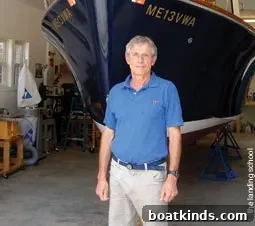
He spent four years at Rumery’s before moving down the coast to Baum’s Boatyard in Kennebunkport. The contrast was striking. “Herbie Baum’s shop felt like a time warp,” Burgess recalls — the wood stove, cedar shavings and rows of old wooden hand planes. In a shed there was a lobster boat in progress, being built by four seasoned Down East craftsmen who knew their roles so well they hardly needed to speak. Everyone concentrated on their craft.
Burgess noticed differences not only in atmosphere but in approach. At Rumery’s there were precise drawings for every job and work often waited until a formal plan arrived. Baum used a quieter, more intuitive method. He’d withdraw to study a new design, then carve a half-model at a 1-inch-to-the-foot scale. From that, he would lay out hull lines on graph paper, measure the sheer, divide the hull into ten stations and use a lead strip to capture curves — an analog way to define the shape. It might have been less formal during lofting, but Baum’s boats matched Rumery’s in quality thanks to craftsmanship honed over a lifetime.
Baum’s island upbringing off Rockland, where electricity was absent and everything was cut by hand, showed in his methods. Craftsmen used simple tools, like egg-beater drills to set pilot holes, fastener holes and counterbores for bungs. Even though Baum’s yard had power tools, much shaping stayed with century-old hand tools — broad axes and lipped adzes — preserving a living connection to older boatbuilding traditions.
Burgess later apprenticed with naval architect Cy Hamlin and taught boatbuilding in Massachusetts for a couple of years. In 1978 he partnered with Cricket Tupper to found The Landing School. With Hamlin and Cricket’s husband, Chris Tupper, contributing to the program, the school began to integrate design and practical boatbuilding. Students learned not only joinery and woodworking but also engineering essentials — weight control and distribution, rudder design, and even formulas such as the moment of inertia for a rectangle. The aim was to give boatbuilders a solid grasp of the mechanical and physical principles that underpin good design and construction.
Impact on the Industry
More than three decades later, The Landing School’s influence on the boatbuilding and repair industry is notable. A large proportion of graduates enter the marine trades and rise into positions of responsibility across repair, restoration, systems, and manufacturing. Burgess describes alumni as members of a close-knit, low-profile fraternity who network, trade know-how and support one another in the field. The school’s graduates populate a wide array of roles throughout the industry.
The Landing School’s success is built on an environment that balances technical training with creativity, teamwork and mentorship. Burgess praises the school as a healthy, constructive organization that gives students tangible fulfillment. He contrasts that fulfillment with the dissatisfaction many feel in pursuit of high-paying but unrewarding careers. For those who work with boats, passion, balance and meaningful work are the rewards — even if the financial payoff is not always immense.
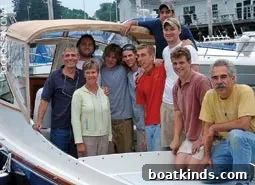
Students at the school come from diverse backgrounds, and that diversity strengthens the learning environment. “We have a nuclear submarine commander working next to a guy with a ponytail and earrings,” Burgess notes. Despite wide differences in experience and temperament, everyone works together toward shared goals, with individual ambitions aligned to larger objectives.
Looking Ahead
Burgess hopes the school will remain true to its educational philosophy while continuing to evolve. He emphasizes ongoing self-assessment: identifying strengths and weaknesses, listening to industry advisors, and continually asking how the program can be improved. The Landing School aims to remain adaptable and intellectually curious, supported by a committed board, talented staff and motivated students.
To better reach students with different learning styles, the school invited a psychologist to work with instructors. The exercise Burgess remembers involved identifying five objects placed into a person’s hand and then recalling them in reverse order. In the group debrief, instructors realized they processed information differently — some formed mental images, others used acronyms — and that at least seven distinct learning strategies were in play. That awareness led to a concrete commitment: when one teaching method fails to reach a student, try another.
That attitude — a willingness to learn and to adapt — defines how The Landing School continues to refine its curriculum and respond to industry needs. Staff regularly survey industry advisers and challenge themselves to do better rather than simply accept the status quo. The school’s mission remains to train skilled, thoughtful boatbuilders and designers who will carry traditional craft and modern technique into the future.
Related feature titles from the publication include:
- Where tradition meets technology
- Fly Fisher 22: the fruit of their hard work
This article originally appeared in the August 2010 issue.