
I recently accepted an invitation from my Patagonian neighbors to visit their daughter, who lives on the island of Chiloé across the Gulf of Corcovado, the channel that separates the island from mainland southern Chile. I have known Mónica since she was a girl, so it was a pleasure to spend time at her home near the small seaside city of Quellón with her husband Israel and their two daughters.
Israel is a woodcutter. For a few days I joined him in the bosque as he and his ox team hauled timber on a biloche — a large sled on skids — and loaded firewood into his truck for sale in town. He told me he had recently cut a 12-meter timber intended for the keel of a boat being built on the beach in Quellón Viejo. Knowing my background in boatbuilding, he invited me to go see the project.
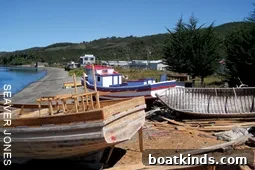
Driving along the black-sand beach, I spotted the boat from a long way off: she stood on her keel and her hull had already been painted red. A short climb aboard revealed a hull ready to receive an engine, driveline, rudder and controls. A little farther down the beach, another group of boats were being built, so we walked down to that shop as well.
The beach yard held half a dozen boats at various stages of completion, ranging in size and style. The scene reminded me of the simple, focused activity of our own beach shop at Gannon & Benjamin on Martha’s Vineyard. Amid a pile of shavings and the scent of fresh-cut wood, a man was fitting a plank. You can always spot a boatbuilder: absorbed, precise and unflappable.
I introduced myself to César Omar Tavie and, as often happens among builders, an easy camaraderie formed. We talked about the particular challenges of handcrafting traditional wooden boats in an age dominated by plastic, composite materials and electronics. César stepped away from his tools to show me around his modest operation. We sat on the aft deck of a 12-meter fishing boat under construction and talked for some time.
César has spent nearly his entire life building boats, aside from a decade in his twenties working as a commercial diver. That period allowed him to save enough to secure the beach property for his shop and his home. Today he employs four carpenters and keeps busy constructing wooden hulls for watermen who value the strength and feel of hand-built boats. He had just completed a 10-meter boat that was painted and due to launch once the balance was paid. According to him, the job took about four months and cost 15 million pesos — roughly thirty thousand U.S. dollars. For propulsion he trusts Mercedes marine diesels, which he says are reliable and offer widely available, reasonably priced parts.
We discussed material availability and resource management, a conversation familiar to builders everywhere. Even in areas that still have decent timber and supplies, the need to salvage, recycle and use materials thoughtfully is growing. That ethic of careful resource use was evident in César’s shop, where nothing useful was wasted.
As we talked, I took in the broader landscape: a bay dotted with shellfish farms and the cages of a recovering salmon industry. These aquaculture activities are the economic backbone of the area. Eastward, the high, snow-capped spine of the Andes and the distant Corcovado volcano rose clear against a deep Patagonian sky. The scene was tranquil and almost idyllic, yet I thought of how quickly this coast can turn violent. In a matter of hours clear weather can give way to raging cold, wind and towering seas. For those who work these waters, a combination of experience, faith and a stout, well-built boat makes safe return possible.
The conversation put me in mind of a voyage a decade earlier, when I boarded a small coastal cargo boat before dawn in a tidal river about 100 kilometers to the south. The captain had brought his vessel up on a rising tide in the black of night. As we left the river on the ebb, I watched him navigate a shrinking channel barely three boat-widths across with no markers, and I marveled at his skill. At daybreak he showed me a worn wooden box that held an ancient bronze compass — his family’s instrument and his trusted guide. It reminded me how many reliable, low-tech tools and traditions sit beneath modern electronics and GPS.
Knowing how boatbuilders feel about time wasted, I didn’t keep César from his work long. He noticed my T-shirt with the marine rail logo from our Martha’s Vineyard shop and said he’d been wanting a similar mechanism for his yard. I described how we had cobbled our own rail system together from scraps and salvage to make it work. He listened intently, smiling as the wheels started to turn. I could easily imagine seeing a marine rail on the beach at Quellón Viejo the next time I visit.
Seaver Jones divides his time among his woodshop and home in Futaleufú, Chile, life aboard his restored vintage motoryacht and boatbuilding at the Gannon & Benjamin Marine Railway on Martha’s Vineyard.
May 2013 issue