
Navigation in the fourth dimension
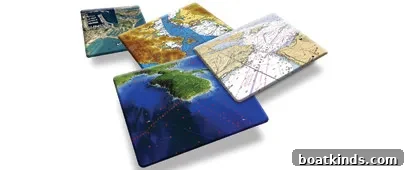
DIMENSION: C-MAP’s new 4-D electronic charting software introduces time as the “fourth dimension,” bringing chart updates and route planning to a new level. According to Jeppesen Marine, the software will be updated two or three times a year—more frequently than competing navigation software—ensuring charts, hazards and routing data remain current. The system uses three-dimensional charts that can be overlaid on high-resolution aerial photography for clear situational awareness, and its “easy routing” feature automatically calculates the shortest safe course between two points while routing around known hazards. C-MAP plans to introduce the 4-D software to North American boaters at the Fort Lauderdale International Boat Show on Oct. 29, when pricing will be announced.
www.c-map.com
Downturn takes down Maxum
As part of broader cost-cutting measures, Brunswick Corporation is discontinuing its Maxum boat line, a brand it launched in 1988. Brunswick spokesman Dan Kubera described the move as difficult but necessary due to economic conditions. Existing Maxum dealers have been informed: Brunswick will continue to sell boats that remain in dealer inventory but will not produce 2010 models. The company also says it will continue to honor all warranty service, parts support and dealer commitments in full.
Maxum was notable in the early 2000s for adopting innovations such as thrusters on smaller boats, and the decision to retire the brand reflects consolidation across Brunswick’s portfolio. Brunswick builds 15 U.S.-based boat brands, including Boston Whaler, Cabo, Hatteras and Sea Ray. In May 2008, the company announced it would cease production of several Bluewater Marine brands, including Sea Pro, Sea Boss, Palmetto and Laguna, as part of the same restructuring wave.
— Beth Rosenberg
Global ocean temperatures reach a record high
New analysis from the National Oceanic and Atmospheric Administration’s National Climatic Data Center shows that the planet’s average ocean surface temperature for July reached the warmest level on record, surpassing the previous July record set in 1998. The global ocean surface temperature in July was 1.06 degrees Fahrenheit above the 20th-century average of 61.5°F.
Arctic sea ice extent for July averaged 3.4 million square miles, which is 12.7 percent below the 1979–2000 average and represents the third-lowest July extent on record, behind 2007 and 2006. Long-term trends show that July Arctic sea ice has declined at an average rate of 6.1 percent per decade since 1979, while July Antarctic sea ice has shown a slight increase of 0.8 percent per decade during the same period. Across land and ocean surfaces, the July average temperature ranked as the fifth-warmest since global records began in 1880.
In our wake
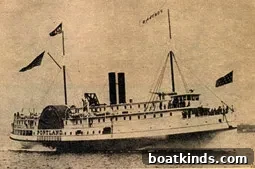
The notorious Portland Gale that struck the New England coast on Nov. 26–27, 1898, remains one of the region’s most destructive storms. Massachusetts suffered heavy damage, and the island of Nantucket experienced hurricane-force winds. More than 400 people lost their lives and over 150 vessels sank. The storm’s name comes from the steamship SS Portland, which vanished while en route from Boston to Portland, Maine, with the loss of all 192 passengers and crew. In 2002, researchers located the Portland wreck in the Stellwagen Bank National Marine Sanctuary in Massachusetts Bay.
More power, lower emissions from new Mercury engine
Mercury and MerCruiser have introduced the next-generation big-block marine engine for sterndrive and inboard applications. The new 8.2-liter gasoline engine replaces the previous 8.1-liter model and delivers increased power and improved midrange acceleration while offering lower emissions and maintained fuel efficiency, according to the manufacturer.
Mercury communications director Steve Fleming notes the change was prompted in part because General Motors stopped producing the block used in the earlier engine. The 8.2-liter is fitted with a catalytic system designed to achieve ultra-low exhaust emissions and to substantially reduce exhaust odor. MerCruiser program manager Derric Drake adds that the engineering team achieved these emissions and performance improvements while preserving fuel economy and serviceability without adding cost to the package. The engine uses closed-loop cooling and runs on regular 87-octane fuel.
Available in base 380-horsepower and high-output 430-horsepower ratings, the new engine is compatible with MerCruiser options such as the Axius sterndrive system with joystick control, the SmartCraft engine monitoring system, SeaCore corrosion protection, and choices of digital or mechanical throttle and shift on sterndrive installations and digital throttle and shift for inboard applications. Designers improved access to service points and connections to simplify installation and maintenance for boatbuilders and dealers.
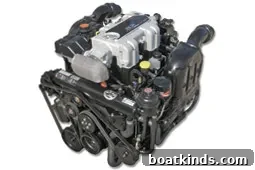
Additional features include a higher charging amperage at idle—more than 15 amps—and an air-actuated seawater drain system to ease winterization and maintenance. Mercury expected to release pricing information in the fall after the International BoatBuilders’ Exhibition & Conference (IBEX) scheduled for Oct. 12–14 in Miami, with retail sales planned to begin in February 2010. For further information, contact Mercury Marine at (920) 929-5040. www.mercurymarine.com
— Chris Landry
This article originally appeared in the November 2009 issue.