
Gyroscopic Stabilizers: A Practical Solution for Boat Roll and Seasickness
Boating is one of the best activities for families, offering relaxation, adventure and time on the water. Yet for many people, seasickness and uncomfortable rolling remain significant barriers to enjoying time aboard. That rolling motion — often a side-to-side sway caused by the interaction of a hull with waves — is the main trigger of mal de mer. Reducing roll dramatically improves comfort and safety, helping more people enjoy boating.
Over the years boatbuilders and owners have used a variety of roll-control solutions. Large displacement yachts commonly employ bilge keels and paravanes (also called flopper stoppers), while active fin or rotor systems are popular on bigger vessels with the power and space to support them. Those systems work well at displacement or semiplaning speeds, but they are rarely practical for smaller, faster boats that spend much of their time at planing speeds.
At speed, many planing boats’ hull shapes help resist roll. But when boats are dead in the water — at anchor, drifting while fishing or simply idling — the dynamics change and the hull alone often can’t prevent uncomfortable rolling. Historically, external stabilizing appendages like fins or keels caused drag that reduced speed and increased fuel consumption, making them undesirable for many owners. Expensive retractable or folding solutions have existed for high-end yachts, yet they aren’t realistic for most boaters.
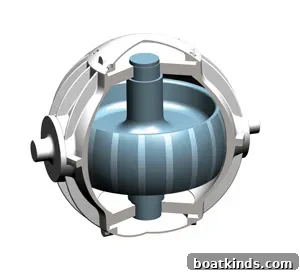
Enter the gyroscope: a technology with a long history that has recently reemerged as an accessible and effective option for a wide range of boats. Gyroscopic stabilizers are high-speed spinning rotors enclosed in a sealed housing and securely mounted to the hull structure. Their inertial forces resist roll, in much the same way a toy gyroscope resists tipping when spinning. The heavier the rotor and the higher its rotational speed, the greater the stabilizing torque it produces.
Modern gyro units are heavy, precisely cast rotors spinning at many thousands of revolutions per minute. Because they impart substantial cyclic loads into the vessel, gyros require a robust foundation and secure attachment to the hull to handle those forces without stressing the structure. That requirement is similar to the mounting needs for active fins and other high-load stabilizers.
Gyros were used on some large ships and yachts earlier in the 20th century, but early models suffered from material and bearing failures. As hydraulic and electric technologies matured, fin stabilizers became more practical and displaced bulky gyro systems. In the last decade, advancements in materials, bearings and control electronics have revived gyros as a reliable and compact solution — especially attractive for vessels that cannot accommodate fins or paravanes.
One of the most useful features of modern gyros is installation flexibility. Instead of one massive unit mounted on a dedicated centerline foundation, multiple smaller gyros can be distributed where structure and space allow. They do not have to be perfectly centered fore-and-aft or side-to-side, which is particularly helpful when retrofitting older boats or replacing another system. This adaptability makes gyros a strong candidate for many mid-size cruisers, sportfishers and other pleasure craft.
It is worth noting that some stabilizer manufacturers use the term “gyro-controlled” to describe control systems that employ a small internal gyro purely as a motion sensor to command active fins or rotors. That is different from a true gyroscopic stabilizer, which generates stabilizing torque directly from a spinning rotor.
Today there are a few leading manufacturers producing true gyroscopic stabilizers for recreational boats. Major names include Mitsubishi, Seakeeper and Veem. These companies offer a range of units covering small to large yachts. The smallest production models from Mitsubishi and Seakeeper are intended for boats in the roughly 10-ton displacement range — typically around 30 feet — and include direct-current options for battery operation at anchor. Entry-level gyro units start below $30,000, with installation costs increasing the total; larger-capacity units that deliver significantly more righting torque move into six-figure territory.
Gyros are gaining acceptance among boatbuilders and owners because they provide quiet, effective roll reduction at anchor and underway without external appendages that add drag. Independent field feedback suggests both major brands perform well; the most important consideration is selecting the correct size and ensuring a proper structural installation.
If seasickness or uncomfortable rolling has kept you ashore or shortened your trips, investing in stabilization can restore confidence and enhance your time on the water. A well-chosen gyroscopic stabilizer can make your boat more comfortable, extend days afloat and let you enjoy boating more often.
This article originally appeared in the July 2015 issue.