
The Nathaniel T. Palmer: 1901 Grounding off Beach Haven, New Jersey
Shipwrecks were a frequent and sometimes dramatic feature of the age of sail, when thousands of vessels navigated America’s inland and coastal waters. Some incidents brought tragic loss of life; others were serious inconveniences for owners and crews but ended without fatalities. The grounding of the five-masted schooner Nathaniel T. Palmer off Beach Haven, New Jersey, in March 1901 is a notable example of a major vessel that ran aground, was rescued without loss of life, and ultimately returned to service.
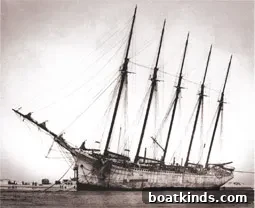
Largest Sailing Vessel of Her Time
The Nathaniel T. Palmer measured 295 feet and, when she slid down the ways in Bath, Maine, three years earlier, she was the largest sailing vessel in the world. Owned by J.S. Winslow and Co., the ship was laden with cargo out of Portland, Maine, bound for Philadelphia when she encountered a series of fierce storms near the New Jersey coast. Seeking shelter and anchored as a last resort, the schooner ultimately dragged its anchors and grounded on a treacherous shoal near the Bonds Life Saving Station.
Rescue at the Bonds Life Saving Station
Life-saving crews from the Bonds station responded swiftly. Station Captain John Marshall organized the rescue operation and used the breeches buoy to bring every crewman safely ashore. The breeches buoy, a standard piece of rescue apparatus at the time, is a canvas or leather seat suspended on a rope that can be hauled back and forth between ship and shore. A line for the device was typically fired out to a stranded vessel with a Lyle gun, a small cannon designed to send a light line across the gap between ship and shore.
In an act that underscored both leadership and seamanship, the ship’s captain, William Kreger, personally took the lifeline shot from the Lyle gun, then remained aboard the disabled schooner for two more days while the rescue and initial assessments took place. The ship carried a crew of 12, all of whom were brought to safety during the operation.
Damage, Salvage, and Return to Service
Damage to the Nathaniel T. Palmer was estimated at $125,000, a substantial amount for the period. Despite the severity of the grounding and the size of the vessel—reported at about 2,500 tons—salvage efforts proved successful. Salvage crews worked to refloat the schooner and, after eight days, managed to free her from the sand and return her to navigable water. Remarkably, after her recovery she returned to commercial service rather than being written off.
The recovery illustrates how, in many cases, even large and heavily damaged sailing ships could be salvaged and repaired if conditions allowed and skilled salvage teams and equipment were available. Salvage depended on factors such as tides, weather, hull condition, and access to towing and repair resources.
A Practical View from Ownership
Commenting on the incident, managing owner E.W. Clark told a local reporter that such events were an accepted part of commercial shipping: “These matters come with the shipping business. [Our] company owns 30 vessels and had eight of them stranded at different times.” The remark reflects a pragmatic view common among shipowners of the era, who recognized that losses and groundings, while costly, were risks inherent to maritime trade.
Legacy and Context
The Nathaniel T. Palmer’s grounding off Beach Haven is remembered not only because of the ship’s size and the insurance estimate but also because it demonstrates the organized coastal rescue capabilities in place at the turn of the 20th century. Stations manned by trained crews, equipped with devices like breeches buoys and Lyle guns, played a crucial role in preventing loss of life even when large vessels were imperiled close to shore.
This account was featured in the August 2013 issue and serves as an example of how many shipwrecks of the age of sail ranged from tragic to salvageable events, depending on circumstances and the quick response of life-saving and salvage personnel.