
If you’ve admired the original Bertram 31 but never had the time or patience to restore one, a modern answer has arrived. Bertram has partnered with yacht designer Michael Peters to create the Bertram 35, a contemporary recreation inspired by its famous predecessor. Lyman-Morse Boatbuilding in Thomaston, Maine, will construct two prototypes, with the first scheduled to launch this year.
Bertram calls the initiative “the Moppie Project,” honoring the original 31 named Moppie. That C. Raymond Hunt–designed boat brought Richard Bertram victory in the Miami–Nassau Race and helped define a generation of sportfishing boats. The new 35 deliberately taps that heritage: a dual-purpose, moderate-size sportfishing boat built in the United States that blends traditional lines with modern construction and systems.
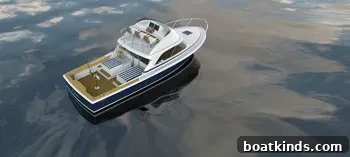
Many elements of the Bertram 31’s identity are immediately recognizable in the 35. The long cockpit paired with a relatively short superstructure and foredeck preserves the visual and functional balance that made the 31 so distinctive. That long cockpit remains a practical feature for anglers, providing a roomy working platform, and it also converts readily into a generous social area for cruising and entertaining. Engine boxes still intrude into the cockpit footprint, but they are positioned to serve as convenient seating and to allow straightforward access to the power plants.
Where the 35 diverges from its ancestor is in subtle refinements to the profile. The original 31 had a gentle, sweeping sheerline that contributed to a flush foredeck look. By contrast, the 35’s sheer is closer to a nearly straight line, with a slight slope from stem to transom. A trunk cabin rises over the foredeck to provide standing headroom in the stateroom; while this adds accommodation comfort, it also changes the forward silhouette and makes the bow area appear a touch less sleek than the original flush deck.
Superstructure design is one of the most visible—and most challenging—aspects of a boat’s appearance. Good superstructures feel integral to the hull; poorly resolved ones stick out awkwardly. In the 35, Peters and Bertram have retained the rounded windshield character of the original but increased the radius, carrying that arc up to define the flybridge windshield and the forward edge of the house. Repeating that angle across these elements creates a coherent family of lines; altering it would have upset the harmony of the profile.
Attention to curvature continues at the house’s after section, where designers have echoed soft radii to knit roofline, overhang and flybridge lip together visually. Those proportional choices reduce the sense of bulk and give the impression of a graceful, well-integrated structure rather than a heavy, tacked-on enclosure. That kind of stylistic restraint is essential when updating a classic: it preserves the original’s character while accommodating contemporary needs.
The 35 follows the same deep-vee hull concept that established the 31’s reputation. Designer Michael Peters has often praised the deep-vee as one of the defining advances in 20th-century powerboat design. When drawn correctly, a deep-vee hull delivers an advantageous combination of ride comfort, predictable handling and efficient high-speed performance—especially in choppy or offshore conditions—qualities important to both fishermen and cruising owners.
Beyond aesthetics and hull form, the new Bertram 35 aims to offer a balanced blend of seaworthiness, speed and practicality—attributes that helped the original 31 become a touchstone among sportfishing boats. By leaning on the lineage of Moppie and pairing it with thoughtful modern design and American boatbuilding, Bertram intends the 35 to be both a tribute and a capable, contemporary platform for anglers and cruisers alike.
I look forward to taking the helm of a Bertram 35 and seeing how this combination of classic proportions and modern execution performs on the water.
This article originally appeared in the March 2016 issue.