
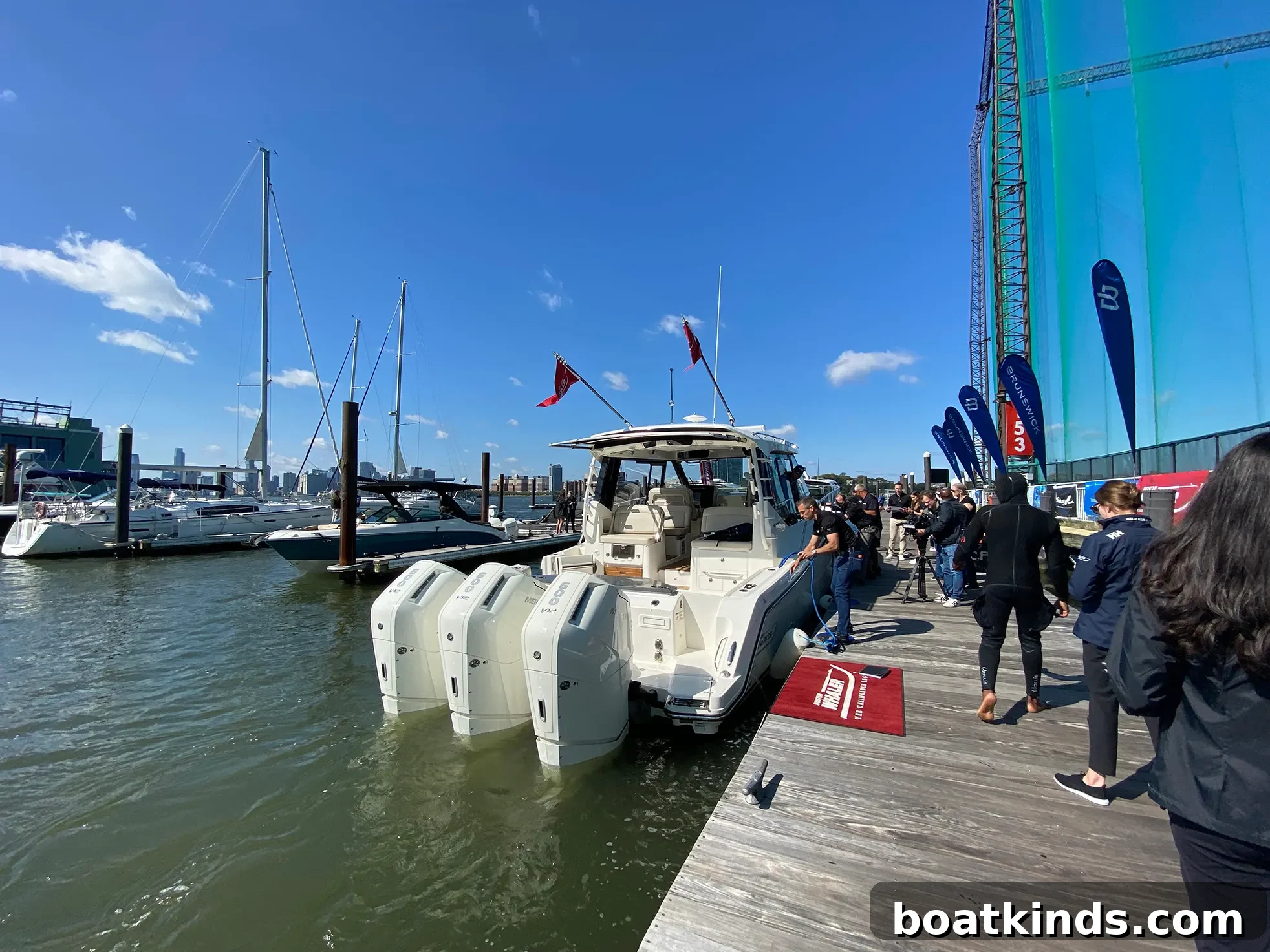
Autonomous Docking Arrives: Inside the Boston Whaler 405 Demonstration
What was once considered cutting-edge for cars—self-parking—now has an analogue on the water. Brunswick Corporation is advancing autonomous docking with its system installed on the Boston Whaler 405, and a live media demonstration in New York last September made clear how quickly the technology is maturing. I boarded the vessel with modest expectations, but after speaking with Brandon Ferriman, program director for Brunswick’s Autonomy and ADAS programs, the capability and potential of the system became obvious.
Two Core Systems: Object Detection and Path Planning
Brunswick’s autonomous docking relies on two tightly integrated components: Object Detection and a Path Planner. The Object Detection subsystem gathers continuous environmental data and identifies obstacles, while the Path Planner calculates safe, executable routes for the boat to follow. Together they enable automated maneuvers such as leaving or entering a slip and moving to a predefined point on the water with the push of a button.
The 405 used for the demonstration carries six stereo cameras placed to cover bow, stern, port and starboard, providing true 360-degree awareness with depth-processing capability. Video streams are processed by a computer belowdecks that evaluates distance, relative motion and other contextual cues. On the helm, a portside display shows the Path Planner interface and the planned route, allowing an owner to select the intended destination while the system evaluates how to get there safely.
Continuous Monitoring and Real-Time Response
One of the most reassuring aspects of the system is its constant monitoring. Ferriman emphasized that the autonomy is designed to respond to dynamic, unexpected events. If a person or object appears in the boat’s path—such as someone jumping off a dock—the system will react, either by steering around the hazard or stopping until it clears. This continuous perception and decision-making layer is fundamental to delivering both convenience and safety.
Environmental Variables and Data Collection
Docking a boat introduces many variables that vehicles on land do not face: tide and sea level changes, wind and wave forces, varying dock heights and adverse weather, to name a few. To make the Object Detection algorithm robust enough to operate anywhere, Brunswick’s development team collects extensive, real-world data. Working with partners like Freedom Boat Club, they deploy a portable camera data collection system to record conditions across different locations, then use those recordings to train and refine the onboard computer’s models.
Vessel Configuration and Requirements
The Boston Whaler 405 in the demo was outfitted with triple 600-hp Mercury V12 Verado outboards, plus a bow thruster and a Mercury joystick for precise control. While the system supports multiple engine configurations, Brunswick requires at least two Mercury outboards and a Mercury joystick for autonomous operation. Bow thrusters improve maneuverability in tight spaces but are not strictly required for the autonomy to function.
Live Demonstration: Smooth, Confident Maneuvering
During the demonstration, a Brunswick representative activated the Path Planner and selected a short destination a few feet from the dock. A safe route was plotted on the screen, and the 405 proceeded to execute the plan—from controlled revs to calculated steering inputs—moving off the dock and out of the slip without human helm control. Within minutes the boat arrived precisely at the chosen spot, illustrating how the system coordinates propulsion, steering and thruster assistance to achieve consistent results.
Ongoing Development and Planned Launch
Brunswick plans to introduce the autonomous docking system commercially in 2025. Between now and then, engineers will continue gathering video and sensor data from diverse environments, then iterate on and refine the algorithm. Ferriman explained that the recorded footage from demonstrations and field testing is used to “teach” the system, improving recognition and decision-making across a range of real-world scenarios.
Human Control Remains Central
Even with autonomy available, boaters retain the ability to pilot their vessels manually. The system is designed to augment human control, offering an additional layer of safety and convenience rather than replacing human oversight. As Ferriman summed up, the autonomous docking capability is intended to provide boaters with extra confidence and peace of mind, particularly in crowded marinas or challenging conditions.
This article was originally published in the January 2024 issue.