
From the Cradle to the Grave: The Ed Coffin Photography Collection at the Penobscot Marine Museum
The Penobscot Marine Museum in Searsport, Maine, presents “From the Cradle to the Grave: Mining the Ed Coffin Collection,” an exhibition of maritime photography highlighting ship launches, wrecks and the visual history of New England sailing vessels.
The Penobscot Marine Museum’s new exhibit celebrates the full life cycle of historic ships through photographs selected from the lifetime collection of Ed Coffin. Titled “From the Cradle to the Grave: Mining the Ed Coffin Collection,” the show features 28 images taken from nearly 3,000 photographs Coffin assembled, most documenting New England sailing vessels and many originating in midcoast Maine. The selection highlights two recurring themes in Coffin’s archive: ship launches—their “births”—and shipwrecks—their “deaths.”
Ship launches, shipwrecks, and maritime memory
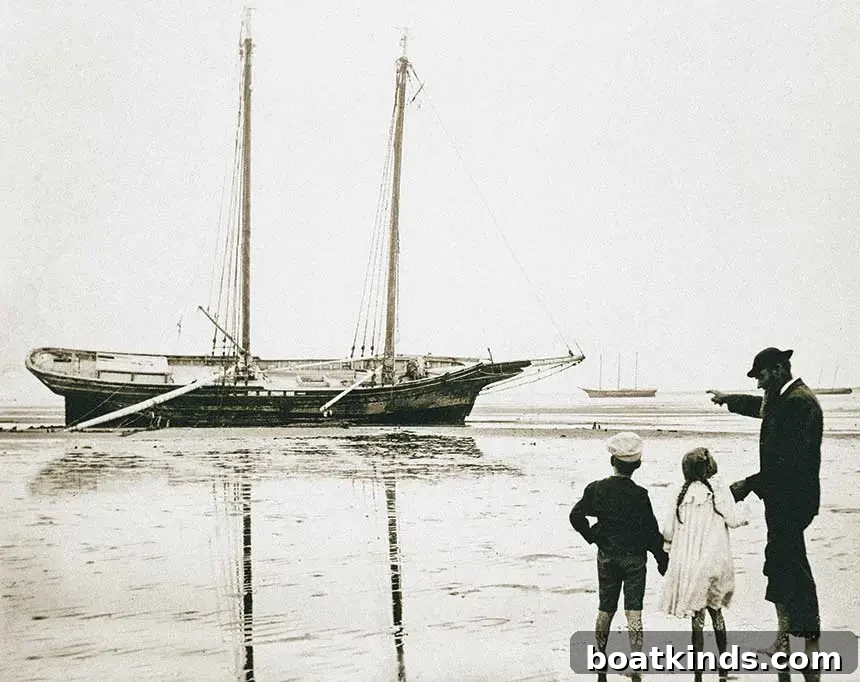
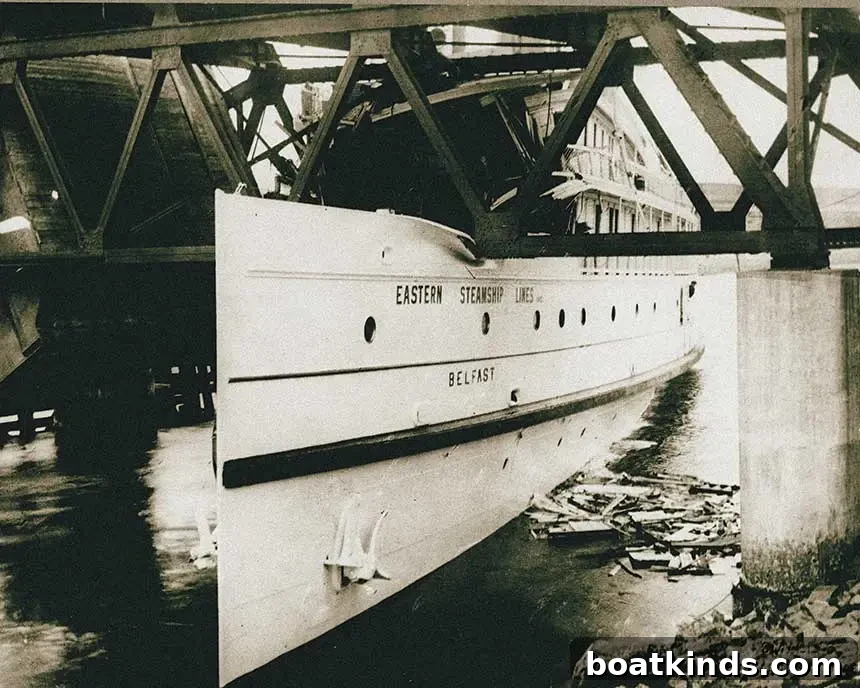
The images in the exhibit capture dramatic, quiet and often surprising moments in maritime history. Some photos freeze the energy of a launching hull entering the water, while others record the aftermath of storms, collisions and navigational failures. One standout image shows the Eastern Steamship Lines vessel Belfast as it struck the Sagamore Bridge on the Cape Cod Canal in 1919, a scene that appears catastrophic yet did not mark the immediate end of the ship’s service; the Belfast remained afloat for another two decades. Another photograph portrays a family—father and children—gazing at wrecked schooners on a Provincetown beach. Coffin’s research revealed that those ships had been claimed by The Portland Gale, the storm that drove hundreds of vessels ashore and, in at least one case pictured by Coffin, left sailors frozen in the rigging. The next day’s calm and barefoot beachgoers add a poignant contrast to the recent disaster.
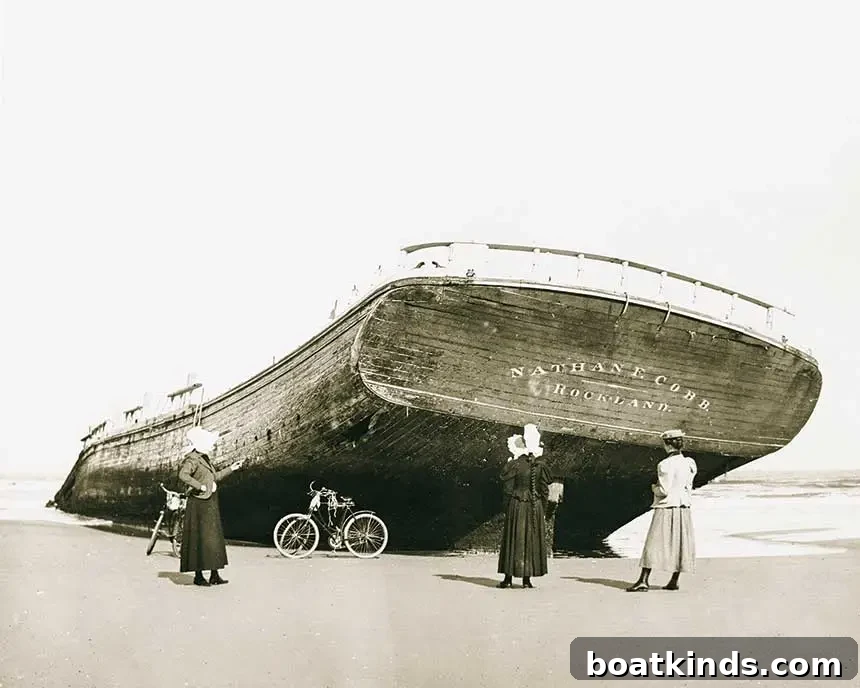
Another evocative photograph shows the schooner Nathan F. Cobb washed ashore in Florida after a gale, with bicycles parked near the hull and three women studying the damage. The image was taken by Maine resident Ida Cree, who six years earlier had photographed the same vessel at its launch in Rockland—an accidental but complete visual record of that ship’s life from launch to wreck.
About Ed Coffin and his approach to collecting
Ed Coffin was not primarily a photographer. Raised on Nantucket and later a member of the Merchant Marine, he grew up surrounded by maritime life and experienced the dangers of the sea firsthand. According to Kevin Johnson, the exhibition archivist, Coffin’s wartime service in World War II—during which several of the vessels he served on were sunk—deepened his interest in shipwrecks. After the war, Coffin and his wife settled in Alfred, Maine, and he worked as a surveyor. He developed a reputation for appearing at homes in an oddly mismatched suit and, because of his charisma and trustworthiness, people regularly entrusted him with family photographs and glass negatives.
Coffin often reproduced material—rephotographing prints or making duplicates from glass negatives—so that owners could retain their originals. More than a collector, he was a researcher: he carefully annotated prints and negatives with dates, names and corrections, sometimes updating earlier or inaccurate identifications. In an era when information was not readily accessible, Coffin and his circle of contacts—captains and maritime historians—relied on close observation and local knowledge to identify vessels. They could often determine a ship’s identity by its lines as seen from a distance at sea, a skill born of experience and shared expertise.
The collection, preservation, and the museum exhibition
Shortly before his death, Coffin donated roughly 60 years’ worth of images to the Penobscot Marine Museum—about 3,000 photographs and prints, most of them 8-by-10. These materials have been archived, digitized, and prepared for public display, allowing visitors to study and appreciate both the images and the stories behind them. The museum’s exhibit presents a curated cross-section of the collection that honors Coffin’s deep commitment to maritime history and his meticulous attention to detail.
Kevin Johnson describes the show as a tribute to Coffin’s hobby and his contributions to understanding regional maritime heritage. The display connects viewers with the labor of preservation and historical inquiry that transformed ephemeral family snapshots into a documented visual record of New England’s nautical past.
Why this exhibition matters
Beyond their visual appeal, the photographs in “From the Cradle to the Grave” function as historical evidence and storytelling tools. They trace the trajectories of vessels, the risks faced by sailors, and the communities that lived alongside the sea. The images remind us that maritime history is built from individual moments—launches cheered by crowds, storms that change lives, and the patient research that restores context to anonymous prints. By making Coffin’s work accessible, the Penobscot Marine Museum preserves not only the pictures themselves but also the local knowledge and investigative habit that turned a private collection into a public resource.
This article originally appeared in the June 2019 issue.