
Flicka: The Little Pocket Cruiser That Became a Legend
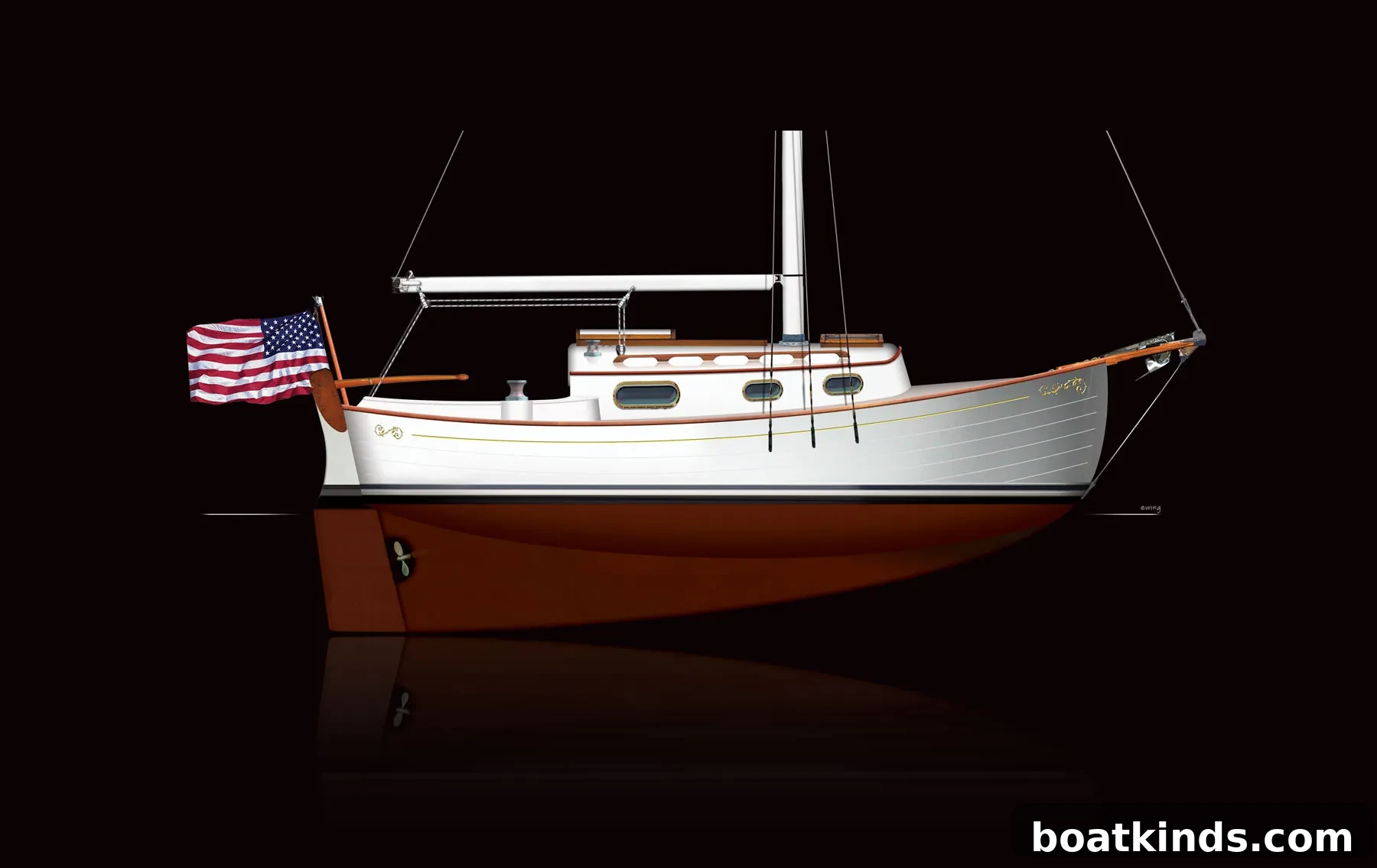
In the 1950s designer Bruce Bingham discovered two derelict wooden sailboats just south of Wickford, Rhode Island. They measured 22 and 28 feet and featured a strong sheer, a bluff bow and low freeboard. Bingham learned they were Newport boats—working fishing boats with roots in mid-19th century Rhode Island—and he used their graceful lines to create an affordable 20-foot length overall (LOD) pocket cruiser that would become known as the Flicka. The name Flicka, Swedish for “happy little girl,” reflected the boat’s compact charm.
Bingham first published line drawings for the Flicka in a 1972 issue of Rudder magazine, and the plans quickly found an audience: roughly 400 sets of plans were sold to amateur builders and boatowners who admired the design’s traditional looks and capable offshore potential. Bingham and his partner Katy Burke intended to build a Flicka of their own and in 1974 produced a plug, but they sold the plug to Nor’Star Fiberglass Yachts in California when finances were tight.
Nor’Star offered the fiberglass hulls either as kits or completed boats through Westerly Marine for about two years. In 1977 the mold passed to the young Pacific Seacraft Corporation (PSC), which is the builder most people associate with the Flicka. While many enthusiasts regard the Nor’Star/Westerly examples as especially beautiful, Pacific Seacraft’s production is widely admired for its robustness. PSC built Flickas to a high standard using hand-laid fiberglass, ample bronze hardware and quality materials that gave the little cruisers a reputation for being almost bulletproof.
Design and Performance
For their size and displacement, Flickas are surprisingly capable sailing vessels. Their hull shape and balanced rig allow them to sail well for a 20-foot boat, and owners commonly describe their motion as kind and steady. These traits, inherited from the Newport-style working boats, help explain why Flickas earned a reputation for keeping crews safe in challenging conditions. Many owners fit a small diesel auxiliary—often an optional 10-horsepower Yanmar—which provides exceptional fuel economy and dependable power when the wind fades.
Interior and Liveaboard Capability
Despite a modest beam of around 8 feet, Flickas make efficient use of interior volume. Typical accommodations include nearly 6 feet of headroom, a forward V-berth large enough for cruising comfort, a convertible settee or optional quarter berth, a compact galley with a two-burner stove and sink, and an enormous insulated cold box. A hinged table that seats four and a dedicated marine head make the layout surprisingly practical for weekend cruising or extended passages. Storage capacity is generous for a vessel of this length, enabling cruisers to stow provisions, water and gear for extended voyages.
Construction and Seaworthiness
Construction details contribute to the Flicka’s offshore reputation. Many were built with a full 1,800-pound lead keel and a stout, transom-mounted rudder hung on three bronze gudgeons with hefty pintles. This conservative engineering results in a boat that can withstand hard groundings and rough seas; stories of Flickas emerging unscathed from heavy groundings have become part of the class lore. Owners report that the design’s heavy displacement and strong underwater profile make it comfortable in a seaway and forgiving when conditions deteriorate.
Production History and Legacy
Pacific Seacraft produced at least 434 Flickas before discontinuing the model in 1998. The company later changed hands and, after a move in 2007, continued offering larger models while the Flicka remained out of production. Although new Flickas are no longer built, the model has developed a dedicated following; an active community of owners and admirers values the boat for its combination of traditional styling, solid construction and proven offshore capability.
Used Market and Value
Because of their reputation and limited production numbers, pre-owned Flickas continue to command respectable prices. A 1989 Flicka recently listed in Alaska—complete with a trailer and new sails—had an asking price of $34,999, illustrating that many buyers are willing to pay a premium for a well-built, seaworthy 20-foot cruiser that will reliably get them home. For sailors who prize safety, economy and classic lines over interior volume and high speed, a Pacific Seacraft Flicka remains an appealing choice.
This article was originally published in the July 2022 issue.