
New York Bans Floating Digital Billboards from Its Waterways
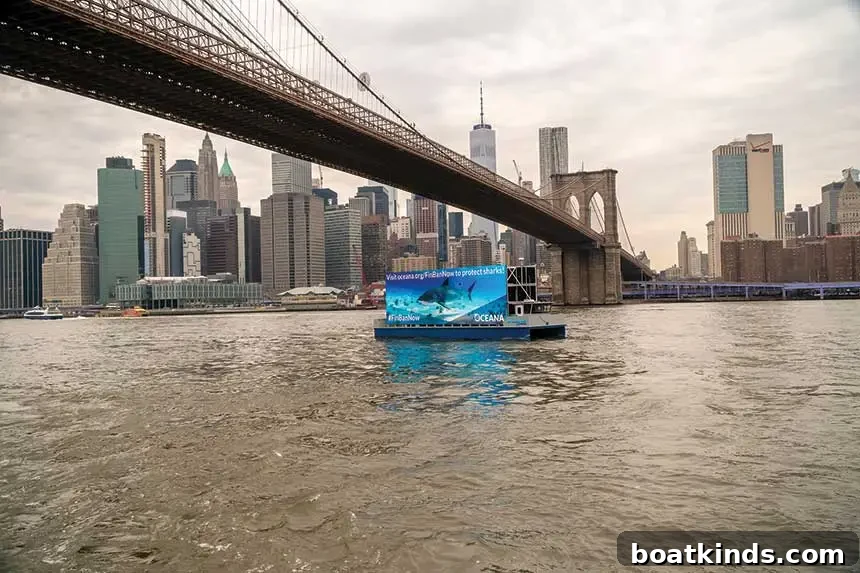
By early October, dockmasters at West 79th Street Boat Basin in Manhattan, Chelsea Piers on the Hudson, and Liberty Landing Marina in New Jersey all reported the same thing: they had not recently seen the giant, flashing floating LED billboards on the water. That relative calm on the Hudson and East rivers came after months of public complaints and legal and legislative action aimed at removing these intrusive screens.
These floating digital billboards—large vessels fitted with roughly 1,200-square-foot LED screens—turned the city’s waterways into a moving neon parade that many residents, park users and boaters compared to an offshore Times Square. Opponents described the displays as visual pollution that distracted from waterfront views and created potential navigation and safety hazards for small boats and drivers watching the shoreline.
In March, New York City Mayor Bill de Blasio filed a federal lawsuit asserting that the signs constituted a “public nuisance,” and sought substantial penalties—up to $25,000 per violation per day. Then in August, Governor Andrew Cuomo signed state legislation that banned the floating digital billboards outright and took effect immediately. The law aimed to preserve natural waterfront views and reduce safety risks associated with the moving LED displays.
“These floating billboards are a nuisance that blight our shores and distract from the great natural beauty of our waterways,” Governor Cuomo said when signing the bill into law. “This action will help make our waters more enjoyable and safer for everyone.”
The legislation was co-sponsored by State Senator Brad Hoylman of Manhattan, who said he had received numerous complaints from residents about visual pollution and from boaters worried about safety on the Hudson and East rivers. Hoylman described the billboards as “floating monstrosities” that function like oversized televisions drifting toward shore.
“It’s like a very large television screen floating down the river right at you,” Hoylman told Soundings. “It’s dangerous to boats. Nobody wants to see it. It’s dangerous to drivers. This is a new technology that I think we needed to ensure local municipalities could take action on, so that’s what we did.”
The company behind the floating billboards, Ballyhoo Media, has previously faced municipal pushback. In 2017 Miami Beach lawmakers moved to limit the digital screens in parts of Biscayne Bay, though the company continued operating on other local waterways. Ballyhoo has promoted the technology as a way to commercialize waterfronts and reach large urban audiences.
Advertising revenue is at the heart of the dispute. Ballyhoo’s CEO, Adam Shapiro, told the Miami Herald that some 100,000 viewers per day in Miami and up to 500,000 per day in New York were being exposed to the floating screens. Media trade coverage has suggested ballpark rates for a 30-second spot in a two-minute loop on these boats could run roughly $55,000 in New York City and $35,000 in Miami for a four-week buy—figures that help explain why operators continued to run displays even after the ban took effect.
Hoylman said Ballyhoo appeared prepared to treat any fines as a cost of doing business when the law became active. He noted that local enforcement could involve different penalties: while the mayor’s federal lawsuit referenced potential fines up to $25,000 per violation per day, Hoylman also noted that city-issued fines tied to enforcement by the NYPD could be up to $5,000 per violation. He added that state lawmakers were ready to revisit and strengthen measures if the billboards persisted.
Since the state ban was enacted and public pressure intensified, marina operators and dockmasters report fewer sightings of the LED-equipped barges. For many boaters, park visitors and waterfront residents, the reduced presence of moving digital billboards represents a return to quieter, more scenic riverfronts.
Supporters of the ban framed it as a victory for waterfront quality of life and for public safety. Hoylman called the law a win for boaters, park users and anyone who values the natural character of New York’s shoreline. He emphasized that the legislation enables local authorities to prevent a technology-driven visual takeover of public waterways.
The controversy over floating digital billboards underscores the tension that arises when novel advertising platforms intersect with public space and environmental aesthetics. While commercially lucrative, the large LED screens provoked sustained opposition in New York and elsewhere. With state law now prohibiting the devices on New York waterways, the debate has shifted from whether they are desirable to how best to enforce the ban and prevent future incursions.
This article originally appeared in the December 2019 issue.