
Geoff Hunt’s paintings are instantly recognizable to readers who have followed the sea‑faring adventures of Jack Aubrey and Dr. Stephen Maturin in Patrick O’Brian’s historical novels. Hunt’s carefully rendered marine art became the chosen cover imagery for many editions of O’Brian’s books, and his name is closely associated with that definitive visual world of the Napoleonic era. For fans of maritime fiction and historic ship portraiture, the combination of O’Brian’s prose and Hunt’s canvases has been a persuasive invitation to imagine life at sea in the age of sail.
Working primarily in oils for much of his career, Hunt has produced striking depictions of the great warships of the late 18th and early 19th centuries — from the iconic HMS Victory to the fictional but vividly realized HMS Surprise. Patrick O’Brian himself praised Hunt’s paintings, writing, “Geoff Hunt’s pictures, perfectly accurate in period and detail, but very far from merely representational, are often suffused with a light reminiscent of [Italian Renaissance artist] Canaletto.” That balance of technical accuracy and atmospheric light is a hallmark of Hunt’s work and part of what makes his canvases so compelling for readers and collectors alike.
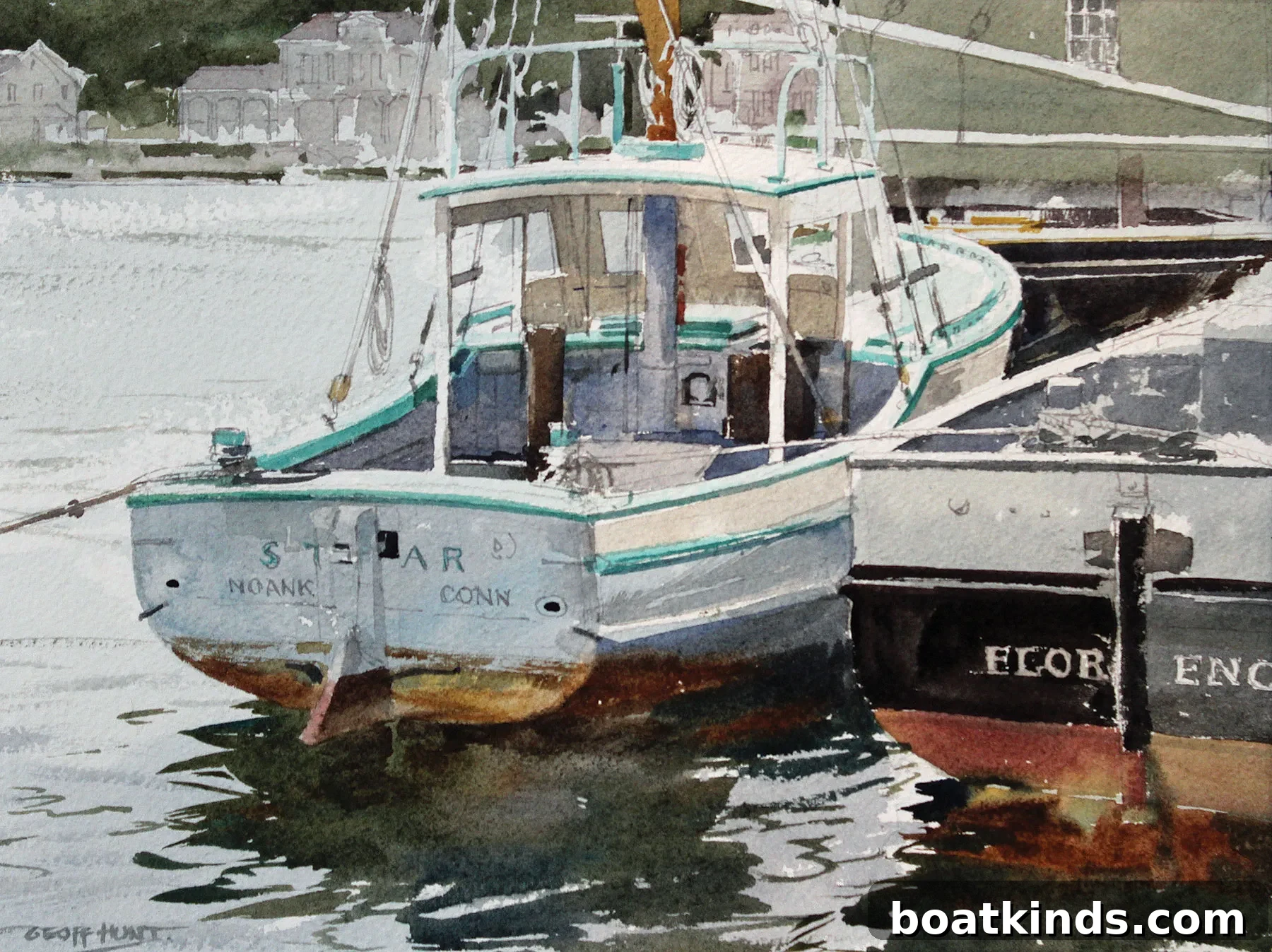
Given this association with large sailing men‑of‑war, it may come as a surprise to see a small New England workboat like the Star appearing in Hunt’s catalogue. The little boat, shown tied up along a wharf in Noank, Connecticut, is nevertheless a natural subject for an artist who studies hull form, rigging, and the functional beauty of working craft. “I was over in Mystic for their Plein Air Painters show in June of 2018, and I spent four delightful days painting in and around Mystic and Stonington. Star happened to be in the harbor at the time,” Hunt recalls. That momentary encounter with a humble local vessel yielded a painting that speaks to the same design ethos Hunt admires in larger naval ships.
Hunt notes the kinship between the grand and the modest: both warships and fishing boats are constructed with purpose and economy — elements he finds visually honest and artistically interesting. “They are both built for a workmanlike purpose, and very little about them is unnecessary decoration,” he says. “Nor is there any provision for cruise passengers!” This practical aesthetic, where form follows function, allows Hunt to celebrate the structural lines and weathered surfaces of traditional craft without romanticizing them.
For this particular piece Hunt worked plein‑air — painting directly outdoors to capture transient light and atmosphere. In recent years he has favored watercolor for plein‑air work because of its luminosity and the immediate results it can yield. “Watercolor has been my chosen plein‑air medium for some years now,” he explains. “I enjoy its luminosity and immediacy of handling. The feeling of always dancing on the edge with this tricky medium is very stimulating, but it does give a failure rate much higher than with oils, especially when it rains.” That willingness to accept risk in pursuit of visual immediacy is characteristic of plein‑air practice and of Hunt’s approach to capturing maritime subjects on location.
When he painted the Star along Connecticut’s southern coast, the sky was overcast, yet the rain held off long enough for him to work. The resulting study retains the spontaneous sensitivity to changing light that plein‑air painting affords, while still reflecting the careful draughtsmanship and period awareness for which Hunt is known. The piece demonstrates how an artist celebrated for historical ship portraiture can find equal fascination in the everyday vessels that continue to populate harbors and coastal villages.
Hunt is a long‑standing figure in the marine art community: he is a member and former president of the Royal Society of Marine Artists, and his body of work spans detailed, historically informed oils and lively plein‑air watercolors. Those interested in seeing a broader selection of his work can consult his book, The Sea Painter’s World: The New Marine Art of Geoff Hunt, which gathers examples of both his studio and outdoor practice.
Steve Knauth contributed the original text for this piece. This article was originally published in the January 2021 issue.