
Chesapeake Bay Capsize: Quick Rescue Saves Three Anglers in Freezing Water
Trouble on the water can arrive in an instant. One moment you’re drifting and celebrating hookups on big striped bass in midwinter; the next you can be waist-deep in 38-degree whitecaps, clinging to the bow rail of a capsized 21-foot boat in the middle of Chesapeake Bay with hypothermia closing in.
“Your perception of time changes in a situation like that,” says Kevin Gladhill, who survived the February incident with two fishing companions. From the first wave that swamped them to the second that flipped the boat was only about three or four seconds, he says. “I went to start the engine and, boom, we were gone.”
The three men launched from Chesapeake Beach in the pre-dawn hours of Feb. 10 to fish the famed “Rips,” the warm-water plume created by the discharge from the Calvert Cliffs Nuclear Power Plant on the Western Shore. Gladhill, a 32-year-old police officer, was aboard his trusted 21-foot Parker center console.
They left at 5 a.m. and ran due south for roughly an hour to the outflow. Conditions at launch were calm and clear, with a forecast calling for 8 to 12 knots of northwest wind once the sun rose. By 6:30 a.m., Gladhill, Michael Krall, 35, and Russell Neff, 55, were jigging soft plastics over the rocky outfall and began landing large rockfish (striped bass).
Rockfish season is closed to harvest for Maryland recreational anglers in winter, but catch-and-release fishing is permitted. By 7:30 a.m. the trio had boated and released roughly a dozen fish of 36 inches or larger. By then the wind had strengthened considerably, with gusts Gladhill estimates at 20 knots or more from the north-northeast—directly against the plume’s flow and creating a dangerous, confused sea.
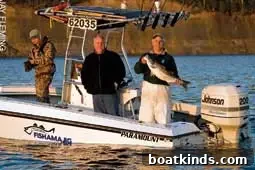
Part-time guide Dennis Fleming arrived in his low-profile 21-foot Paramount with a friend and engineer Terry Warhurst. Fleming, 51, says the Rips were ugly. “There were 4- and 5-foot standing waves in the plume,” he recalls. “The front, where the water comes out, was fishable, but a quarter of the way back it was mayhem.” He tried a couple of drifts and hooked two good fish but judged the conditions too hazardous and was preparing to leave.
That’s when Fleming saw Gladhill’s boat heading into the plume with its motor off. “The boat got sideways, it started listing, and within seconds it turtled,” Fleming says. He called a mayday on VHF channel 16. The Coast Guard responded and pressed for GPS coordinates, which Fleming didn’t have; he relayed the general location at the Calvert Cliffs discharge and stressed there were people in the water needing rescue.
The capsized Parker was only about 100 yards away. When Fleming pulled up he encountered debris everywhere. At first he thought a camouflage jacket floating in the churn might be a person, then spotted the three men standing on the bow rail of the overturned hull, hanging onto it roughly three feet below the surface. They were wearing life jackets.
Fleming maneuvered carefully to avoid crushing them against his bow. His low bow rail and a stern swim ladder made the rescue possible. “They didn’t want to swim to me, and I didn’t want to crush them,” he says. One by one they grabbed the rail and were worked toward the ladder. The second man was heavy and frightened—“Please don’t let go of me,” he begged—and got his foot caught in the ladder before finally entering the boat headfirst. The third man, the oldest but lightest, was easier to help aboard.
Fleming and Warhurst then battled to keep their own boat from swamping as they worked to get the drenched, freezing anglers inside. Once aboard, the three survivors instinctively curled into survival crouches—knees to chin—seeking shelter for the rough, cold run back to shore. Fleming keeps his boat at a marina in Flag Harbor, about three miles from the Rips, and the trip back was three hard, upwind miles in an overloaded small vessel.
They arrived at Flag Harbor around 8:30 a.m., Fleming waving frantically and sounding the air horn to attract help. Local EMS personnel were initially in their vehicles with the windows up and the heaters running; Fleming contacted the Coast Guard dispatcher to get the ambulance crew to his slip so the men could be transported to the hospital.
Fleming downplays any notion of heroism. “He just said that he would have done the same for me,” Gladhill says gratefully. All three were treated at the hospital for mild hypothermia and released. Gladhill’s Parker sank and was lost, but it was insured. Looking back, Gladhill believes the critical mistake was cutting the engine for a drift—doing so likely prevented them from powering out of the rough patch after the first wave swamped the cockpit. “That cost me my boat and almost my life,” he says.
The men had made a policy of wearing life jackets. While Gladhill admits they may not have been the sole reason the trio survived, the jackets certainly reduced the danger in the freezing water.
“If you’d told me a Parker would flip, I’d have called you crazy,” Gladhill says, but he plans to be back on the water fishing again this spring.
This article originally appeared in the May 2011 issue.