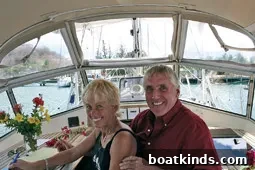
A collision with a submerged object may have re-opened a repaired keel area and sank the 47-foot cruiser.
The weather had not been kind to Paul and Helen Glavin as they cruised, and the night of April 1 was no different. Fooled by a forecast of gentle northeasterlies, the retired British couple set off from the British Virgin Islands on a 120-mile night passage to St. Kitts aboard their 47-foot sailboat, Helen Mary Gee.
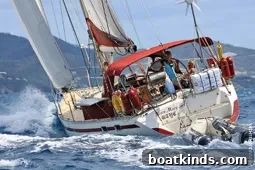
They left Virgin Gorda in a warm breeze under clear, moonlit skies, but soon ran into a line of squalls and steep 6- to 8-foot seas. Helen, zipped up in foul-weather gear, helmed while Paul slept on a cockpit settee. The sturdy Sovereign 470 powered on at about 6 knots under reefed sail until, at 2:20 a.m., HMG came to a violent stop and then slammed forward again. The impact hurled Paul to the deck and threw Helen into the stainless-steel wheel with such force she bent it.
They still do not know exactly what the boat struck. “We can’t guarantee it was a whale,” Paul says from their home in Weymouth, “but it was something bloody hard. I hope it got an extreme headache, because it sank our boat.”
The Glavins had planned this voyage as the beginning of a round-the-world cruise. A retired automotive engineer and certified oceanmaster yachtsman, Paul had spent two years preparing the 1990 Sovereign for long-distance work. Built in Spain with a solid Kevlar-reinforced fiberglass hull below the waterline, Helen Mary Gee was a rugged boat in which he had confidence.
The yacht had already proven itself on an earlier passage: during the first day of the November 2007 Atlantic Rally for Cruisers from the Canary Islands to St. Lucia the bluewater cruiser survived a severe knockdown and later made 6 knots under bare poles in 55-knot winds and 18-foot seas on the 2,700-mile crossing. That ARC passage proved brutal for many — a skipper was lost, a boat was abandoned, and several entries suffered damage — but the Glavins managed it and intended to continue their plans after a pause to be near family.
Waves of water
The collision badly injured both of them. Helen broke two ribs and later required elbow surgery; Paul smashed his chin and suffered nausea and a persistent headache. After the strike Paul went below to check for damage and, finding nothing obvious, returned to help Helen. An hour later the masthead wind instruments and VHF antenna began failing. At the companionway he stepped ankle-deep into water. Flooding had shorted cables in the bilge that ran up the keel-stepped mast and disabled communications.
In the forward cabin Paul found water pouring in from under the floorboards at the foot of the berth. The black-water tank blocked access to the bow bilge, where he suspected the hull breach lay, so he stuffed cushions under the boards to try to slow the inflow. The yacht’s two electric bilge pumps continued to run, and Paul worked a manual pump, but the deluge overwhelmed their efforts. “It was very much like the Dutch boy and the dike story,” he says. He had screwed the floorboards down, a small measure that prevented them from floating and making movement impossible once the cabin filled.
Rather than a slow, steady rise, the water moved in violent surges. Tons of water sloshed back and forth, tearing up fittings and spewing from inspection hatches as Helen Mary Gee pitched and fell on the steep seas. Paul remembers the scene as “heart-rending” — this was their home being destroyed.
With the bilge rising, his priorities were to summon help and prepare Helen for the life raft; she could not swim or climb into a raft from the water unaided. They estimated they were about 24 miles from Saba in the Netherlands Antilles. Paul’s hand-held VHF had roughly a 15-mile range. Earlier that night he had seen navigation lights, but at the time of the flooding none were visible.
They kept broadcasting maydays on the hand-held while making for Saba, hoping to raise a passing vessel. Paul secured the life raft painter to the stern rail and deployed the canister. The raft inflated, but getting Helen into it from a sinking deck would be difficult.
Decision to ditch
By about 6 a.m., nearly four hours after the strike, HMG was still well off land and no one had answered the maydays. Water had reached the top of the battery box under the aft berth; once the batteries were submerged, the electric pumps would fail and Paul feared battery acid reacting with salt water could produce chlorine gas in the cabin. “We knew we were losing the battle at that stage,” he says.
Helen packed their waterproof grab bag with essentials — money, passports, cards, a change of clothes — and an emergency kit containing a hand-held VHF and GPS, two flare packs, an EPIRB, a chart, water and biscuits. With the bow nearly awash, they launched their 9-foot inflatable dinghy from the bow using the topping lift and boom, a maneuver they had performed many times before.
Paul boarded first with the grab bag and emergency gear, then helped Helen aboard. Before leaving Helen insisted on retrieving her deck sandals; both were still wearing foul-weather gear. “There was no way she was going to walk down [the street] in her sailing boots and shorts,” Paul recalls. He quietly agreed to bring his sandals too.
The rescue
They towed the life raft and tried to motor for Saba, but Paul had left the outboard’s safety lanyard in the chart table. He improvised by unraveling a painter line and tying a strand behind the shut-off to hold it in the “on” position. He activated the EPIRB; a satellite picked up the signal at 5:50 a.m. and fixed their position about 10 minutes later.
Drifting away from Saba with the raft in tow, they cut the raft loose and motored toward the island. As they passed HMG they saw her stern high and bow low, the mast sinking deeper with every wave. “The back of the boat sat there like a duck’s butt up in the air when it’s feeding,” Paul says. The boat slipped beneath the waves with the wind generator the last to go. “You could see her outline just below the surface,” he remembers. “Then bits and pieces began to pop up. It was very eerie.” The sight still brings him to tears.
They fired three flares over the next hour and a half and kept broadcasting maydays. Around 7:30 the French sea rescue service in St. Martin answered and arranged for the British yacht Dreamcatcher, eight miles away, to come to their aid. The Glavins made for Dreamcatcher and by 10:30 they were aboard Roger and Lucyna Culverwell’s boat. Over a cup of tea they finally broke down — frightened, exhausted, but relieved. “I never accepted for a second that we weren’t going to survive,” Paul says. Their preparation and calm decision-making had paid off.
Before returning to England the Glavins stood as official witnesses at the Culverwells’ wedding aboard Dreamcatcher; the couples had become close during the ordeal.
Their insurer paid a $250,000 settlement and offered a likely explanation for the flooding. Helen Mary Gee had grounded hard in Saint Martin in January, damaging the keel area. Although the Glavins had taken the boat to a shipyard and had repairs made, the insurer believes the impact off Saba re-opened the crack and may have extended it forward. “Had this been the first strike, we probably would have survived it,” Paul says.
Another boat?
Back ashore and restless, Paul began looking for another bluewater boat. Helen is more hesitant, but Paul hopes they might find a good cruiser in California and resume their plans: sail to the Galapagos, cross the Pacific to the Marquesas, New Zealand and Australia, and return home via the Suez Canal. “The sea humbles you,” he reflects. “But you meet some very nice people. It really is great fun.” Sinkings aside.
This article originally appeared in the September 2009 issue.