
Last month I reviewed how planing, semi‑planing and displacement hulls behave in rough water. This month I’ll cover practical offshore boat‑handling tactics: how to approach steep and breaking waves, the role of speed and hull form, running down‑sea and through inlets, and how trim tabs, rudder design and steering response affect control.
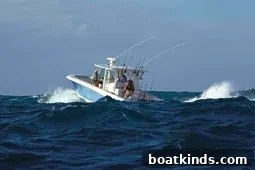
Meeting steep waves
Striking a wave head‑on increases the relative speed between boat and sea, which in turn raises impact forces and abrupt motions. If your destination lies directly on the same bearing as your present position, sailing a straight course is the shortest route, but not always the safest when the seas are steep. In large, choppy conditions it often makes sense to zig‑zag 20–30 degrees to either side of your intended track. This reduces the effective closure rate with each wave and lets the hull crest and descend more gradually.
One practical technique is to change course briefly and, when appropriate, ease off the throttle just before cresting a particularly big wave. Launching gently over the peak and then returning to your original heading helps dissipate energy through both pitch and roll rather than concentrating it entirely in pitch. These controlled course changes and speed adjustments make the ride less violent and improve crew comfort and safety.
Breaking waves
When a wave is steep enough to break, the priority shifts from smoothing impacts to avoiding capsize. A broad bow impact on a breaking crest can simultaneously induce pitch and roll, increasing the risk of overturning. In these cases the safest approach is usually to meet the wave bow‑on, reducing speed enough to soften the hit but not so much that you lose steerage and control of heading.
As a crest hits, you may need a sudden burst of power and firm rudder input to hold heading and prevent the bow from being pushed sideways. This is where azimuthing propulsion systems — pods, outboards and some sterndrives — provide a big advantage. They deliver nearly instant steering authority even at very low headway, allowing you to crawl into a breaker with better control than many conventional drive setups.
Think in terms of wave gradients: the boat aligned directly into or with the wave conforms most naturally to the slope, while a beam sea places the hull in a less conforming position. Often the best compromise is to present the bow at 25–45 degrees to the wave face to retain both trim and heel control. On keel‑less planing hulls, abrupt course changes can be used to induce heel that actually aids control. Conversely, deep‑keel boats that heel outboard in turns can worsen control when trying to turn back up‑sea or recover in quartering seas.

Speed and the ability to use it
Speed capability is invaluable in rough water, provided the hull form delivers controllability, dynamic stability and a reasonable ride. I’ve handled many 12‑knot boats in adverse conditions and never missed extra speed. A planing hull that planes cleanly at 12–13 knots while maintaining good tracking and comfort up‑sea and down‑sea is ideal. Many production planing hulls are too flat or too full forward to sustain speed comfortably in a seaway.
The Hunt hull form is one well‑known example that performs consistently as an all‑around offshore planing hull, which is why many pilot boats use this design. A hull that maintains higher average speed through rough water can be the difference between arriving safely and being overwhelmed. Speed and agility let you avoid local hazards, cross bars more safely and position the boat relative to waves to reduce risk.
Running down‑sea
Running down‑sea exposes boats to different risks than running up into the waves. One advantage of a capable planing hull is the ability to overtake waves: if a wave is very long you may need 19 knots to keep pace; having the capacity to run at 25–30 knots lets you choose your position on the wave’s back, where motion is often gentlest. A slow or poorly designed planing hull lacks that flexibility.
Displacement hulls offer superior range and a predictable motion, but they are more vulnerable to storm systems and breaking waves because they cannot escape or reposition quickly. Displacement sterns pick up buoyancy gradually, so the stern lifts less dramatically when a sea from astern arrives, reducing bow plunge. By contrast, a broad, buoyant planing stern can lift suddenly if you are running below wave speed, causing the bow to dig in and potentially turning the hull into an unmanageable control surface.
Successful down‑sea handling is a function of hull form, rudder effectiveness, dynamic stability and speed. Often the best tactic is to run with the waves, matching their speed and staying on the back of a wave when possible. If the waves are quartering, between beam and stern, mismatched speeds can produce heavy rolling and sudden yaw. Deep simultaneous roll and yaw can lead to broaching and capsize, so minimize overtaking waves unless you have an appropriate hull, ample power and the necessary experience.
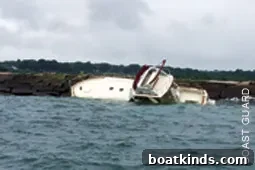
Running an inlet
Inlets and bars concentrate wave energy as the bottom shoals, making waves steeper and closer together, and creating frequent breakers. A breaking face can approach vertical and even invert; if any heading other than bow‑on catches you on that inverted face, capsize is likely. Maintaining a bow‑on approach through an inlet is ideal, but often impractical without speed. The alternative is to time your transit and ride the back of a wave through the channel.
Study the pattern of waves before committing. Watch 40–50 successive waves to learn where the breaks occur and identify the deepest, safest part of the channel; the waves are least likely to break there. Aim for the smallest surf line and wait for a lull or for a chance to move in between unusually large or “freak” waves. Prepare the boat: close hatches and doors, clear scuppers, have everyone wear life jackets and sit low and near exits. Do not allow passengers to shelter in the cabin during a bar crossing — if the boat capsizes they are more likely to become trapped below decks.

Tabs, steering response, rudder design
Trim tabs let you adjust bow attitude. Lowering tabs can improve acceleration onto plane or smooth the ride into a head sea by changing how the forward deadrise meets waves. Designers often bias the center of gravity slightly aft so the bow runs high for down‑sea stability, and use tabs to bring the bow down when needed. Tabs can also correct heel from beam wind or an off‑center load.
For inboard configurations, rudder design and placement are critical. A rudder creates lateral lift, and sufficient surface area and allowable deflection are essential for control at both low and high speeds. A 35‑degree deflection each side (70‑degree arc) is a good target — more causes stalling, less reduces lift. Small rudders reduce drag and can gain speed, but they compromise low‑speed handling.
Rudder reliability depends on positioning far enough aft to avoid ventilation when turned and on a shape that produces predictable lift. An axe‑head profile is often preferred for planing boats because it yields proportionate lift with increasing angles and resists stalling. Foil‑shaped rudders work well on displacement hulls because they minimize drag at lower speeds but tend to stall at planing speeds.
Next month I’ll examine handling for waterjets and open‑bow boats, explore situational awareness in greater detail, and discuss how different propulsion types affect control and tactics at sea.
October 2014 issue