
Gary Ramos is in the midst of a solo circumnavigation around the top of the world.
California native Gary Ramos is attempting a rare solo circumnavigation by sailing around the North Pole aboard his 39-foot steel cutter, Arctic Wanderer. Sailing solo around the top of the globe is exceptionally challenging; if Ramos completes the voyage, he may be recognized as the first person to accomplish this feat solo. The voyage draws attention among explorers and sailors because the Arctic presents unique and constantly shifting hazards that make a continuous passage extraordinarily difficult.
While several sailors and crews have circled the Southern Ocean and even Antarctica, the Arctic is a different test. Notable Southern Ocean voyages include Brazilian Amyr Klink’s mostly non-stop 14,000-mile passage around Antarctica aboard the 50-foot aluminum sloop Paratii in 1999, and Russian adventurer Fedor Konyukhov’s 2008 solo non-stop 16,000-mile dash around Antarctica on the 85-foot racer Trading Network Alye Parusa. Those achievements highlight the contrast: the Southern Ocean, though savage, is navigable year-round, whereas the Arctic is dominated by sea ice that opens and closes ephemeral channels each summer.
The Arctic’s frozen seas allow only a brief window for navigation. Open channels commonly appear for roughly two months—generally August and September—before closing again as the ice shifts. Ice movement can create sudden openings and dangerous pressure ridges; conversely, it can crush or pin a vessel against shore or other ice. These conditions make any attempt at a full circumnavigation around the North Pole an immense logistical and physical challenge, yet Ramos has chosen to press on.
“I love the cold,” Ramos, 56, told Soundings by satellite phone from Sisimiut, Greenland, roughly 30 miles north of the Arctic Circle. “I feel at home in the Arctic. Sailing around the North Pole just seemed like something I wanted to do.” His commitment to the region, combined with a lean budget and a small, sturdy boat, drives this bold endeavor.

Ramos set out from Seward, Alaska, in May 2005 aboard Arctic Wanderer, a cutter built in 1983 and powered by a temperamental 27.5-hp Yanmar engine. His plan was to make a west-to-east transit of the legendary Northwest Passage in a single season. He sailed north through the Bering Strait, crossed the Chukchi Sea along Alaska’s North Slope, and pressed east into the Beaufort Sea and Canada’s Northwest Territories.
By late August he had completed just over 1,000 miles of the roughly 3,400-mile Northwest Passage—a complex network of islands, narrow channels, and shallow straits that thread through the Canadian Arctic Archipelago. Then a combination of mechanical problems and administrative complications halted his progress. Engine trouble forced him to stop in Cambridge Bay, a small community of about 1,500 people located 170 miles above the Arctic Circle, and ice soon trapped Arctic Wanderer at the dock.
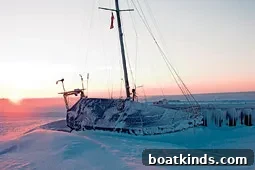
Winter in the high Arctic was severe. The sun set on Nov. 28 and did not return until Jan. 12, bringing prolonged darkness and temperatures that plunged past minus 50 degrees Fahrenheit, while gale-force winds arrived at times. Ramos kept warm inside the boat with a Dickinson cabin heater and improvised fuel storage, periodically digging jerry cans out of snowdrifts when supplies ran low. The cold pressed on the hull and tilted the boat about 15 degrees to starboard, but Ramos made do—sleeping below and living the close-quarters reality of a vessel hard-packed in ice.
Despite the hardship, Ramos described the experience as rewarding: the Arctic’s stark light during twilight and its quiet, vast landscapes left a strong impression. He managed to find occasional shelter ashore by housesitting for locals who were away, and he savored the unique, otherworldly beauty of polar winter twilight—a scene he says is difficult to imagine without seeing it in person.
After several months in Cambridge Bay, Ramos left the boat under the care of friends he had made in the community and flew to the United States to visit family. When he attempted to return in spring 2006, Canadian authorities denied his re-entry on the grounds that his lengthy winter stay had been unlawful, and he was deported. Arctic Wanderer remained frozen in Cambridge Bay through another winter.
Ramos returned to the boat in 2007 after resolving some of the bureaucratic barriers, but timing again worked against him. He launched late in the season and was forced to leave Arctic Wanderer frozen in Cambridge Bay for a third winter. Finally freed in August, he resumed his voyage and on Sept. 20 reached Greenland after a demanding 1,900-mile passage that involved dodging pack ice, braving storms, and making urgent repairs at sea.
“I was elated to get to Greenland,” Ramos said. After the Greenland stop he planned to continue eastward, with Norway as a target for the following season. He intends to resume his circumnavigation in the spring and to press onward around the Arctic as conditions permit.
For those interested in following his progress or learning more about the expedition, Ramos maintains a site documenting the voyage: www.arcticwandering.com.
This story originally appeared in the January 2009 issue.