
Rich Wilson’s Solo Vendée Globe: Endurance, Injuries, and Resolve
Rich Wilson sits at home in Marblehead, Massachusetts, carrying a head full of memories and a body marked by the cost of a single-handed circumnavigation. Wilson, who turned 59 in April, became only the second American to complete the Vendée Globe, the notoriously demanding solo round-the-world race often called the “Everest of sailing.” He finished ninth, after 121 days, 41 minutes and 19 seconds at sea, logging 28,197.2 nautical miles aboard his fiberglass Open 60, Great American III.
The Vendée Globe is a non-stop, solo race of roughly 26,000 miles held every four years. The fleet for that edition left Les Sables-d’Olonne, France, on Nov. 9, 2008, with 30 boats starting and only 11 vessels reaching the finish line. Since the race began in 1989, fewer than 60 sailors have completed it, underscoring how rare and difficult the achievement is.
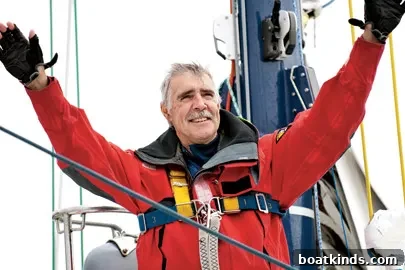
Wilson’s Vendée Globe campaign was defined by punishing weather, technical failures, and injuries. Late in November a massive storm forced 11 competitors to withdraw. The same storm left Wilson ill for days and, soon after, he was violently thrown across his cabin, cracking a rib when his back struck a grab rail. He describes the ongoing pain: every time he ground the pedestal winch, pulled a line, or braced himself against a lurching deck, the rib reminded him of the cost of every maneuver.
Tough going
He calls the entire race “beyond physical.” While nursing that rib, Wilson struggled to sleep and to keep his energy up as instruments and weather conspired against him. He jury-rigged a reclining seat from bench cushions to provide a 45-degree support for his back, because climbing into the bunk became too painful. That makeshift arrangement helped him rest but never fully eased the difficulty of sleeping in cold conditions when he couldn’t fully get into his sleeping bag.

By Dec. 27, another accident in the Southern Ocean added to his injuries. Sleeping on the windward side of the boat, Wilson was thrown from his bunk and struck his head, opening a large gash above his left eye. Blood covered the cabin and the wound became a dramatic reminder of how unforgiving solo ocean racing can be.
Injuries were not unique to Wilson. French sailor Yann Elies had to retire on Dec. 19 after a violent wave fractured his femur, and many others withdrew during the stormy stretch. Derek Hatfield, a fellow competitor and friend from near Toronto, retired his Open 60 Algimouss Spirit of Canada on Dec. 29 because of mast problems. Wilson regularly called Hatfield during the race to trade encouragement and commiseration; Hatfield recalls Wilson’s consistent thoughtfulness and support despite his own hardships.
Technical challenges and fatigue
Beyond physical trauma, Wilson faced persistent technical problems. His primary wind instrument failed off South Africa, and when he switched to the backup it didn’t function. At times the primary unit did recover for short stretches—through parts of the Indian Ocean and later for a time in the Pacific—but ultimately the instrument failed for good before Cape Horn. With unreliable wind readouts, Wilson relied on his autopilot tied to a compass and forced himself to keep watches of only 15 to 20 minutes to return to the cockpit and verify heading and avoid uncontrolled jibes. The constant upwind slog in the Atlantic compounded fatigue: working a 60-foot boat for months while managing sleep deprivation, pain, asthma triggers and mechanical breakdowns results in relentless pressure on body and mind.

Uneasy start
Wilson’s relationship with Great American III began with challenges. He bought the Open 60 in 2006 and, while delivering her from La Trinité-sur-Mer, France, to testing waters, the boat struck a submerged object that fractured the bow, sheared off the daggerboard and damaged a rudder. Wilson completed a 14-hour emergency repair, swapping rudders and nursing the boat the rest of the way, and discovered the vessel’s speed despite the damage.
The boat had been set up for single-handed sailing with 51 lines routed aft to the cockpit and a pedestal winch able to power three other winches. That layout helped when Wilson later completed a solo Brazil-to-France passage as his Vendée Globe qualifier. Still, some friends worried about his choice to attempt the Vendée on that particular boat. Newport sailor Ed Sisk admits he wasn’t initially convinced by the plan, but he respects Wilson’s seamanship and meticulous care for his boat—so much so that Sisk noted Great American III was among the best-presented boats into port after the race.
The Great American and the man behind it

Sailing has been Wilson’s life since childhood. His father began racing a 42-foot ketch when Wilson was young, and Wilson later won the Newport Bermuda Race aboard that vessel. He lives with severe asthma but finds the cleaner air at sea generally helps his condition—though the stress and exertion of the Vendée meant he used his inhaler more during the race than in many years.
Wilson describes himself as conservative and meticulous rather than a risk taker. He prepared carefully for the race and accepted his realistic goals: without a major sponsor and with a boat not expected to challenge for the win, his aim was to finish and to represent American single-handed sailing on the world stage. He also used the campaign for educational outreach; a former math teacher, Wilson operates an educational site, Sites Alive, that brings expedition experiences to students and classrooms.
The 2008-2009 Vendée Globe was won by French skipper Michel Desjoyeaux aboard Foncia, who set a new race record. Wilson says he could not imagine attempting the Vendée again without significant sponsorship and doubts his own physical ability to do it at 62, when the next edition would roll around. He continues to live with persistent pain in his neck, shoulders, elbows, forearms and fingers and planned to return to France to move Great American III to a new port and determine the boat’s future.
For further information about Wilson’s voyage and archived materials, look for Sites Alive and vg.sitesalive.com for the project archives and expedition resources.
See related article title: “Adventure as an educational tool.”
This article originally appeared in the New England Home Waters section of the July 2009 issue.