
Long-distance cruising does not always mean crossing oceans. For more than 6,000 boaters, the Great Loop—a roughly 5,000 to 6,000-mile circumnavigation of the eastern half of the United States—offers a highly achievable and rewarding adventure. The route delivers scenic waterways, rich history, and a community of fellow cruisers ready to share advice and hospitality.
Those who undertake the journey are commonly called Loopers. Many belong to America’s Great Loop Cruisers’ Association, a leading resource for planning and completing a Great Loop cruise. The association provides route-planning resources, practical equipment recommendations, and details about fuel locations, provisioning, and winter storage. Their free guide is often the first stop for boat owners just beginning to explore the Loop.
“A typical average daily passage is 50 miles per day, more or less, although some Loopers choose to slow down, adjust their mileage and stay longer in select destinations,” says Kim Russo, the association’s director. Many Loopers plan the journey in manageable legs, sometimes spanning several months or even a couple of years, and often pause to return home for business or family commitments.
Membership in the association brings useful benefits, especially access to collective, experience-based knowledge. The members’ forum is a rich source of firsthand recommendations on places to visit or avoid. The association also operates a harbor host network: local volunteers who offer insight about nearby attractions, services, marinas, and cruising conditions.
In 2022, about 227 association members “crossed their wakes,” meaning they completed the Loop where they began. Those boats ranged from 41 to 59 feet, with 41 feet being the most common length. More than 200 of these were first-time Loopers—Gold Loopers—while 15 were Platinum Loopers who had completed two or more circuits.
Choosing the right boat for the Great Loop requires attention to three critical factors: bridge clearance (air draft), hull draft, and fuel range. These constraints shape route options and onboard systems and often determine whether a boat can safely and efficiently complete the journey.
Air draft is the most immutable limit on the Loop. Fixed bridges set hard clearance limits that cannot be changed. For example, a fixed railroad bridge on the Illinois River at mile 300.6 lists a clearance of 19 feet, 6 inches, and a fixed bridge at the eastern end of Lake Erie on the Erie Canal lists a 15-foot clearance. The Illinois River bridge is a frequent challenge for Loopers, while the low Erie Canal clearance can be avoided by routing through Lake Champlain to the St. Lawrence Seaway or by using the Oswego Canal into Lake Ontario.
Russo recalls her own routing choices: “We transited the Erie Canal to the Oswego Canal, which has bridge clearances of 21 feet, and then entered into Lake Ontario. We explored a small portion of the Thousand Islands, then transited the Trent-Severn Waterway from Lake Ontario to Georgian Bay and continued along the North Channel along the Canadian coast of Lake Huron.” These alternative paths can keep boats with moderate air draft on safe, scenic routes.
Hull draft is the second major consideration. The association recommends boats with a draft of no more than 5 feet. Some waterways, like the Trent-Severn Canal, are effectively limited to drafts of about 5 feet; boats deeper than that may be required to sign waivers acknowledging potential shallow spots. Even boats at the 5-foot draft threshold can encounter difficulties in certain stretches of the Atlantic Intracoastal Waterway at low tide, so conservative drafting is often advisable.
Range is the third constraint. On the Mississippi River, for instance, the last reliable fuel stop before a long open-water leg is Hoppies Marina, south of St. Louis. From there the run to Paducah, Kentucky, on the Ohio River covers about 200 miles. Recent improvements, like a transient dock on the Paducah waterfront, have shortened some long fuel legs, but boats with limited range should carry supplemental fuel in approved jerry cans or fuel bladders for safety and flexibility.
Below are several boat models that meet common Loop requirements and offer features that make long-distance inland and coastal cruising practical and comfortable.
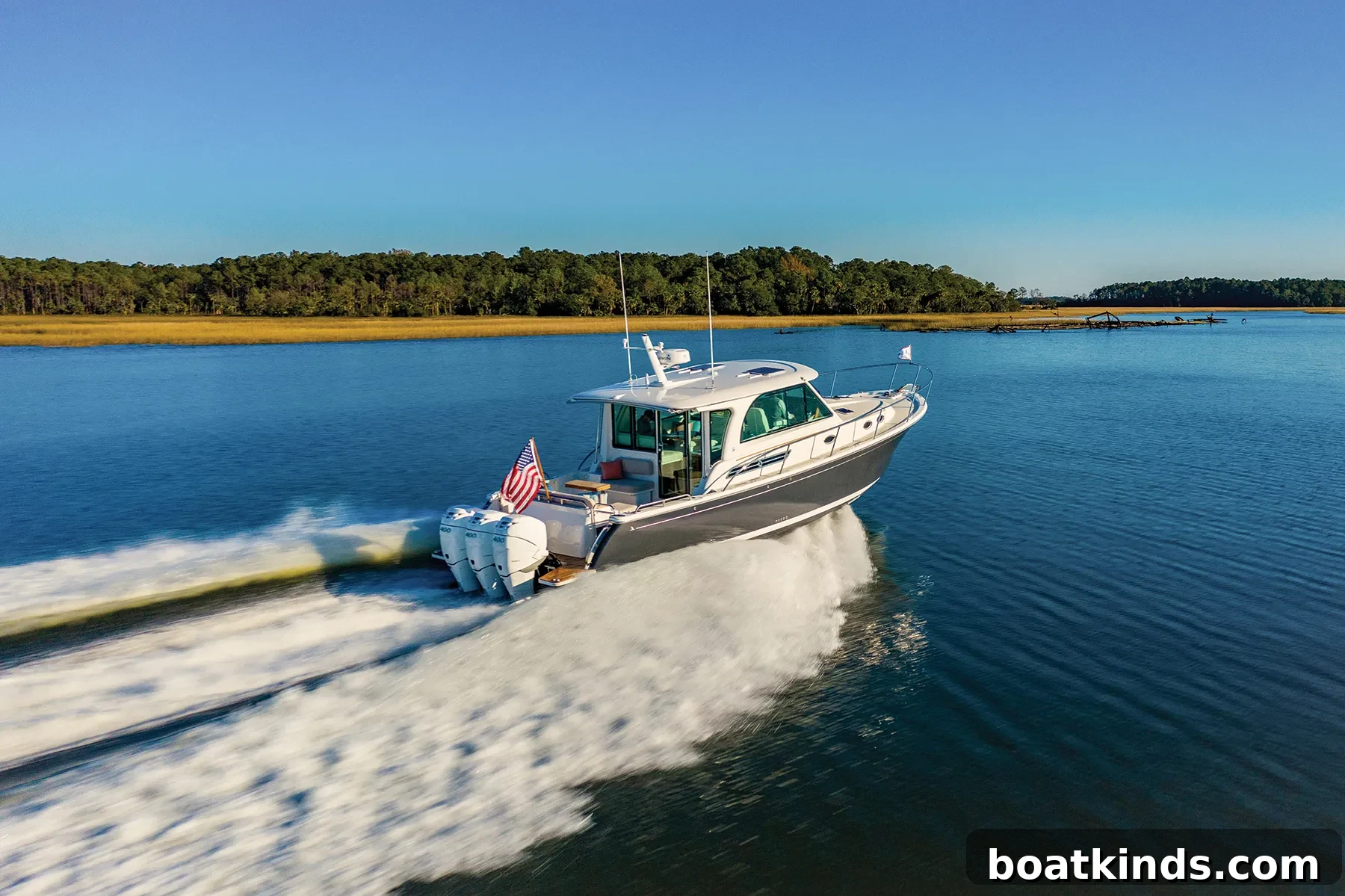
Back Cove 39O
The Back Cove 39O is suited to cruisers who want to make steady progress while still enjoying ample time ashore. Power options include triple 400-hp engines or twin 600-hp Mercury V-12 Verados. With up to 1,200 horsepower the 39O can reach a top speed near 46 knots, while its fuel-efficiency sweet spot between 3,500 and 4,000 rpm yields a range around 316–320 nautical miles at a burn of approximately 35–40 gph. Draft is about 3 feet even to the prop arc, and air draft to the top of the radar mast is 12 feet, 7 inches—well within many Loop clearances. The helm offers side-by-side seating with 360-degree visibility and space for twin multifunction displays, useful for navigating busy river systems. Interior layout includes a forward owner’s stateroom and an amidships guest stateroom to port beneath the U-shaped dinette, with wide side decks for easy line handling in locks and marinas.
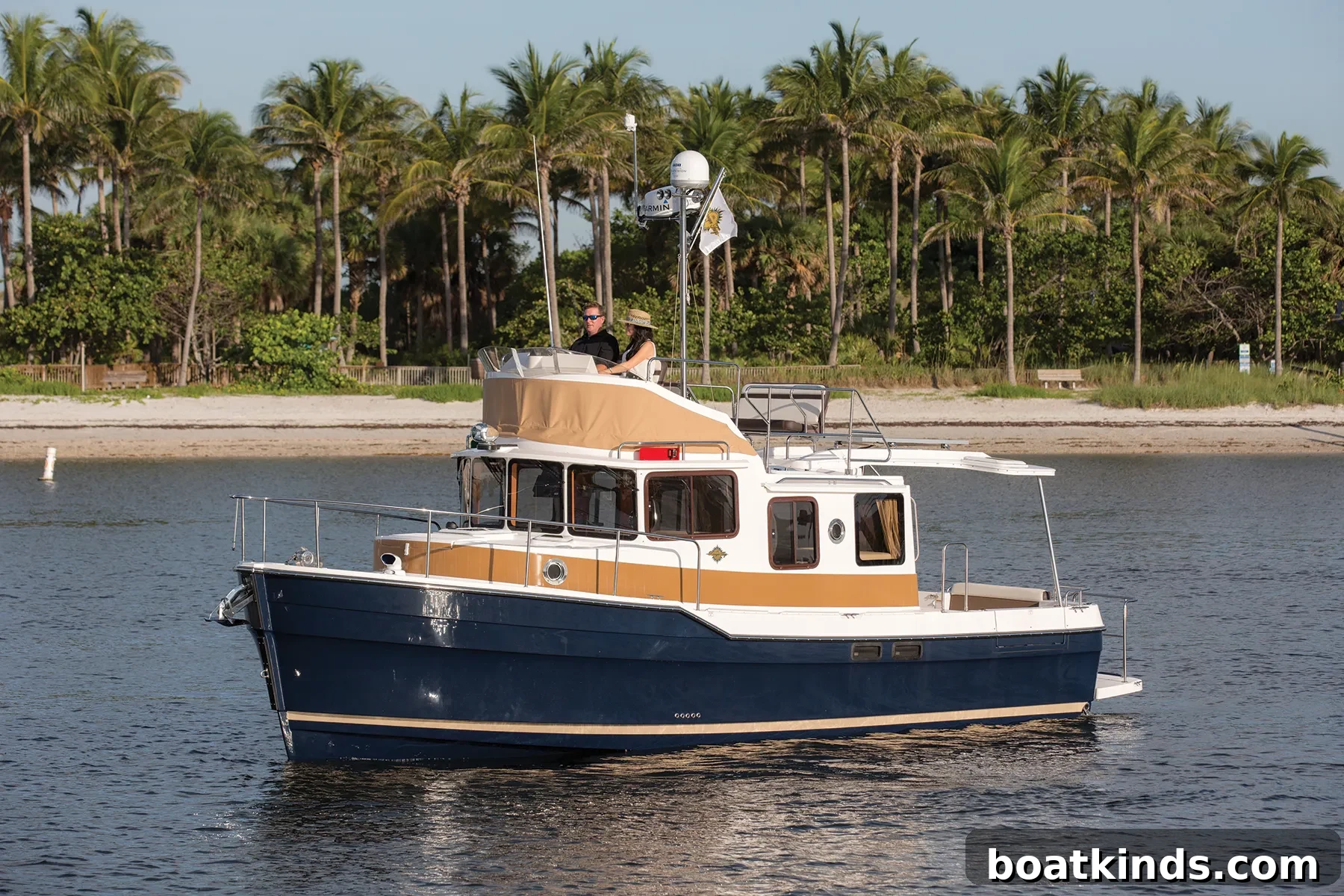
Ranger Tugs R-31 CB
The Ranger Tugs R-31 Command Bridge is a Loop-ready design with several practical features, including trailerability and a fold-down flybridge that helps meet bridge clearance limits. Its flexibility makes it attractive for Loopers who want the option to store or relocate the boat seasonally. The layout offers two staterooms, one full head and one day head, twin electronics stations for seamless helm switching, and standard bow and stern thrusters for easier docking. Draft is just 2 feet, 6 inches, and air draft is 18 feet, 2 inches with the bridge up or 10 feet, 3 inches with it down. Powered by a 320-hp Volvo-Penta D6, the R-31 CB can top out near 20 knots and cruise efficiently at 6–8 knots for a practical range of about 540 nautical miles.
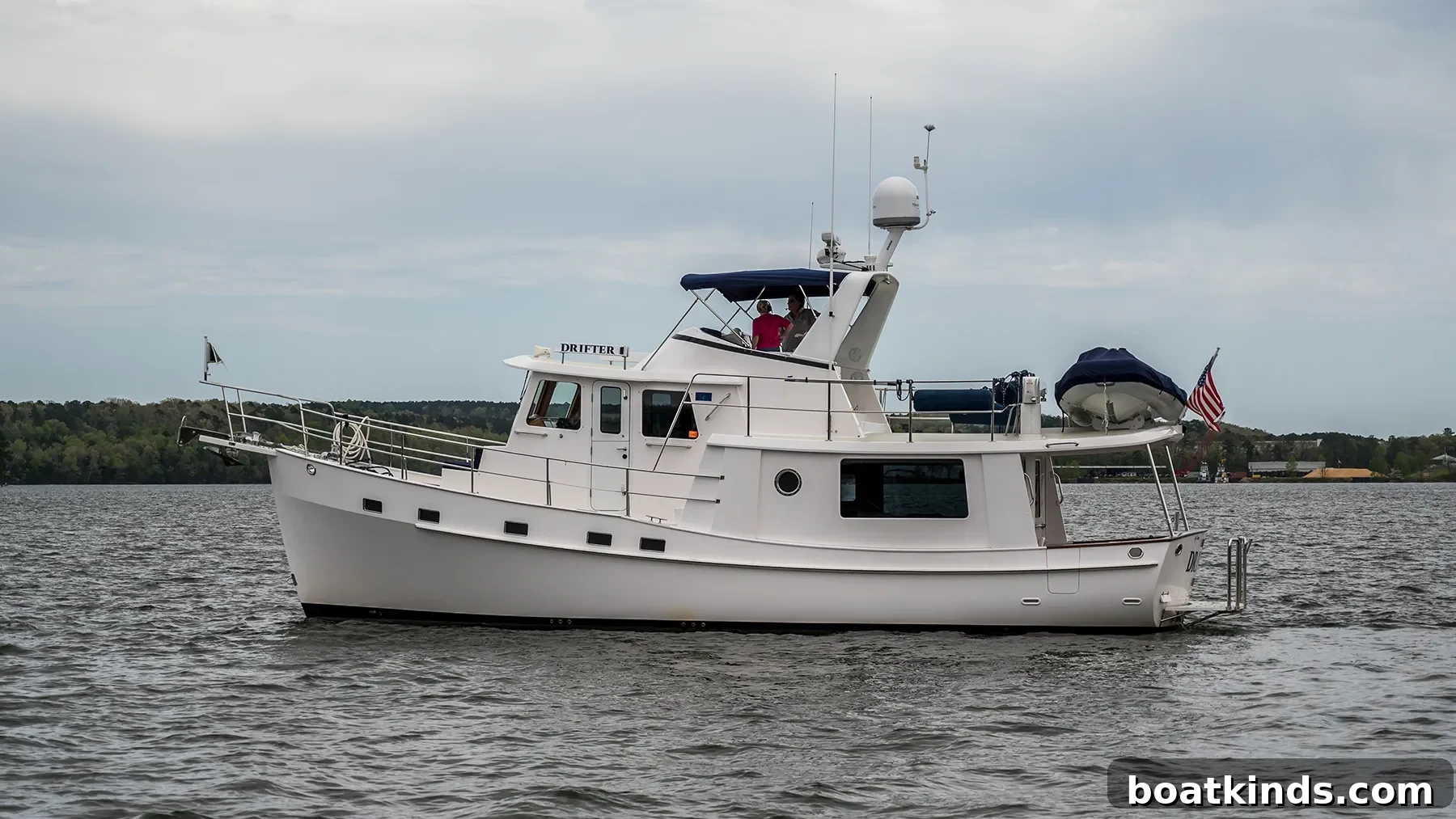
Krogen 44 AE
The Krogen 44 AE combines robust offshore construction with Loop-friendly clearances. Its normal bridge clearance is about 23 feet, 3 inches, while mast-down clearance is approximately 13 feet, 3 inches—compatible with many Loop routes. Driven by a single 160-hp John Deere 4045AFM85, it can reach roughly 9 knots and, at a comfortable 7-knot cruise, burns around 1.9 gph for an impressive theoretical range near 3,000 nautical miles. The designed waterline draft is about 4 feet, 6 inches. Built for long-term durability, the 44 AE uses a solid fiberglass hull below the waterline and closed-cell Corecell sandwich construction in the sides and superstructure, offering a seaworthy and low-maintenance platform suited to both protected and open-water passages.
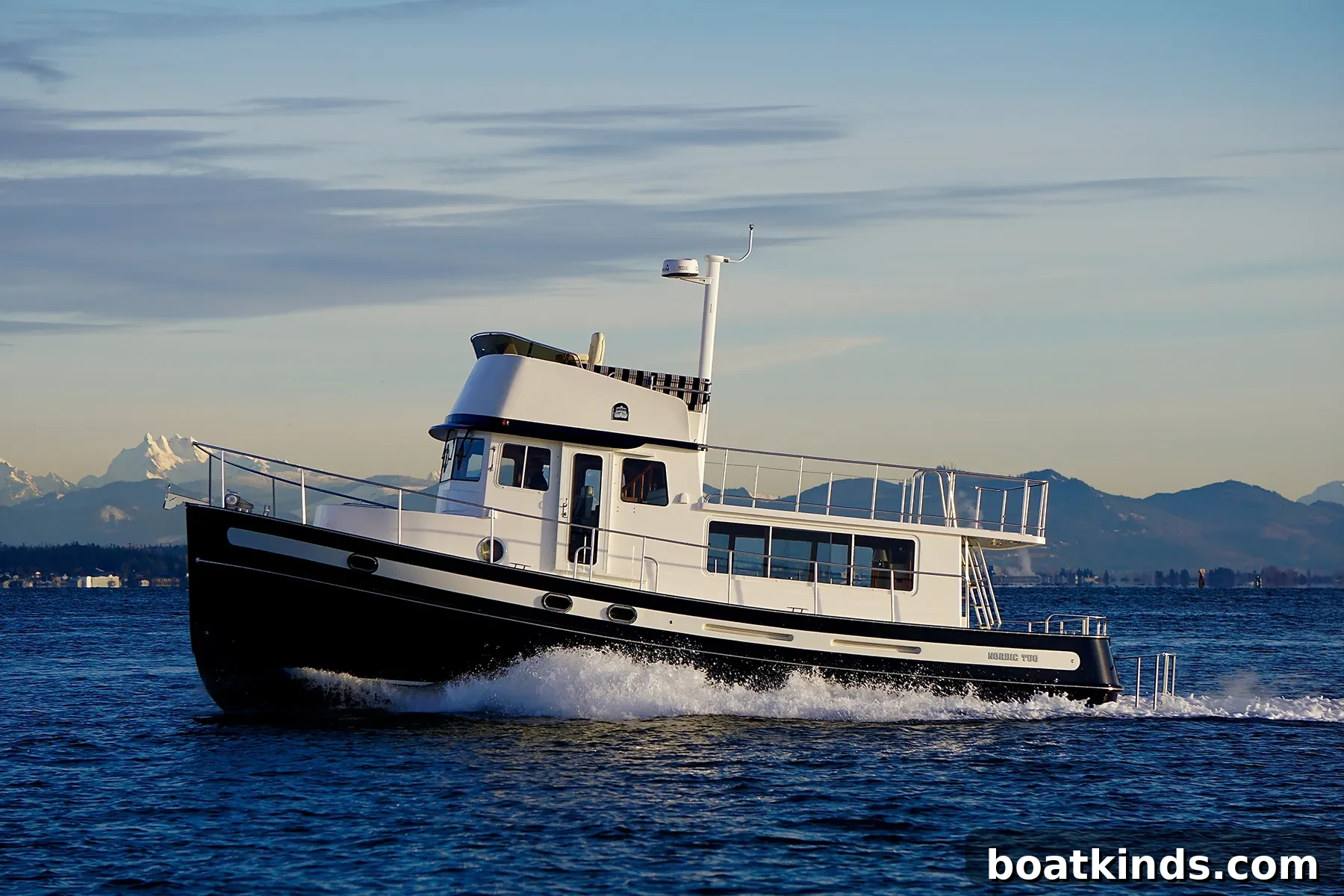
Nordic Tugs 40
The Nordic Tugs 40 is a balanced choice for Loop cruising, combining manageable size and solid range. Draft is approximately 4 feet, 4 inches, and with either a 380-hp Cummins QSB or a 370-hp Volvo-Penta D6, the NT40 can achieve an estimated range near 1,000 nautical miles. Its low profile, easily accessed boat deck above the main cabin, and twin pilothouse doors simplify line handling and movement on deck—useful in locks and tight marinas. The raised lower helm provides excellent sightlines and a comfortable place to drive in poor weather, and the accommodation plan sleeps six while remaining capable in both protected inland waters and more open coastal conditions.
This article was originally published in the November 2023 issue.