
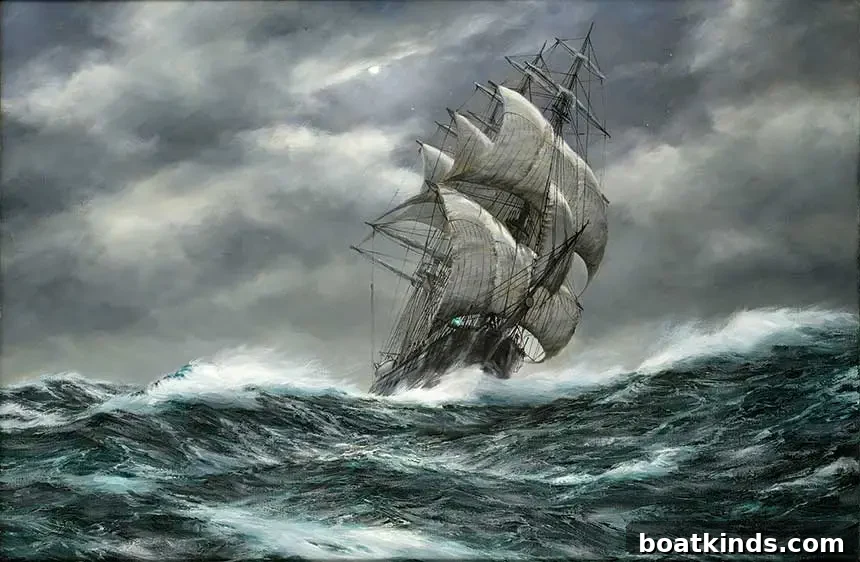
Few vessels capture the romance and raw power of the sea like the clipper ship. Towering with three masts and tens of thousands of square feet of canvas, a classic clipper could harness the wind and surge across the oceans at remarkable speeds. With its rigging humming and sails set taut, a well-handled clipper might sustain 20 knots or more under the right conditions, a feat that made these ships legends of the Age of Sail.
Clippers were a 19th-century innovation, shaped largely by American shipbuilders in the 1840s who prioritized speed and sleek hull lines. Those design choices changed maritime transport: high-value, time-sensitive cargoes—most famously tea from the Orient—moved faster and more profitably, and the competitive rush to be first ashore fuelled a culture of record-setting voyages. The tea clipper Black Prince, for example, measured 183 feet and was built specifically for the long, fast runs that the tea trade demanded; she could reach distant ports such as Australia in under three months on a well-executed passage.
Artists who sought to preserve the drama and technical beauty of these ships have long been drawn to the clipper’s elegant lines and kinetic energy. Among them, Henry Scott stands out for the way he recorded the life and motion of sailing vessels. Born in Britain in 1911, at a time when steam was replacing sail, Scott devoted much of his artistic career to rendering the great ships that were already becoming part of maritime memory. His paintings do more than show a vessel’s form; they convey wind, sea state, and the human effort required to master both.
Scott’s depiction of the British clipper Black Prince is a strong example of his approach. The painting emphasizes the ship’s performance: canvas filled by a brisk wind, water spraying across chop, and a hull slicing through waves. One contemporary observer captured Scott’s style precisely: “His sails are nearly always bellowed with a good, stiff breeze, which is further emphasized by the spray of the water being wisped across the top of the choppy seas.” That attention to the interaction between wind, sea, and sail gives his maritime art a palpable realism.
Critics and collectors often point to Scott’s skies as a defining feature of his work. He used cloud and light to animate the entire composition, turning a static image into a moment of weather, movement, and tension. The contrast of brooding or sunlit skies against taut white sails makes the vessels feel alive, as though they might shift course or accelerate off the canvas at any instant. This mastery of atmospheric detail helps explain why his paintings remain beloved by maritime art enthusiasts.
The clipper’s performance record adds to its mystique. Speed was essential for tea clippers whose profitability depended on freshness and arrival times, and clippers were celebrated for their ability to cover vast distances quickly. For perspective, the American clipper Lightning once logged a remarkable run of 436 nautical miles in a single 24-hour period, a benchmark that immortalized the clipper era’s capacity for exceptional passage-making.
Henry Scott’s work stands as both artistic achievement and historical preservation. By focusing on the ships’ movement, rigging, and the play of light and weather, he ensured that viewers could appreciate not only the clipper’s elegant silhouette but also the gritty reality of life at sea. His paintings help keep the memory of these high-speed sailing vessels alive for modern audiences who marvel at a time when wind alone powered global commerce.
This article originally appeared in the April 2020 issue.