
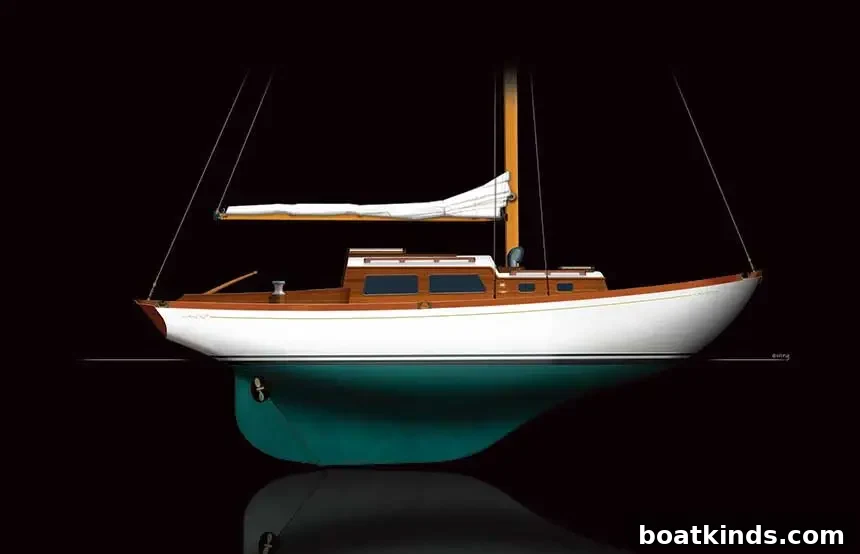
Newell Cadet (Offshore 27): A Timeless 1960s Fiberglass Sailboat
In the 1960s, fiberglass transformed small-boat building and launched a golden era for recreational sailing. Marinas and yacht clubs filled with versatile cruising boats and nimble racers, and several established builders—Pearson, Columbia, Irwin and Cal among them—dominated the market. Into that busy scene came designer Taylor Newell’s compact 27-foot entry in 1965, commonly known as the Newell Cadet or Offshore 27. More than fifty years on, the Cadet remains a noteworthy example of the era’s multipurpose fiberglass sailboat: compact enough for coastal cruising, handsome enough to still draw admiring looks, and robustly built by a respected yard.
Taylor Newell, based in Rowayton, Connecticut, earned a reputation for well-balanced, seaworthy designs throughout his career. His portfolio included larger sloops such as the 40-foot Musketeer and the 38-foot Duchess, the latter built for Scandinavian production. The Cadet was produced overseas at the Cheoy Lee shipyard in Hong Kong, a yard that later expanded into a wide range of sail and power craft. The Cadet’s international construction combined American design sensibilities with an efficient production approach that helped make fiberglass cruising boats accessible to a growing audience.
Dimensionally, the Cadet measures 26 feet 5 inches overall with an 18-foot 9-inch waterline. Those proportions create the characteristic long overhangs fore and aft and a pleasing spoon bow, giving the hull a classic silhouette and an easy, graceful sheer line. The rig is modest but effective: a mainsail area of about 160 square feet and a total sail area just over 320 square feet provide adequate power for coastal passagemaking and club racing without overwhelming a small crew. The spars were originally Sitka spruce, though many yachtsmen of the period also opted for aluminum mast and boom conversions as they became common.
Under power, the Cadet was offered with a small diesel as standard—a 7-hp Volvo Penta—while optional gasoline engines included the well-known 30-hp Universal Atomic 4 and a 22-hp Palmer 1-H 60. That range of propulsion choices reflected the boat’s dual role as both cruiser and daysailer: you could motor comfortably in and out of harbors, yet still enjoy the boat’s sailing performance. The hull and deck construction used fiberglass with an attractive teak overlay on the cabin house and decks, a detail that set the Cadet apart from many all-fiberglass contemporaries and contributed to its classic, upscale appearance.
Below decks, the Cadet accommodates four in a simple, efficient layout. A V-berth forward provides sleeping for two and houses the head under the port berth, while settee berths in the main cabin add sleeping space for two more. The galley was designed to be flexible: it could be arranged aft or amidships to suit owner preference and interior ergonomics. Typical equipment included a cooktop, icebox, sink and a dining table—features that made short-term cruising comfortable without compromising sailing weight and balance.
With its clean lines, teak detailing and balanced proportions, the Newell Cadet earned praise in reviews of the day as something like “a little gold-plater”: a compact boat dressed in classic finishes. That combination of attractive aesthetics, practical accommodations and straightforward handling explains why the Cadet still appeals to enthusiasts who appreciate 1960s fiberglass boats that were built to last and designed for real-world use.
Today the Cadet is valued by classic-boat owners for its traditional look, solid construction and manageable size, making it suitable for coastal cruising, weekend outings and classic-boat gatherings. Maintenance priorities for surviving examples typically focus on preserving the wooden trim, checking core and gelcoat condition, and ensuring the auxiliary engine and rigging remain serviceable. For sailors who want a compact classic with period charm and capable sailing characteristics, the Newell Cadet remains an attractive choice.
This article originally appeared in the June 2020 issue.