
Aphrodite II: The 1928 Commuter Yacht That Preceded a Legend
The name Aphrodite evokes one of the most celebrated classic yachts of American yachting history. Most people immediately picture Aphrodite III, the 74-foot 1937 commuter yacht built for Manhattan financier John “Jock” Hay Whitney. That later vessel became famous for its World War II service, for ferrying President Franklin Roosevelt on the Hudson, and for hosting a remarkable roster of notable passengers. Fewer people know, however, that the well-known Aphrodite III had two predecessors, including the elegant Aphrodite II shown here.
Origins and Design of Aphrodite II
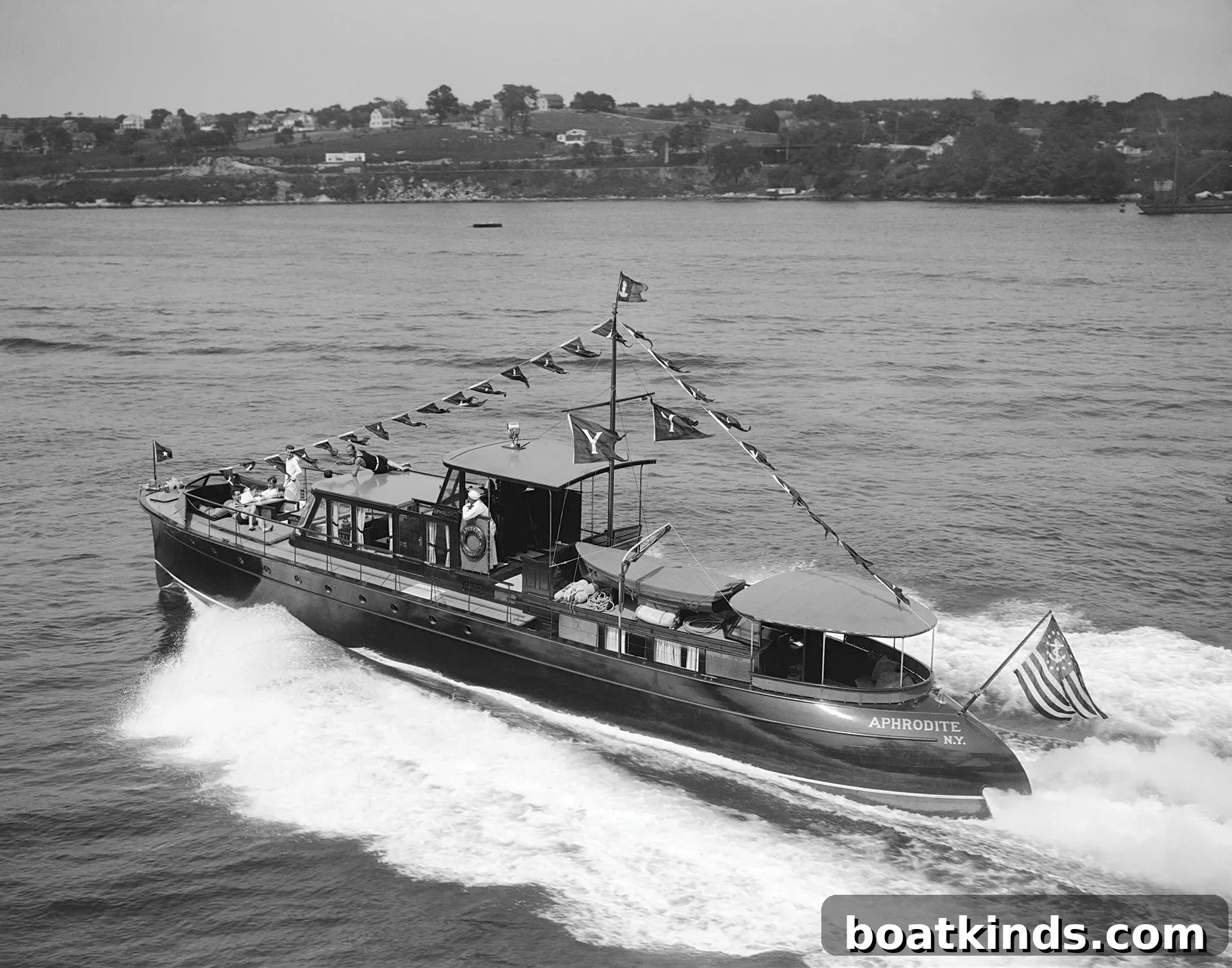
Aphrodite II was a 72-foot commuter yacht constructed in 1928 by the Albany Boat Company in Watervliet, New York. This photograph, credited to Rosenfeld and Sons, shows the yacht only a year after her launch as she ran down the Thames River in New London, Connecticut, to attend the 1929 Harvard-Yale regatta. In the image she proudly flies Yale “Y” flags on her side stays, alongside John Hay Whitney’s private swallowtail—signal-yellow with a blue panel and a woman—and the New York Yacht Club burgee on her bow.
Selected and piloted by an owner with a keen eye for both style and speed, Aphrodite II was powered by two Wright-Typhoon gas engines. With her double-ended hull and those twin powerplants, she could reach a top speed of about 25 knots—impressive performance for a commuter yacht of her era. Her lines and outfitting reflected the transitional period between the grand steam yachts of the late 19th century and the more compact, fast motor yachts that became popular in the 1920s and 1930s.
A Rivalry on the Water
John “Jock” Hay Whitney was an enthusiastic participant in the social and sporting life centered on New York Harbor and Long Island Sound. He often raced Aphrodite II against his brother-in-law’s 69-foot Wheeler Company commuter yacht, Saga, on runs from Long Island to Wall Street. Those contests were spirited and drew attention among the boating community. When Aphrodite II routinely came up short in speed, Whitney commissioned a new, more powerful yacht capable of outperforming Saga—thus setting the stage for Aphrodite III, built by the Purdy Boat Company of Port Washington, New York.
Transition to Aphrodite III
The subsequent Aphrodite III, launched in April 1937, reflected a deliberate step up in engineering. Contracted to deliver 33 knots and fitted with a pair of 800-horsepower V‑12 Packard engines, the new yacht represented the era’s pursuit of higher performance in private motor yachts. The terms of her construction included a financial penalty for any shortfall in speed, underscoring how seriously performance was taken by owners and builders alike.
Historical and Cultural Significance
While Aphrodite II itself is a compelling example of late-1920s commuter yacht design, its true significance is partly as a bridge between the grand steam yachts of the 19th century and the streamlined, fast motor yachts of the mid-20th century. The original Aphrodite (a much larger 330-foot steam yacht built in 1898) and these later Aphrodites together trace a lineage of private yachting that connects industry, society and national service. The name Aphrodite carries associations with high society, presidential transport during wartime, and a roster of celebrity guests—Fred Astaire, Shirley Temple and Katharine Hepburn among them—who visited aboard later iterations.
Photographs such as the Rosenfeld and Sons image of Aphrodite II at the Harvard-Yale races provide an evocative visual record of that era. They capture not only the boats themselves but also the flags, signals and club burgees that signified membership in particular social and sporting circles. The swallowtail and the New York Yacht Club burgee visible on Aphrodite II are symbols as much as decoration, telling a story about ownership, identity and the rituals of waterfront society.
Preservation of Yachting Heritage
Classic yachts and their stories remain important to maritime historians, restorers and enthusiasts. Boats like Aphrodite II and her successors help us understand changing technologies—engine development, hull design and the growing influence of speed—and the social patterns that shaped coastal life in the northeastern United States. Whether viewed as elegant commuter yachts, racing rivals or predecessors to a famous 1937 vessel, Aphrodite II occupies a distinctive place in that continuum.
This article was originally published in the October 2021 issue.